


BOOK REVIEW: Lineage: Genealogy and the Power of Connection in Early America by Karin Wulf (Oxford University Press, 2025). $35.00 Hardcover.
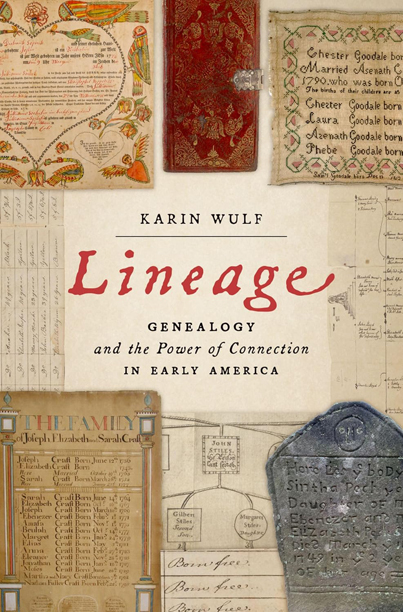
In Lineage: Genealogy and the Power of Connection in Early America, Karin Wulf explores the ways in which people of the foundational era represented their family histories and what we can learn about the era through these genealogical presentations. Viewing genealogy as a historically specific cultural phenomenon, Wulf contends that family drove colonial practice and policy. Although the American Revolution is often perceived as having ushered in a new era of individualism, Wulf challenges this by showing that the founding generation had a significant interest in genealogical matters for reasons both personal and political. Wulf points to the extensive evidence of the founders’ genealogical research and family history practices as demonstrative of the continuities of the practice across the long eighteenth century and the ability of genealogy as a cultural practice to adapt and persevere. While historians often interpret the American Revolution as ushering in an era of a more liberal society, Wulf emphasizes the practice of genealogy as an avenue for persistence of older forms of access and authority (page 248).
 In her examination of genealogical practices in early America, Wulf counters assumptions about genealogy that have led many scholars to overlook its importance during this period in history. Genealogy has a reputation as a hobby, which leads many historians to discredit its practice. However, Wulf points to a mutuality of genealogy and history. While not all genealogists presented themselves as historians, many historians pursued genealogy. Particularly in cases of localized histories, genealogy proves inescapable. As examples, Wulf points to works of early American history such as Bradford’s Of Plymouth Plantation or Hutchinson’s History of Massachusetts. Moreover, Wulf demonstrates that family histories were recorded to an extent that has been heretofore overlooked due to the nature of items in which the recording took place.
While the family Bible is regarded as the repository for family history information, family history recording took place in a wide variety of materials—including almanacs, account books, or even plain notebooks. Bibles did not commonly start to include the now-familiar pages for family recordkeeping until the nineteenth century, although even before this family histories were sometimes recorded on its pages. Although items like Bibles or account books became repositories for family history, Wulf points to the existence of family record books in the size of other, portable notebook forms—like cash or memorandum books—as evidence of the pervasiveness of genealogy as part of the fabric of society. The small size of the notebooks suggests that they were meant to be carried or perhaps sent to others for their use (p. 79). Printed family histories, many of which contained tidbits gathered from these family record books, increased alongside the surge in print culture in the late eighteenth and early nineteenth centuries.

In addition to these varied mediums of family record keeping, Wulf draws attention to the way that genealogy pervaded society and the law, particularly in relation to slavery. Although traditional genealogical practices were reserved for those with access, genealogy for the enslaved population appears in non-traditional ways. Print culture plays a role here as well, as Wulf points to newspapers that printed genealogies in advertisements for runaways. Although the persistence of genealogy in the new nation marks a continuance of older forms of authority, genealogy in relation to slavery indicated a stark departure. In this instance, genealogy became a legal matter as laws developed to dictate free or enslaved status in relation to the status of the mother; genealogy as a legal principle in turn surfaced in court cases that determined status.
Wulf mentions the founders’ careful keeping and use of their family histories at points throughout the narrative, but it is not until nearly the end of the volume that she breaks down some details of the founders and their genealogical interests. The genealogy of slavery prominently coexists alongside the genealogy of the Founding Fathers. George Washington and Thomas Jefferson both carefully documented matters of slavery within their family record keeping. For example, George Washington made notes on his own family history regarding the enslaved people that he would inherit upon the passing of his family members. Jefferson, meanwhile, documented his enslaved individuals in a separate book, including the children that he fathered with Sally Hemings. Common to all the founding fathers’ stories is their cognizance of such things as heraldry as well as their appreciation for and willingness to undertake family history research that involved communication with family members, often travel, and a reliance on the work of previous family members. None eschewed family history because of the potential taint of aristocracy but rather embraced the privilege (p. 244).
Overall, this book is an entertaining read. It will especially interest readers who are involved in the practice of genealogy as well as those interested in the development of print culture and recordkeeping in early America. Although the argument is slow building in some spots, readers will come away with an increased understanding of the importance of genealogy as a practice in early America through the ways ordinary and elite people alike engaged in their own family recordkeeping and the practical implications of it.
PLEASE CONSIDER PURCHASING THIS BOOK FROM AMAZON IN HARDCOVER OR KINDLE.
(As an Amazon Associate, JAR earns from qualifying purchases. This helps toward providing our content free of charge.)

Recent Articles
The New Dominion: Virginia’s Land in The Northwest
Lineage: Genealogy and the Power of Connection in Early America
Coup D’oeil: William Washington at the Battle of Cowpens
Recent Comments
"Coup D’oeil: William Washington..."
Great article. I am reminded of a point only incidentally mentioned, the...
"Thomas and Peter Costner..."
Thanks for your wonderful article. As we study the Revolutionary War, we...
"The Revolutionary War Letter..."
Superb storytelling!