


Henry Laurens is recognized by scholars of revolutionary history as the president of the Second Continental Congress during the Valley Forge winter and as a peace commissioner at the close of the American Revolution. He is also known to a broader audience, thanks to Lin-Manuel Miranda’s Hamilton, as the father of John Laurens, the fiercely loyal abolitionist compatriot of the play’s namesake. The younger Laurens passionately and futilely urged his fellow South Carolinians to arm their enslaved in defense of their new country.[1]
Henry gave modest support to his son’s endeavor but had no real desire to further its success.[2] In fact, thirty years earlier, Henry was instrumental in reviving South Carolina’s dormant slaving industry. Most of the considerable wealth he would accumulate throughout his lifetime was, in fact, a direct result of captured, traded, and exploited human beings, whom he viewed as both a labor force and a commodity.
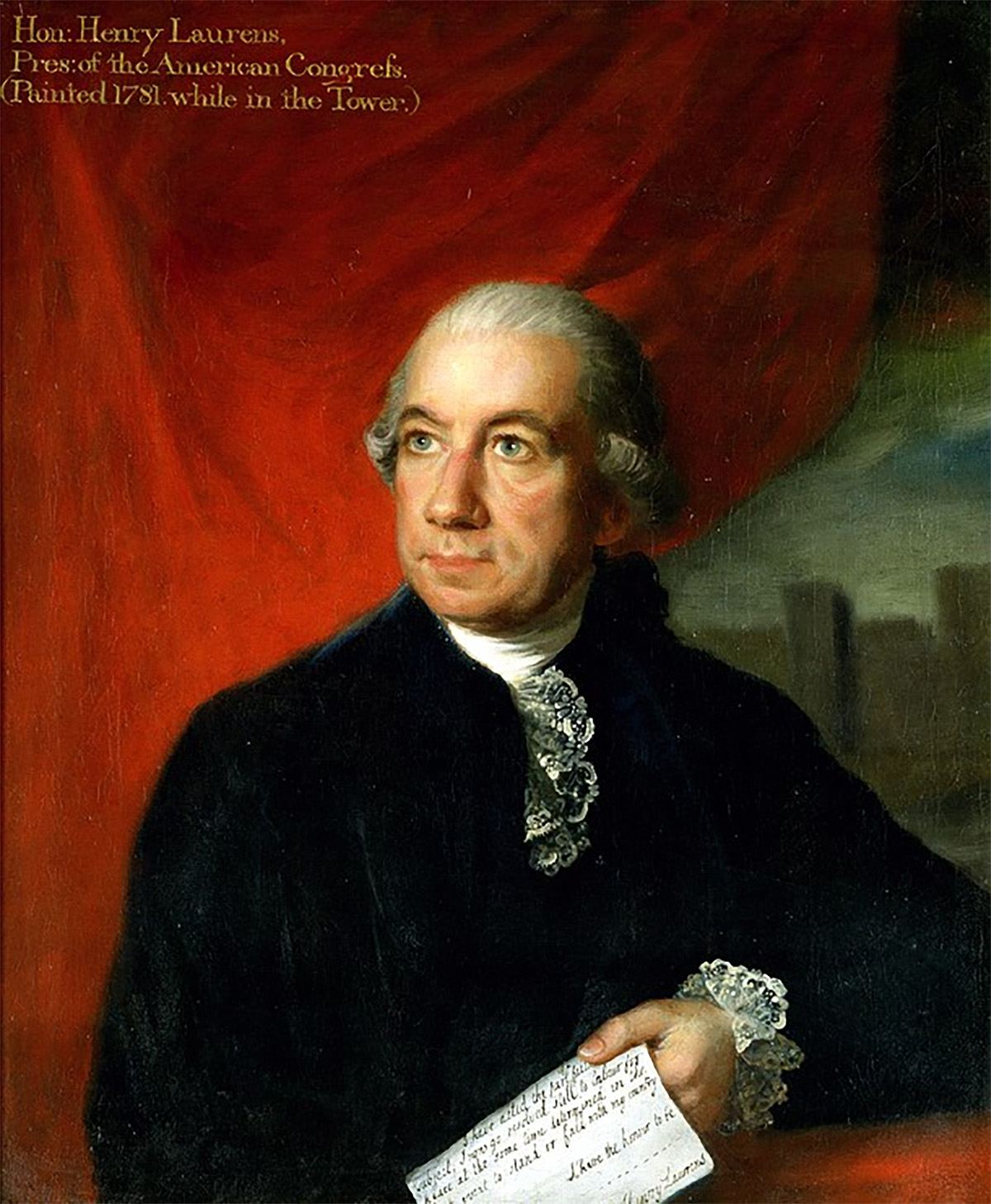
As the American Revolution began to erupt in August 1776, Henry penned a letter to his beloved son, John, claiming that he “abhor[red] slavery,” but that the laws of Great Britain and South Carolina long predated his “existence.”[3] His apologia continued, “The day I hope is approaching when from principles of gratitude as well as justice every man will strive to be foremost in shewing his readiness to comply with the Golden Rule.”[4] All of this, and more, contained in a fourteen-page private letter to his idealistic, favored child, is rubbish. There is nothing in Henry’s life and letters, before this date and after, to indicate he truly believed what he wrote to his son that summer day. Henry Laurens was a proslavery advocate from the beginning of his career in the 1740s until his death in 1792.
Henry was born in 1724 to Jean Laurens, a well-respected and master saddler in Charles Town, South Carolina. A skilled tradesman, he customized his tack for general riding, hunting, and horse racing. It was an ideal profession for cultivating close social relationships with colonial elites, such as the Ball family, who collectively owned several rice plantations and bred fast horses.[5] They kept a foaling book listing their purchases and sales of thoroughbreds and enjoyed showing off their investments at the racetrack that Jean owned just outside of the city.[6]

Jean Laurens was an ambitious man, intensely focused on providing more than a competency for his family. He was active in the Charles Town real estate market while also owning properties in the broader Lowcountry. He augmented his saddlery business with a dry-goods store, ideally situated near the city’s wharves.[7] His growing prosperity allowed him in 1738 to purchase a prominent family pew in St. Philip’s Church, located behind his long-time friend and successful merchant, Gabriel Manigault, and five pews behind the plantation-rich Ball family and their young daughter, Eleanor.[8] This allowed Jean even greater access to the colony’s social and economic elite.
Another leading parishioner, James Crokatt, was a merchant and planter who worked closely with Jean Laurens on both church and civic activities. He followed a trend among English-born Carolinians who returned to the capital after accumulating significant wealth in America. He opened a shop in London and also promoted South Carolina’s import-export potential.[9] His success in these endeavors convinced colonial officials to later appoint him as the provincial colonial agent.[10] Seemingly having no plans to return to Charles Town, he left his business and plantation affairs to the care of his business partners, Ebenezer Simmons and Benjamin Smith, two men who would soon aid the advancement of young Henry Laurens’ career.[11]
Henry’s father “gave his children the best education which Charles Town afforded.”[12] As an adolescent, Henry learned to read and write while gravitating to the practical branches of mathematics and basic merchant accounting.[13] With his growing knowledge, he was able to assist with the considerable amount of record-keeping generated by the family’s various business interests, especially at the store. Henry furthered his studies under Archibald Hamilton, who taught navigation and advanced accounting, and worked occasionally under the tutelage of Peter Chassereau, a prominent London architect, who held classes on mapmaking, real estate evaluation, and the laying out of gardens and parks in Jean’s store.[14]
Henry’s efforts at his studies and in the shop did not go unnoticed. Soon after his seventeenth birthday, a Ball family neighbor gave him his first enslaved person, a boy named March, who may have been trained as a personal valet.[15] One of the witnesses to the transaction was George Chicken, whose widow would marry Elias Ball, Jr., a few years later. Henry spent the next summer, in 1742, with his uncle, a Rhode Island attorney, perhaps to gain familiarity with the legal documents he would encounter as a merchant.[16]

He would need those lessons because he began an apprenticeship that fall in the merchant house of the newly formed partnership of William Hopton and Thomas Smith, the younger brother of Crokatt’s partner. It is here that Henry truly “learned business” and the mercantile trade at a higher level.[17] At this time, Jean Laurens sold his saddlery business to his nephew Peter, garnering funds that could become available should a partnership opportunity come Henry’s way. But Henry had to serve that apprenticeship first.
Henry Laurens was older than the typical beginning apprentice and thus much more experienced. He was well-versed in retail business practices and general accounting methods. In his new position, he mastered the management of ledgers and books for sales, accounts, invoices, memoranda, credit, petty cash, correspondence, scheduling, warehouses, and customs-house business.[18] Ordinarily, he might have anticipated an offer of a partnership in the firm, but the Hopton and Smith partnership was set to expire soon.[19] Henry’s intelligence and tireless work ethic, however, came to the attention of James Crokatt, who offered him a position that effectively allowed him to complete his training in London.
Jean Laurens promptly sold his racetrack to increase the additional funds available to Henry.[20] To escort Henry to London, Crokatt sent one of his most trusted ship captains, David Bellegarde, in May 1745.[21]
Crokatt so trusted twenty-one-year-old Henry Laurens that he gave him power of attorney to complete the dissolution of his Charles Town partnership.[22] While at the imperial capital, Henry was introduced to and earned the respect of the most prominent South Carolina merchants in London, including former colonial agent Samuel Wragg.[23] He early recognized the importance of relationships and reputation and used his time in England to establish lifelong business connections.[24]
Meanwhile, James Crokatt was developing a strategy to persuade Parliament to subsidize indigo production in South Carolina. Indigo was widely used in everyday items throughout Europe, and he wanted to simultaneously reduce England’s dependence on imports and improve South Carolina’s plantation economy. Crokatt made clear that “Rice and Indigo are the two pillars on which our future prosperity must be built.”[25]
With Henry helping to manage his store on Cloak Lane, Crokatt wrote a detailed pamphlet highlighting the benefits of imposing a tariff on indigo and granting a domestic bounty for South Carolina indigo.[26] A South Carolina Gazette editorial written by Patricola informed decision makers in the colony that “no time should be lost, no pains or cost spared, in soliciting for a bounty at home upon indigo from Carolina.”[27] Crokatt methodically built a strong coalition of all the participants in the indigo trade. In addition to the growers and exporters, he recruited commodity dealers, clothiers, and brokers, as well as representatives of the linen and wool industry.[28]
Crokatt went to great lengths to explain the process of growing and marketing the crop to Carolina plantation owners. A two-part series detailing the stages of indigo production was published in the Gazette in early 1747.[29] Elias Ball, Jr., took notice and obtained 670 Lowcountry acres in anticipation of planting the new crop. Two months later, Crokatt sent a mill to South Carolina that could grind, heat, and press both seed oil and indigo.[30] The very day it was to be displayed at the treasury office, Elias’s brother, John Coming Ball, purchased 4,100 acres, a strong indication that South Carolina planters were eager to produce the new crop, provided the required labor was available.
Henry knew that South Carolina’s slave imports had stagnated due to the excessive tariff imposed on slave imports following the 1739 Stono Rebellion and the difficulties of conducting trade during King George’s War.[31] Consequently, the demand for labor was only partially met by current traders, as few had the incentive or logistical capacity to transport cargo to Charles Town at this time.
Henry Laurens knew that South Carolina could fully exploit the financial opportunity that indigo offered only when there were sufficient laborers in the fields to take advantage of a long growing season that could yield two harvests in the same year.[32] Crokatt had no personal interest in becoming a slaver. Moreover, Crokatt needed every parliamentary vote he could secure to pass the stipend measure and feared that the slavery issue might appear to be a conflict of interest or otherwise hinder his plan.[33]
That said, James Crokatt had nothing against the practice of slavery. He utilized enslaved labor in his homes, fields, and warehouses in Charles Town, but preferred to avoid the high-risk nature of slaving itself—slaving here indicating the purchase, transport, and sale of human chattel rather than merely using such labor. In general, Crokatt’s primary objection was the simple fact that monetary losses of human cargoes at sea far exceeded those of traditional cargoes.[34] He also remained laser-focused on building South Carolina’s indigo business, from which he would profit greatly. Laurens, on the other hand, viewed his time in England and the current political situation as an opportunity to learn more about the slave trade, as he had no tangible experience in the trafficking of human beings.
Henry Laurens was aware that for many years the Royal African Company (RAC) had a monopoly on Britain’s slave trade, but its fortunes had been in steady decline once that advantage was relinquished in 1708. The trade’s deregulation led to persistent and growing financial losses for the RAC and to annual requests for assistance from Parliament. These government stipends dried up before Laurens left South Carolina, and the company ultimately failed in 1750, after transporting more enslaved Africans to the New World than any other single entity.[35]
With the Royal African Company in dire straits, opportunities to fill that trading vacuum existed. With some informational and economic assistance, Laurens believed he could help fill that void. He sought out the merchant Samuel Wragg, who made a considerable fortune in the slaving industry in the 1720s and 1730s.[36] Wragg was one of the few South Carolinians to ever work with the Royal African Company, which agreed to ship at least three hundred enslaved people annually with him.[37] He instructed Laurens in the basics of the trade, such as calculating the amount of capital required to cover losses, mitigating potential losses by entering into partnerships with other merchants to purchase ships, and gauging demand to align slave imports with harvest seasons.[38]
The year 1747 would be a pivotal one in Laurens’ life. Impressed by his talent, intelligence, and drive, James Crokatt extended a partnership offer to him in January. After considering it, Laurens gave a surprising answer. He declined the invitation and never seriously contemplated it again. While the stated reason is unknown, indications are that a clash of strategies between two strong-minded men occurred. Laurens saw slavery as the most profitable leg of a three-legged stool that included rice and indigo, and he was not about to let this economic opportunity pass. But Crokatt was a more cautious man, avoiding the risk involved in slaving.
A frustrated and typically cantankerous Crokatt remained hopeful that Laurens would change his mind, and he repeated his offer.[39] But Laurens had other plans. Although he wanted to continue developing the personal and commercial relationship with Crokatt, he planned to return home to consult with his father about his future business plans. Before departing, with a letter of introduction from Crokatt, Laurens messaged Bristol slaver Isaac Hobhouse to express his interest in establishing a business relationship.[40] Laurens’ ship set sail for America before he could receive Hobhouse’s reply.
Upon his arrival at Charles Town in early June, he received tragic news. “This day I arrived here & to my great grief find that my best friend my dear father died” four days ago.[41] Grief, connecting with old friends and family, including the young Eleanor Ball, and settling his father’s estate occupied all of Laurens’ time. He also had to conduct his own business and found himself in something of an economic bind. He brought with him to Charles Town a portion of Crokatt’s goods that, as it would turn out, were not selling well in the city’s glutted market. So Laurens soon placed an ad for “a great variety of shop goods” from his father’s store.[42] He may have received assistance from his friend Gabriel Manigault and his brother-in-law Francis Bremar, both of whom operated dry goods stores that could accept some of the inventory.
Laurens’ situation became even more complicated when his cousin Peter Laurens died a few weeks later.[43] He worked tirelessly to dispose of a considerable amount of saddlery equipment from his father’s old business, seeking buyers along the eastern seaboard.[44] He also undertook the arduous task of calling in the many notes and bonds owed to his father’s estate, which required him to travel to North Carolina.
Six weeks after Laurens’ arrival, Crokatt sent him yet another offer of partnership. This was acknowledged by Laurens, who indicated he had shown the offer to several of Crokatt’s Charles Town friends. This almost certainly meant the Smith brothers and Gabriel Manigault, who all advised Laurens to accept the offer and return to London. If there had been a time when Laurens would have accepted the offer, it would likely have been that July.[45]
It would certainly have made paying his debt to Crokatt easier, but Laurens knew the economic situation in South Carolina was about to grow rapidly, and he wanted to profit from that boom. He was now also the patriarch of the Laurens family. His father’s death likely confirmed his decision to establish himself in South Carolina. Unaccustomed to rejection, Crokatt insinuated that he had not received a response to his original offer. Laurens simply responded to this perplexing situation, “Anything I could say on the subject of our intended co-partnership would be only a repetition of what I have often said to you in London.”[46]
While dealing with these various personal and commercial issues, Laurens began courting Eleanor Ball, the sixteen-year-old daughter of the wealthy rice planter Elias “Red Cap” Ball.[47] Their families knew each other, and this personal connection would accelerate Laurens’ career. “I paid my addresses to the lady . . . in the vigour of youth,” he wrote years later. “She was . . . under guardianship, and although my life and conversation, my connections and prospects were intimately known to her guardians, to her father and to her brothers, I scorned to attempt an attachment of her affections until I had obtained the consent and approbation of the other parties so nearly interested.”[48] In this union, Laurens wed his personal and professional lives.
“Red Cap” Ball was decidedly interested in uniting his family with the up-and-coming Laurens. His two sons-in-law, George Austin and Richard Shubrick, were both well-to-do merchants and plantation owners. The prospect of having another relative who could help arrange the labor force needed to service the considerable amount of land the Ball family enterprise acquired that year was appealing to him.[49]
In August, Laurens learned that Hobhouse was interested in working with him. Laurens expressed his gratitude, declaring he looked forward to “transacting a part of your business in this place.”[50] Although the Bristol slave trader was preparing to leave the business himself, he would prove valuable in introducing Laurens to other traders. Laurens now had “a pretty large sum . . . in silver” from his father’s estate and was looking for opportunities to start paying down his debt to Crokatt so he could pursue his own business endeavors.[51]
“Red Cap” Ball prevailed upon his son-in-law, George Austin, to lend his assistance to Laurens and allow him a space to export commodities. A longtime merchant and planter, the semi-retired Austin spent most of his time at his rice plantation on the Ashepoo River but took up a Charles Town residence in late August.[52] It was located on the southernmost part of the bay with a wharf. Laurens wrote to his sister that fall that he was “now settled in a store on the bay.”[53] It was from here that he shipped 140 barrels of rice, 25 barrels of pitch, and 30 barrels of turpentine to Crokatt, with the commodities likely coming from Ball family plantations.
Laurens continued to repay his debt to Crokatt by sending occasional cargoes, and in January 1748, he finally liquidated his father’s store. The next month, his debt was paid in full, and he had no further financial obligations in London. In May, Parliament passed the anticipated indigo bounty for South Carolina, and the race to secure labor intensified. Laurens soon procured twelve enslaved men and women for the all-but-declared partnership with Austin. By September, he was ready to return to England and advance his plan to enter the slave trade.
After a long and unpleasant journey, he arrived in London to a chilly reception from James Crokatt, who insisted that Laurens acted with cruelty and ingratitude towards him by not responding to his partnership offers. Laurens would tell his friends that he was once again “disappointed” at not having received an offer from Crokatt. Both statements were false, as the two men may have sought to save face while preserving reputations vital to merchants. Any lingering ill feelings evaporated quickly, as a few weeks later, Crokatt named Laurens and Austin as his legal representatives in Charles Town.[54]
Carrying letters of introduction from George Austin and James Crokatt to slavers in Bristol and Liverpool, Laurens spent several months connecting and soliciting business for the now-established Austin and Laurens. He wrote to one slaver, “I can venture to assure you there is a prospect of good sales for Negroes” in South Carolina.[55] It was an especially advantageous time for such a venture because the Royal African Company had officially ceased operations.[56] Not coincidentally, some of Laurens’ slaving contacts helped craft the language that dissolved the company.
One such merchant was Richard Oswald. He and his London partners understood the developing situation and purchased Bunce Island in Sierra Leone (also spelled Bance, Bense, or Banse). They would invest in design and repairs to create a very profitable slave factory. In the years ahead, Henry conducted significant business with Oswald while also developing a lifelong friendship.[57]
While traveling to the various major slave-trading port cities, Laurens met with James Pardoe of Bristol. Pardoe had been a longtime participant in the trade and had previously sent cargoes mainly to the Caribbean. He expressed interest in adding South Carolina to his portfolio, but already had a firm with which to work. Undeterred, Laurens offered his services should Pardoe change his mind.[58] In October 1749, the ship Pardoe arrived in the colony and disembarked 197 enslaved people to an eagerly awaiting customer base.
If the Ball family had been able to acquire any enslaved during this voyage, it would have been costly and likely insufficient to meet their needs. But Laurens knew what few others likely knew. Another Pardoe ship, the Lamb, was set to arrive in the coming weeks. He arranged for Richard Shubrick, who was now in London, to pay for the entire cargo with the commission still going to Pardoe’s chosen merchants, Perry and Taylor.[59] The Lamb arrived with little notice in the South Carolina Gazette. It was listed as arriving, but there was no advertisement for the sale of the 103 disembarked enslaved people.[60] They were all going to be distributed to the Ball family plantations.
Laurens fulfilled the first aspect of his plan by gathering enough labor to fill the Ball plantations. He was now accepted into the elite of the colony with an invitation to join the exclusive Charleston Library Society four months later.[61] Two months after that, in June 1750, he wed Eleanor Ball.[62]
Everything was falling into place for Henry Laurens, and the new firm of Austin and Laurens focused on import-export to build enough capital to move into the next phase: slaving. Starting in 1751 and over the next eighteen years, Laurens was involved in the importation of seventy slave ships and thousands of captured Africans to South Carolina, providing the labor to buttress its golden economic age.[63]
Foremost among Henry Laurens’ thoughts as he began his merchant career was how to profit from the slave trade. His Protestant work ethic and blunt, honest nature endeared him to the most important business contacts in that field. They, in turn, agreed to conduct business with him, starting Laurens on a long career as both a slaver and enslaver. Contrary to the words he wrote his son in 1776, Henry Laurens was thoroughly enmeshed with slavery from the 1740s to the 1790s.
[1] John Laurens (JL) to Henry Laurens (HL), Headquarters, Valley Forge, January 14, 1778, Philip M. Hamer, George C. Rogers, Jr., David Chesnutt, and C. James Taylor, eds., Papers of Henry Laurens (University of South Carolina Press, 1968-2003), 12:305 (PHL).
[2] HL to JL, York, January 22, 1778, PHL, 12:328.
[3] HL to JL, Augusta 14, 1776, PHL, 11:222-236.
[4] HL to JL, Augusta 14, 1776, PHL, 11:222-236.
[5] Edward Ball, Slaves in the Family (Farrar, Straus and Giroux, 1999), 144-145 and 177.
[6] “Laurens, John, Memorial for 40 Acres in Berkly [sic] County, Summarizing a Chain of Title and Release Dated Mar. 3 and 4, 1731 From George Anson.” Date: January 16, 1733, Memorial Books, South Carolina State Archives, Columbia. See also, Henry A. M. Smith, “Charleston and Charleston Neck: The Original Grantees and the Settlements along the Ashley and Cooper Rivers,” South Carolina Historical Magazine (SCHM) 19, no. 1 (January 1918): 44.
[7] For example, see South Carolina Gazette (SCG), November 6, 1736, January 15, 1737, and March 12, 1737. Also see, Jeanne Calhoun, Martha Ziertden, and Elizabeth Paysinger, “The Geographic Spread of Charleston’s Mercantile Community, 1732-1767,” SCHM 86, no 3 (July 1985): passim.
[8] Sale of pew number 21, William Fairchild to Jean Laurens, November 22, 1738, Conveyance Books, Series S372001, South Carolina Department of Archives and History (SCDAH), Columbia; Anne Simons Deas, Recollections of the Ball Family of South Carolina (n.p., 1909), 17; Maurice A. Crouse, “The Manigault Family of South Carolina, 1685-1783,” (PhD diss., Northwestern University, 1964), 49, 152, 171, and 221; and Kinloch Bull, Jr., The Oligarchs in Colonial and Revolutionary Charleston: Lieutenant Governor William Bull II and His Family (University of South Carolina Press, 1991). Jean paid £200 South Carolina money for the pew. Fourteen years prior, Peter Manigault purchased the nearby pew for £80.
[9] SCG, September 7, 1734, and November 15 and November 20, 1735; Carl Bridenbaugh, Cities in the Wilderness: Urban Life in America, 1625-1742 (Oxford University Press, 1964), 372; and Kenneth Scott, “Sufferers in the Charleston Fire of 1740,” SCHM 64, no. 4 (October 1963), 207. Crokatt moved to London in 1739, a move he advertised for months. SCG, November 16, 1738—June 16, 1739. See also, Huw David, Trade, Politics, and Revolution: South Carolina and Britain’s Atlantic Commerce, 1730—1790 (University of South Carolina Press, 2018), xvi, 36-41, 52, and 66-70 and H. L. to Rawlinson & Davison, Charles Town, December 10, 1755, PHL, 2:31-33.
[10] Edward McCrady, The History of South Carolina under the Royal Government (The Macmillan company, 1899), 281.
[11] David, Trade, Politics, and Revolution, 40-41.
[12] HL to Messieurs and Madame Lawrence, London, February 25, 1774, PHL, 9:308-312.
[13] SCG, January 4, 1734, and February 2, 1740.
[14] SCG, February 19, 1737, and SCG, January 4, 1734. Chassereau’s advertisement instructs interested parties to reach out to Jean Laurens.
[15] “Lawrence, Henry, Acknowledgment of Ownership by Isaac Child of a Slave Boy Named March in the use of Lawrence for his Lifetime,” May 4, 1741, Miscellaneous Records, (Main Series [Selected Volumes], S213003, SCDAH.
[16] HL to Mathew Robinson, Charles Town, May 30. 1764, PHL, 4:294-296 and Gabriel Manigault to Anne Manigault, Newport, June 4, 1774, MSS, Manigault Family Papers, Caroliniana Library, Columbia.
[17] For the business see, SCG, September 20, 1742. For Henry’s apprenticeship see, Elizabeth Anne Poyas, The Olden Time of Carolina (Courtenay & Co., 1855), 67, 77.
[18] Jacob M. Price., “Directions for the Conduct of a Merchant’s Counting House, 1766,” in Business in the Age of Reason, edited by R. P. T. Davenport-Hines and Jonathan Liebenau (Routledge, 1987), 136-138.
[19] David, Trade, Politics, and Revolution, 50.
[20] Walter Fraser, Jr., Charleston! Charleston! The History of a Southern City (University of South Carolina Press, 1989), 58; South Carolina Gazette, January 17, 1736; John B. Irving, History of the Turf in South Carolina (Charleston: Russell & Jones, 1857), 33; and SCG, January 24, 1736; Smith, “Charleston and Charleston Neck,” South Carolina Historical and Genealogical Magazine (hereafter, SCHGM), 19, no. 1 (January 1918), 44; and SCG, January 24, 1736. For the purchase of the racetrack, see John Laurens, Memorial for 40 Acres in Berkeley County, Memorial Books, Series S111001, SCDAH, Columbia. Jean sells within days of Crokatt’s probable offer in December 1744. See, Deed of Release for 40 Acres in Berkeley County, George Anson to John Laurens to Richard Boddicot, January 16, 1733, Conveyance Books, Series S372001, SCDAH, Columbia.
[21] SCG, March 18, 1745. The Neptune, Capt. David Bellegarde, departs for Bristol. Henry arrived in Bristol on May 26, 1745. Daily Gazetteer, May 29, 1745.
[22] Laurens is given the power of attorney on October 5, 1745. April 4, 1746, Miscellaneous Records, Series S213003, Volume 2F, Page 412, SCDAH, Columbia.
[23] Laurens is given the power of attorney on September 17, 1745. See, April 4, 1746, Miscellaneous Records, Series S213003, Volume 2F, Page 370; H. L. to Rogers & Dyson, Charles Town, July 8, 1747, PHL, 1:17-18; and H. L. to Rogers & Dyson, Charles Town, November 9, 1747, PHL, 1:74. For the collection see, H. L. to Rogers & Dyson, Charles Town, May 9, 1748, PHL, 1:133-135.
[24] C. James Taylor, “A Member of the Family: Twenty-Five Years with Henry Laurens,” SCHM 106, no. 2/3 (April-July 2005), 123.
[25] [James Crokatt, ed.], Further observations intended for improving the culture and curing of indigo, &c. in South-Carolina (London, 1747), 10. For Crokatt’s indigo championing see, David, Trade, Politics, and Revolution, 63-70.
[26] Ibid., 64.
[27] SCG, March 2, 1747.
[28] David, Trade, Politics, and Revolution, 63; Crokatt, Further observations; and SCG, March 23, 1747.
[29] SCG, January 19 and 26, 1747
[30] Crokatt, Further observations and SCG, March 23, 1747.
[31] April 5, 1740, “AN ACT for the better strengthening of this Province, by granting to His Majesty certain taxes and impositions on the purchases of Negroes imported …,” Thomas Cooper, ed., The Statutes at Large of South Carolina (Columbia, 1838), 3:556-569. This prohibitive tariff was in effect from 1741-1744. Historian of colonial South Carolina David Duncan Wallace has also suggested the same tariff was in place from 1746-1749. See, David Duncan Wallace, The Life of Henry Laurens (G.P. Putnam’s Sons, 1915), 80 and Elizabeth Donnan, “The Slave Trade into South Carolina Before the Revolution,” The American Historical Review, 33, no. 4 (July 1928), 807. See also, Darold D. Wax, “‘The Great Risque We Run’: The Aftermath of Slave Rebellion at Stono, South Carolina, 1739-1745,” The Journal of Negro History, 67, no. 2 (Summer 1982), 144.
[32] S. Max Edelson, Plantation Enterprise in Colonial South Carolina (Harvard University Press, 2006), 92-125 and Daniel C. Littlefield, Rice and Slaves: Ethnicity and the Slave Trade in Colonial South Carolina (University of Illinois Press, 1991), 74-114 and David, Trade, Politics, and Revolution, 43.
[33] Ibid.
[34] David, Trade, Politics, and Revolution, 33-34.
[35] The Case of the Creditors of the Royal African Company (London, 1748); K. G. Davies, The Royal African Company (Atheneum, 1970), 142-143 and 151-152; William A. Pettigrew, Freedom’s Debt: The Royal African Company and the Politics of the Atlantic Slave Trade (University of North Carolina Press, 2013), 11; and David Hancock, Citizens of the World: London Merchants and the Integration of the British Atlantic Community, 1735-1785 (Cambridge University Press, 2009), 175. See also, Daily Gazetteer, March 12, 1745, highlighting this process.
[36] G. Terry Sharrar, “The Indigo Bonanza in South Carolina, 1740-1790,” Technology and Culture, 12, no. 3 (July 1971): 447-455; G. Terry Sharrar, “Indigo in Carolina, 1671-1796,” SCHM, 72, no. 2 (April 1971): 94-103; John J. Winberry, “Indigo in South Carolina: A Historical Geography,” Southeastern Geographer, 19, no. 2 (November 1979): 91-102; R. C. Nash, “South Carolina Indigo, European Textiles, and the British Atlantic Economy in the Eighteenth Century,” The Economic History Review, 63, no. 2 (May 2010): 362-392;
Donnan, “Slave Trade,” 805-807; and David, Trade, Politics, and Revolution,16 and xvi.
[37] Donnan, “Slave Trade,” 806. Ultimately, he would send just one.
[38] Ibid. and David, Trade, Politics, and Revolution, 32.
[39] HL to James Crokatt, Charles Town, July 29, 1747, PHL, 1:36-38. For Crokatt’s demeanor see, HL to Elizabeth Laurens, London, December 16, 1748, PHL, 1:179-181.
[40] HL to Isaac Hobhouse, London, March 16, 1747, and HL to Hobhouse, Charles Town, August 20, 1747, PHL, 1:44-45. [Note: the first letter has not been found].
[41]HL to Crokatt, Charles Town, June 3, 1747, PHL, 1:2-5. Jean Laurens died on May 31, 1747. A. S. Salley, Jr., ed., Register of St. Philip’s Parish, Charles Town, South Carolina, 1720-1758 (Walker, Evans and Cogswell, 1904), 205.
[42] SCG, July 6, 1747.
[43] Peter died on July 6, 1747. Salley, Register of St. Philip’s Parish, 206 and SCG, September 14, 1747.
[44] Wallace, Henry Laurens, 12.
[45] HL to Crokatt, Charles Town, July 14, 1747, PHL, 1:28-29.
[46] HL to Crokatt, Charles Town, July 29, 1747, PHL, 1:36-38.
[47] HL to Caladon de Verne, London, November 13, 1782, PHL, 16:59-62.
[48] Ibid.
[49] April 18, 1747, Miscellaneous Records, Series: S111001 Volume: 0007 Page: 00493 Item: 002. SCDAH.
[50] HL to Hobbhouse, Charles Town, August 25, 1747, PHL, 1:44-45.
[51] HL to Mary Gittens, Charles Town, September 18, 1747, PHL, 1:56-58.
[52] SCG, August 31, 1747. For Austin see, Deas, 54.
[53] HL to Gittens, Charles Town, September 18, 1747, PHL, 1:56-58
[54] Laurens is given the power of attorney on October 5, 1745. April 4, 1746, Miscellaneous Records, Series S213003, Volume 2F, Page 412.
[55] HL to Foster Cunliffe, Liverpool, January 20, 1749, PHL, 1:202-203.
[56] Benedict Der, “Parliament’s Interest in West Africa, 1713-1765: A Study Based on Published Parliamentary Records,” (master’s thesis, University of Ottawa, 1967).
[57] Hancock, Citizens of the World, 177.
[58] See any of eleven letters from January 20, 1749, through February 26, 1749, PHL, 1:202-216.
[59] See voyage 90120 at Slave Voyages, accessed January 10, 2026, www.slavevoyages.org.
[60] See voyage 90118 at ibid.
[61] SCG, April 16, 1750.
[62] “Record of Marriage,” June 25, 1750, PHL, 1:241.
[63] W. Robert Higgins, “Charles Town Merchants and Factors Dealing in the External Negro Trade, 1735-1775,” SCHM, 65, no. 4 (October 1964), 206, 209, and 210.


One thought on “A Brief Introduction to the Slaving Empire of Henry Laurens”
Richard Oswald was one of the Treaty negotiators who worked for Britain negotiating with Adams, Jay and Franklin. He was criticized by some at home as being partial to the Colonial cause – and seeing his trade relations and his library holdings one might expect as much.