


The two sieges of Fort Morris have remained comparatively obscure events in the historiography of the 1778 British invasion of Georgia. Overshadowed by the larger-scale capture of Savannah, the sieges were nonetheless impactful events in the intensifying war in the southern states. With the eventual surrender of the fort, the British army and navy consolidated their control of coastal Georgia from Savannah to East Florida. More importantly, the surrender proved to be a considerable blow to American men and material with over 200 prisoners, dozens of artillery pieces, and hundreds of small arms and gunpowder captured. The action brought about the effective end of the Georgia Continental Line as a regimental force.
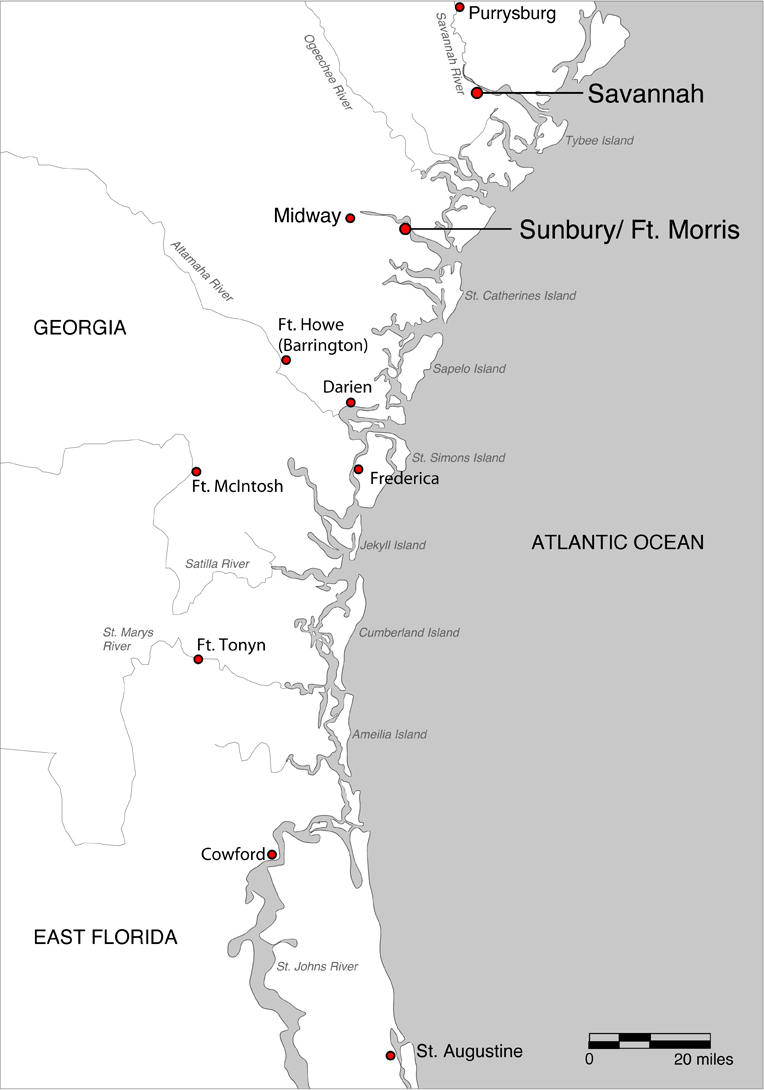
What would become Fort Morris was closely tied to the adjacent town of Sunbury. Founded in 1758 on the Medway River, the town was situated about thirty miles south of Savannah and ten miles inland from the Atlantic Ocean.[1] The plan of the town was likely influenced by the Savannah grid and featured three main public squares with 496 lots.[2] It was estimated that town’s inhabitants numbered between 800 and 1,000 free and enslaved people before the Revolutionary War. The small port at the time was said to rival that of Savannah.
At the same time that Georgia was authorizing its Continental battalions, the Congressional Congress advised the construction of two forts in Georgia, one at Savannah and the other at Sunbury.[3] At Sunbury, the fort was to be built 350 yards south of town at a strategic bend in the Medway River.[4] There is remarkably little documentation on the design of the fort during the Revolution. Ironically, the best graphic depiction of what would become Fort Morris was by British Lt. Col. Archibald Campbell whose 1779 map detailed a roughly rectangular fort with four projecting corner bastions and a palisade which extended around the town.[5] Given the scale of the map this depiction is not thought to be accurate.
South of Sunbury, a number of forts were constructed along Georgia’s southern border. These fortifications, both British and American, became focal points of military action from 1776 to 1778. Two American forts were on the Altamaha River at Fort Howe (aka Barrington) and a smaller one at Beards Bluff. Further south, on the Satilla River, was Fort McIntosh. In February 1777, a reinforced British army detachment captured the fort and burned it.[6] Later in 1778, Fort Howe too was burned. In 1776, the British constructed Fort Tonyn on the St. Mary’s River.[7]

Sunbury was a collection point for the several American military expeditions against British-controlled East Florida. In September 1776, Gen. Charles Lee, commander of the Southern Department, was briefly in the town preceding the first invasion of East Florida. After Lee was recalled to the north, Gen. Robert Howe demanded a battery be built where the fort eventually stood. On December 11, 1776 construction of the fort was authorized and begun.[8] By mid-1777, the fort was not yet complete but the Second Company of Georgia Artillery was there under the command of Capt. Thomas Morris, the fort’s namesake. By August 1778, construction of the fort likely consisted of earthen wall mounds with elevated cannon platforms surrounded by a perimeter ditch, barracks building and possibly a palisade wall and other defensive ditches.[9]
Prior to late 1778, most of the military action in the state occurred far south of the fort. At the end of June, the third American expedition to East Florida had advanced to the St. Mary’s River to attack Fort Tonyn. Lt. Col. Thomas Brown of the East Florida Rangers evacuated the fort and later ambushed the vanguard of the American force at the Battle of Alligator Bridge. By July 11, 1778 the American force was retreating. With the loss of Forts McIntosh and Howe, Fort Morris became the southernmost fortified position in Georgia.
Joining the last expedition to East Florida were two recently promoted officers of the Georgia Line, Lt. Col. John McIntosh and Major Joseph Lane.[10] The men were later to command Ft. Morris where by mid-1778 there were about 200 soldiers.[11] By November, unbeknownst to Americans in Georgia at the time, were upwards of 4,500 soldiers and sailors amassing against them from the north and south. Compounding what was soon to be an overwhelming enemy force against them was the recall of General Howe to General Washington’s headquarters. Gen. Benjamin Lincoln would take command of the Southern Department from Howe.[12] Neither Howe or Lincoln were in Georgia at the time of the first siege of Fort Morris.
In East Florida by mid-1778 were the balance of two British army regiments, the 16th and 60th under the command of Maj. Gen. Augustine Prevost.[13] By 1776, the 3rd and 4th Battalions of the 60th (Royal American) Regiment were reconstituted largely from recruits from Hanover and England and some officers from the other battalions, amounting to about 580 men.[14] With these regiments were several Loyalists units, the East Florida Rangers, South Carolina Royalists, and McGirt’s cavalry. At least 260 Loyalists refugees from Georgia and the Carolinas comprised the nucleus of the South Carolina Royalist Provincial Regiment.[15]

In November 1778, about 1,000 British soldiers were assembled to attack Midway and Sunbury from East Florida. General Prevost’s two-pronged attack was to be a joint land-sea operation with 750 men led by Maj. James Mark Prevost and a force consisting of 250 men under Lt. Col. Lewis Valentine Fuser. Prevost would march largely overland while Fuser was to sail north via the inland coastal passage to Sunbury. The overland force consisted of cavalry, the grenadier company of the 2nd Battalion 60th Regiment, 70 chosen men from the 3rd Battalion 60th Regiment, the East Florida Rangers, South Carolina Royalists, and McGirth’s cavalry with a four-inch cohorn. Lieutenant Colonel Fuser sailed with 250 men of the 60th Regiment’s 4th Battalion.[16] Major Prevost set out on November 19, 1778 and was south of Midway by November 22 where they encountered an American force under Gen. James Screven and Col. John White of the Georgia Continental Line.[17] General Screven was mortally wounded in the engagement after which the remainder of the American force withdrew north. Prevost advanced to Midway, burned the town, and retreated south with two thousand livestock and two hundred enslaved people.[18]
On or about the same day Prevost was at Midway, Lieutenant Colonel Fuser’s men landed at Colonel’s Island south of Sunbury. Lt. Col John McIntosh,of the Georgia Continental Line, nephew of Gen. Lachlan McIntosh, commanded the fort. The number of soldiers under his command was uncertain but it certainly included Capt. Thomas Morris’s Georgia Continental artillery, 127 men of the 3rd Regiment, and militia likely amounting to about 200 men. McIntosh was aware of the British landing as deserters from privateer vessels had alarmed the fort. Capt. Patrick Murray of the 60th Regiment gave by far the most detailed accounts of the two sieges of the fort. As British forces approached the fort from the south, two American riflemen fired shots that almost struck Lieutenant Colonel Fuser. Soon “the Citadel” came into Murray’s sight with the American flag flying above the fort’s earthen enclosure. Fort Morris was situated in a rather isolated position with the town to its north, marsh to its south, and the river on its east. Fuser’s men quickly made camp on the ground west of the fort. During the night cannon from the fort fired at the British campfires to no effect. Fuser and Capt. William Wulff used the cover of darkness to reconnoiter the defense and reported it was “well provided with heavy guns and men.” Wulff managed to get into the town and found it deserted except for two Loyalists on parole. Fuser took possession of a merchant’s house and distributed rum and provisions to his men. The intermittent fire from the fort continued throughout the night with the Americans apparently unaware of the British presence in the town.[19]
In the morning, Fuser sent out a detachment northwest to locate Prevost at Midway. While he awaited news, he “summoned” the fort to surrender. Fuser’s letter employed a bit of subterfuge in attempting the surrender, noting to the fort’s commander that “you cannot be ignorant that four armies are in motion to reduce this Province.”[20] In his letter he noted that General Prevost was on his way to join the siege and that the townspeople and the men would be allowed to keep their possessions if they surrendered. Fuser, as best as can be determined, did not have a sufficient number of troops to make an assault and did not have siege artillery with him. Nor did he know at the time Prevost had left Midway. According to Captain Murray, the force would not have had provisions for a prolonged siege.
Two hours after Fuser’s demand, Maj. Joseph Lane handed over the commander’s “spirited response.”[21] McIntosh’s retort has become the most well-known epigram of the two sieges. He stated he “would rather perish in a vigorous defence than accept your proposals. We, sir, are fighting the battles of America, and therefore disdain to remain neutral till its fate is determined. As to surrendering the fort, receive this laconic reply, ‘Come and take it.’”[22] McIntosh’s retort was a historical reference to the exchange between King Leonidas I and King Xerxes I at the Battle of Thermopylae. Almost certainly paraphrased from Plutarch’s “Sayings of the Spartans,” the response was a variation of Xerxes’ request to “Hand over your arms,” and the reply, “Come and take them.”[23] With the failure to locate Prevost’s army, Lieutenant Colonel Fuser and his men retreated back to their ships, receiving a few parting shots from the fort. Both British detachments retired about 100 miles south to the St. Mary’s River.
After the first siege, Lieutenant Colonel McIntosh left the fort under the command of Maj. Joseph Lane. Concurrently, there was also a change in the Continental soldiers there. None of the pension applications of men who were there during the second siege reported being there for the first siege. Likewise the one pension applicant who was at the first siege was not there for the second. One of these men noted that Gen. Robert Howe detached men from each company to reinforce Fort Morris and they arrived a few days before the second siege began.[24]

Two days after the first siege of Ft. Morris, on November 27, a detachment of Continental soldiers reached Zubly’s Ferry on the Savannah River led by General Howe.[25] That same day General Prevost received notice from British commander in chief Gen. Henry Clinton of the coming invasion of British soldiers from New York to capture Georgia.[26] According to General Howe, Fort Morris was not in a defensible state. At the fort from December 8 to the 12th, he was “confused” and “perplexed” by the state of affairs in Georgia. He found that Sunbury “is not defensible for half an hour; should it be attacked the least formidably.”[27] Howe concluded that it was only the spirited defense of the men and the lack of initiative of the British that saved the fort. In this timeframe, a deserter had revealed that 5,000 British soldiers were sailing from New York to Georgia. With news of the large invasion force en route, Howe correctly concluded that without reinforcements “this state will probably be lost.”[28]
Much has been written about General Howe’s decision to engage the recently arrived British force near Savannah under the command of Lt. Col. Archibald Campbell. In his nineteenth-century memoir, General William Moultrie criticised Howe for his “absurd” decision to defend the town against four times as many British soldiers.[29] In light of Howe being relieved of command and the known size of the enemy force, he could have retreated without much difficulty into South Carolina and rendezvoused with Gen. Benjamin Lincoln. Instead of withdrawing, Howe’s Continentals and militia moved south of the town to meet the British and were routed on December 29, 1778 with over 500 men killed, wounded, and captured.
Before the battle at Savannah, Major Lane received several letters from General Howe noting that reinforcements were expected from South Carolina and he was sending supplies to the fort.[30] Two days later, December 30, Lane received two letters in quick succession “most pressingly and peremptorily requesting” the evacuation of the fort. Howe later testified that he was so anxious about the fort that he wrote his first letter in pencil on horseback while retreating from Savannah. Consistent with Lane’s account, Howe later wrote several other letters “more explicit in its content repeating the order for evacuation.”[31] He elaborated for Lane to destroy the stores and spike the cannon if they could not be removed.
Lane immediately responded to Howe’s first letter with a response that almost defies explanation. He wrote that he could not find a single suitable guide among his men, the town’s militia or a citizen of the town to direct their retreat. His officers and the town inhabitants were “unanimous in opinion that a retreat was impracticable” and their “safety was entirely dependent on a rigorous defense of the fort.” Lane noted a month later in a letter to Lincoln a number of other reasons he did not retreat that he did not reveal to Howe. There were “Enemy Rangers” to his west, at Ogeechee Ferry to his north, and to his south on Colonels Island. He also reported his letters were being captured and his fort reconnoitered by the enemy. There was also the fear of Lieutenant Colonel Campbell’s men falling upon them from Savannah. With this he formed a “secret design” to evacuate the fort by sea to Beaufort, South Carolina but found the boats were not seaworthy. Now “fully confident that all communication with the Confederal army was cut off,” he resorted to the fort.[32] General Howe listed other reasons. Lane was swayed by “the Magistrates and citizens of the town, hoping to defend it again, solicited, implored, and beset him to remain in it.” Being “in the bloom of youth, in the hey-day of blood and spirit” and possessed with “an enthusiastic ardour for fame … all these prevailed upon him to delay an execution of his orders, and he had his punishment in his fault.”[33]
Major Lane had over a week to leave the fort before the British appeared from the south. Lieutenant Colonel Campbell did not march from Savannah until December 31 and his effort was north along the Savannah River in pursuit of Howe, not south to Sunbury.[34] By January 4, Campbell had reached Two Sisters Ferry, thirty-five miles north-northwest of Savannah with selected troops from the dragoons, light infantry, New York Volunteers, and 71st Regiment.[35] It was not until January 9 that Campbell first mentioned Fort Morris in his journal. By January 11 he had been informed by General Provost that the fort had been taken.[36] While Campbell may have ultimately blocked Lane from a rendezvous with Howe, maps of the time indicate several roads north of where the British temporarily halted their advance. The route north remained open for several days. Lt. Aaron Smith of the 3rd South Carolina Regiment, commanding a small detachment at Ogeechee Ferry, received the same order from Howe and successfully rejoined Howe after an arduous thirty-six hour journey through the swamps.[37] In fairness to Major Lane, a retreat would have been hazardous and difficult given the marshy terrain of the area. He appeared to have no intelligence regarding Campbell’s men or their whereabouts. Whether he and his men had even a fair chance to rejoin Howe is impossible to determine.
The second siege of Ft. Morris began for the British army in the same way as the first. In undated accounts, Captain Murray came ashore with the light infantry companies of the 4th Battalion 60th Regiment and the 16th Regiment from Colonel’s Bluff (Island) south of Sunbury. Murray’s men met a few scouts south of the fort but quickly advanced to the “ditch” on the west side of the fort on January 7. The next morning, an American force of twenty-three cavalry sallied out from the fort to attack Murray’s men; most of the cavalry were soon captured. More importantly, General Prevost arrived later in the day with the remainder of the troops, two eight-inch howitzers and a cohorn, taking position on the south and west sides of the fort. American cannon from the fort and river galleys fired on the assembling British on the third day of the siege.[38] According to Major Lane, “every piece of ordnance that could bear on them” was used in their defense but were unable to dislodge the enemy.[39] That same day the Americans made another sally from the fort which was quickly beaten back after only wounding three British soldiers. Later that day the British howitzers found their range and began firing into the fort’s interior. One shell soon hit the barracks building in the fort and set it ablaze, killing one and wounding nine men. “Convinced that the fort was untenable and further resistance would cause the lives of many brave men” a parley was made with conditions for surrender.[40]
The losses in men and material at Fort Morris were generally less but in proportion to those at Savannah. British accounts of American soldiers captured at Fort Morris amounted to 172 men (129 Continental soldiers and 43 militia).[41] However, a detailed list by Major Lane noted at least 205 men made prisoner (27 Georgia artillerymen, 103 Georgia Continentals of 2nd, 3rd, and 4th Georgia Battalions, 29 men from the 3rd South Carolina, and 46 Georgia militia).[42] By comparison, a return of the soldiers captured at Savannah listed 453 total men captured: 365 Continentals, 54 militia, and the remainder light cavalry and artillerymen.[43] The losses in cannon and small arms were more similar. At Fort Morris, the British had captured 32 cannons, 1 mortar, 820 cannon shot, 192 muskets and rifles, 3,000 musket balls, and 28 barrels of gunpowder.[44] In comparison, at Savannah the British captured 43 cannons, 12 mortars, 1,500 cannon shot, and 320 muskets and rifles.[45] Most critically, the battles at Savannah and Fort Morris essentially destroyed the Georgia Continental Line’s regiments. Only 30 men from Col. Samuel Elbert’s command reportedly made their escape from Savannah.[46] A few months later at Briar Creek, about 70 Georgia Continentals had re-assembled.[47] By April 6, 1779 a return of the four regiments of the Georgia Brigade mustered 159 men, the most being 54 men in the 2nd Regiment.[48]
Most of the rank and file prisoners from Fort Morris were taken to Savannah. Twelve of these prisoners left pension applications. Interestingly, nine of the twelve men were exchanged, escaped, or deserted from British military service. Three of the twelve men joined the British army or navy while prisoners. Eight of the twelve men later returned to American militia service later in the war in varying capacities. At least one Georgia Continental prisoner from Fort Morris was put on board a prison ship. After six months, he joined the British army to save his life, “though he took the oath and at the same time intended to violate it, it was to escape from a prison of death.”[49] Once in the British army, he deserted in September 1779 near what would have been the completion of his three-year term in the Continental Army.
Gen. Robert Howe later became involved in several court martial trials after leaving the Southern Department. Prior to his own court martial, he served on the two court martial committees of Benedict Arnold. In December 1781, he faced trial for his conduct at Savannah and was found not guilty. In his court statements, he mentioned his several letters to Lane to evacuate Fort Morris. He specifically noted that Lane should not have “remained in a work too extensive for five times the number of men, ill-constructed, unfinished, without casemates, and without the least probability of relieving it.”[50]
By September 1779, Major Lane had been paroled and wrote to Gen. Lincoln requesting provisions for prisoners being held in Sunbury.[51] Lane was subsequently involved in the negotiations to parole or exchange prisoners of war in February 1780.[52] There are differing accounts as to his later service in the Continental Army. Several sources indicate that he was court-martialed and found guilty in October 1780.[53] However, Lane’s name is not found among court-martial records of this time. One source lists him as “retired” in October 1780.[54] A return of soldiers made after the war noted that Lane was “descharged by resolve of Oct. 80.”[55]
Fort Morris was renamed Fort George after its capture. British Provincial soldiers occupied the fort until September 1779 when it was briefly re-captured by men under the command of Col. John White. Following the failed siege of Savannah, White retreated to South Carolina in mid-October. From 1780 to the spring of 1782, there were no records of British soldiers at Fort George although there may have been some Loyalists stationed there for a period.[56] The fort was reconstructed during the War of 1812 and renamed Fort Defiance. Sunbury became one of Georgia’s several “dead towns” in the decades after the war. By 1829, there were only a reported 150 residents in the vicinity of the town and fort.[57] After the Civil War, observers noted the town’s public squares became corn fields, its streets covered in Bermuda grass, and the fort overgrown with weeds. By 1878, historian Charles C. Jones noted that Sunbury and Fort Morris became a place “where nature survives, but all the rest is a shadow.”
Today, nothing of the Revolutionary era fort and town remain, at least above ground. Fortunately, Fort Morris was designated a state historic site in 1973. Since then, several archaeological investigations on the property have made two broad revelations. First, was the excavation and discovery of substantial material culture across the site from the 1779 siege, American-British occupations, and even much earlier Native American settlements. Many of these artifacts are currently on display in the small on-site museum. The second discovery was that the current earthworks visible today are the likely those of Fort Defiance and not what was believed to be the significantly larger Fort Morris. While the later earthworks destroyed the Revolutionary fort it also covered, and mostly preserved, its artifacts. To date, only one percent of the site has been excavated. Given the extensive acreage of the property it is clear that many more artifacts remain beneath the surface. Perhaps the resources may soon be available to expose from the “shadows” the important history concealed by a few feet of lowcountry soil.
[1] Charles C. Jones, The Dead Towns of Georgia (Morning New Steam, 1878), 148.
[2] Paul Morton McIlvaine, The Dead Towns of Sunbury, Ga., and Dorchester, S.C. (Groves Printing, 1976), 154-155.
[3]John McKay Sheftall, Sunbury on the Medway: A Selective History of the Town, Inhabitants, and Fortifications (State of Georgia Department of Natural Resources Office of Planning and Research Historic Preservation Section, 1977), 24.
[4] Daniel T. Elliott, Archaeological Investigations at Fort Morris State Historic Site, (Liberty County Georgia, Office of State Archaeologist, 2003), 1.
[5] Ibid., 19.
[6] George Kotlik, East Florida in the Revolutionary Era, 1763–1785, (University of Georgia Press, 2023), 64.
[7] Ibid., 51.
[8] Sheftall, Sunbury on the Medway, 25-26.
[9] Ibid., 31.
[10] Martha Condray Searcy, The Georgia-Florida Contest in the American Revolution, 1776-1778, (University of Alabama Press, 1985), 139.
[11] Elliott, Archaeological Investigations at Fort Morris, 24-25.
[12] Charles E. Bennett and Donald R. Lennon, A Quest for Glory: Major General Robert Howe and the American Revolution (University of North Carolina Press, 1991), 87.
[13] Memoir of Major Patrick Murray in Lewis William George Butler, The Annals of the King’s Royal Rifle Corps, (Smith, Elder and Co., 1913), 1:299.
[14] Ibid., 1:208.
[15] Ibid., 1:303.
[16] Ibid., 1:306.
[17] Kotlik, East Florida in the Revolutionary Era, 80.
[18] Jim Piecuch, South Carolina Provincials: Loyalists in British Service During the American Revolution, (Westholme, 2023), 79.
[19] Butler, The Annals of the King’s Royal Rifle Corps, 1:307.
[20] George White, Historical Collections of Georgia: Containing the Most Interesting Facts, Traditions, Biographical Sketches, Anecdotes, Etc., Relating to Its History and Antiquities, from Its First Settlement to the Present Time, (Pudney & Russell, 1855), 525.
[21] Butler, The Annals of the King’s Royal Rifle Corps, 1:308.
[22] George White, Historical Collections of Georgia, 526.
[23] Plutarch, “Sayings of the Spartans,“ Moralia, (Loeb Classical Library, Harvard, 1931), 351.
[24] Pension Application of Henry Smith (W9300), National Archives and Records Administration.
[25] Bennett and Lennon, A Quest for Glory, 89.
[26] Piecuch, South Carolina Provincials, 80.
[27] Howe to Moultrie, December 8, 1778, in William Moultrie, Memoirs of the American Revolution: So Far as It Related to the States of North and South Carolina, and Georgia (David Longworth, 1802), 1:247.
[28] Bennett and Lennon, A Quest for Glory, 91.
[29] Moultrie, Memoirs of the American Revolution, 1:253-4.
[30] “Major Lane’s Letter from Georgia together with a return of the prisoners taken at Sunbury,” Lincoln Papers, Emmett Collection, New York Public Library, February 22, 1779.
[31] Robert Howe in Proceedings of a Court Martial, held at Philadelphia, in the state of Pennsylvania, by order of His Excellency General Washington, commander in chief of the army of the United States of America, for the trial of Major General Howe, December 7, 1781. Major General Baron Steuben, president (Hall and Sellers, 1782), 28.
[32] Maj. Joseph Lane to Maj. Gen. Robert Hower, Emmett Collection, New York Public Library, December 30, 1778.
[33] Robert Howe testimony in Proceedings of a General Court Martial, 28.
[34] Colin Campbell (ed.), Journal of an Expedition Against the Rebels of Georgia in North America under the Orders of Archibald Campbell, Esquire, Lieutt. Colol. of His Majesty’s 71st Regiment, 1778 (Ashantilly Press, 1981), 32.
[35] Ibid., 30, 33-34, 37.
[36] Ibid., 39.
[37] Hugh McCall, The History of Georgia: Containing Brief Sketches of the Most Remarkable Events Up to the Present Day (1784).
[38] Butler, The Annals of the King’s Royal Rifle Corps, 1:310.
[39] “Major Lane’s Letter from Georgia together with a return of the prisoners taken at Sunbury,” Lincoln Papers, Emmett Collection, New York Public Library, February 22, 1779.
[40] Ibid.
[41] “Return of the rebels in the garrison at Fort Morris now Fort George,” The National Archives, Kew, UK: CO 5/97 Part 1, January 10, 1779.
[42] “A return of the garrison of Fort Morris commanded by Major Joseph Lane, January 9, 1779 made prisoners by B. Gen. Prevost”, Emmett Collection, New York Public Library.
[43] “Return of prisoners of war taken in action December 29, 1778 by His Majesty’s troops under the command of Lt. Col. Archibald Campbell, The National Archives, Kew, UK: CO 5/97 Part 1, December 29, 1778.
[44] “Return of brass and iron ordnance and ordnance stores in Fort Morris/ Fort George,” ibid., January 13, 1779.
[45] “Return of brass and iron ordnance and stores belonging to the rebels taken at Savannah in Georgia,” ibid., January 8, 1779.
[46] David K. Wilson, The Southern Strategy: Britain’s Conquest of South Carolina and Georgia, 1775-1780 (University of South Carolina Press, 2005), 98.
[47] Joshua B. Howard, “‘Things Here Wear a Melancholy Appearance’: The American Defeat at Briar Creek,” The Georgia Historical Quarterly, 88, no. 4 (2004), 483.
[48] Return of the Remains of the Georgia Brigade, Benjamin Lincoln Papers, Massachusetts Historical Society, Roll 3, Vol. I, January-May 1779.
[49] Pension Application of Henry Smith (W9300).
[50] Robert Howe testimony in Proceedings of a General Court Martial, 28.
[51] Joseph Lane to Benjamin Lincoln, The Gilder Lehrman Collection, 1493-1859. The Gilder Lehrman Institute for American History, GLC03369, September 22, 1779.
[52] Joseph Lane Jr. to Continental Congress, February 7, 1780, Report on Condition of Southern Prisoners, George Washington Papers, Series 4, General Correspondence, Library of Congress.
[53] Samuel Huntington to George Washington, February 7, 1780, Founders Online, National Archives.
[54] Francis B. Heitman, Historical Register of Officers of the Continental Army (The Rare Book Shop Publishing Co., 1914), 339.
[55] Robert S. Davis, Georgia Citizens and Soldiers of the American Revolution, (Southern Historical Press, 1979), 126.
[56] Elliott, Archaeological Investigations at Fort Morris, 38.
[57] Jones, The Dead Towns of Georgia, 218.


3 Comments
Thank you for the article highlighting our Fort Morris. A few comments are in order. When Fuser told McIntosh four armies I don’t think he knew Campbell had been delayed. Fuser, Prevost, and Campbell would be three. Creek four? Sheftall claims most forts of the period were four bastion with central building. Schenawolf says redoubts like found at Sunbury were the most common. Indeed, the symbol on Campbell’s map was found for every fortification on British maps of the period, including the irregular forts Fort Frederica, Fort King George, and Fort Johnston. I believe the symbol was a cartographers icon.
The idea the fort was destroyed by the British and rebuilt in 1814, as claimed by some, is countered by report of a duel in 1794 “at the old fort” and letters speaking of repairing the fort by the Liberty County Committee of Safety during the War of 1812. Further, CC Jones Sr, father of the author of Dead Towns which claimed the redoubt was Fort Morris, went to school in Sunbury in the early 1800s and later mapped Sunbury. He certainly would have told his son what the old fort looked like.
Peter, thank you for your comments. I found no primary sources describing which specific four armies were being referenced by Fuser. The larger issue for me, in the decision to lift the first siege, is that neither Fuser or Prevost had sufficient artillery for a lengthy siege. However, the four armies you noted may very well be correct. For the fort, the archaeological reports I read indicated that Fort Morris may have had corner bastions. A large-scale drawing in the visitor center depicts the larger fortification with corner bastions. However, the park ranger there informed me that the depiction is speculative. I found no records that the British destroyed the fort although they probably did modify it to some degree. Based on archaeological reports, I have difficulty reconciling that the current earthworks contained well over 200 soldiers, a barracks building, and 32 cannons. On this last point, a more extensive archaeological investigation would (or could) answer the question about the true size and extents of the fort.
I very much enjoyed your well-written article. Interest in the site continues, and I have great hope that the entire fort will be found and properly studied. My belief is that Fort Defiance is one of the original bastions of Fort Morris.
While researching the Kettle Creek site in 1974, I found the Joseph Lane material on the second siege, which resulted in John Sheftall’s report. That also led me to realize that the papers of General Benjamin Lincoln survive and are scattered across the country in various archives and libraries, containing a goldmine of information on the war in Georgia, 1779-1780.
If someone wants to do a great project on Georgia and South Carolina during the American Revolution, I highly recommend creating a calendar of the Lincoln Papers.