




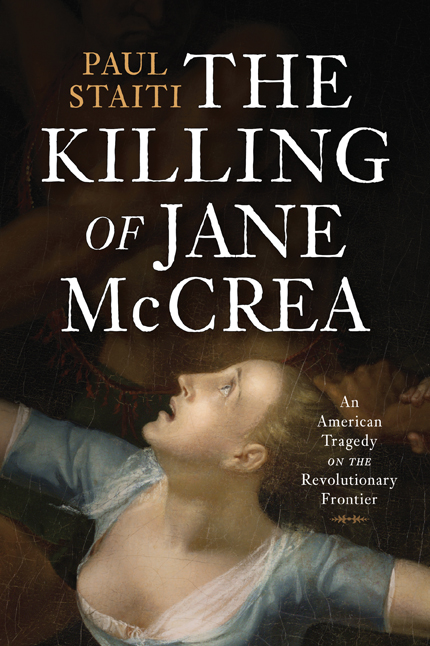
BOOK REVIEW: The Killing of Jane McCrea: An American Tragedy of the Revolutionary Frontier by Paul Staiti (Yardley, PA: Westholme Publishing, 2025).
My introduction to the Jane McCrea story came fifty years ago as part of a Revolutionary War reenactment weekend. The organizers chose my group to be part of the opening of the battle demonstration: we had to rescue a fair maiden from the clutches of her captors. Whether or not we got there in time to “save her life” is gone from my memory these decades later but, that failure could fit nicely within the premise of Paul Staiti’s new book.
 Most people who have read much about the 1777 Burgoyne campaign have, at least, a passing familiarity with Jane McCrea’s story, how Jane and her lover came from opposite sides of the conflict—she from the patriot side while her betrothed served in a Loyalist unit. How their plans called for the two to join and be married when Burgoyne’s army reached the Fort Edward area where Jane had situated herself. How some Indians operating in advance of Burgoyne’s force found her and began to return to Burgoyne’s lines but, along the way, killed her. How her death almost immediately became legend.
The problem with the story, like so many legends, is that it has become dramatically muddled since the moment it happened. Aside from the Indians who lacked the written word to use as a basis for a historical account, no verifiable witnesses reported what they saw. Since the American side immediately latched on to the story for propaganda purposes, imagination took on a significant role in the telling. As time passed, new accounts suffered from time-altered memory (if not outright lies) and only added to the confusion.

Professor Staiti (Mount Holyoke College) does an excellent job of addressing this situation. He sought out numerous accounts of the incident and not only points out the inaccuracies within each narrative but explains how they added to the legend. While his effort helps clarify the narrative, it is only to a degree. If one is looking for a definitive, final accounting of the Jane McCrea story, this ain’t it. But, that’s part of the book’s argument—that the tale became even more nebulous as time passed and that an accurate narrative will likely never be known.
A study of the killing is not all there is to the book; the basic story is really not complicated—girl loves boy—girl is killed—girl becomes famous. Mr. Staiti takes his work well beyond a mere accounting of Jane McCrea and her death. He fills a few pages discussing the backgrounds of Ms. McCrea and her fiancé, David Jones, but then takes about three-quarters of the book to address the aftereffects of the event in great detail. This is where The Killing realizes its true value.
It will likely be surprising to many readers just how far Jane McCrea’s story traveled in time and distance. Following his description of the propaganda efforts in America, the author looks at the treatment the incident received in England and France. He goes on to discuss how the story remained in American consciousness well into the nineteenth century, appearing in articles, history books, as a basis for other stories including a novella, and even circus acts. Not until over a century had passed did the killing begin to fade from memory, all but disappearing in the twentieth century.
Professor Staiti’s training and career has centered on fine art. In fact, the book’s opening sentence exposes this characteristic when he writes, “I have been haunted for decades by a painting from 1804 that hangs in a museum in Hartford, Connecticut.” It is probably not surprising, then, that he devotes a few pages to the various paintings of the killing that have been created over the ensuing centuries. He begins with a look at the painting in Hartford, John Vanderlyn’s interpretation of Jane McCrea’s killing, discusses a handful of other works on the same subject, and concludes with Don Troiani’s 2018 image (perhaps the most realistic of all). Some readers may find these entries to be unnecessary tangents but, to his credit, the author does not stray from maintaining the connection with the book’s objective.

The Killing may pose challenges for some readers. For one, it presents little of a positive image of Native Americans. The killing itself certainly is not rational to the modern American mind but, in the context of when and where it happened, it can be at least understood and, to his credit, Mr. Staiti does make an effort to put the incident in context. There is no firm evidence as to which tribe the Indians who killed Ms. McCrea belonged but the author makes a concerted effort at presenting coincidental evidence pointing to an answer for that question. With very few exceptions, however, the book lumps all Native Americans together even though Burgoyne utilized several nations separated by hundreds, if not thousands, of miles and, at times, significantly dissimilar cultural practices.
Further, scalping is addressed more often than seems necessary. The practice is also attributed almost exclusively to Native Americans with only a minor reference to whites doing the deed.
Some of the author’s conclusions can also be debated. This may be attributed to the fact that while Mr. Staiti certainly delved deeply into the Jane McCrea affair, he likely is not intimately knowledgeable about the rest of the period or the Burgoyne campaign. The result is an oversimplification of some events and ascribing too much importance to the killing. For example, the author states that General Gates’ letter propagandizing the killing prompted the militia to report for service to exact revenge at the Saratoga battles. This conclusion ignores the fact that General Schuyler had recently been replaced as commander of the army. The New Englanders who comprised the bulk of the newly-arrived militia regiments could not stand Schuyler and did not want to serve under him. In his place Congress appointed Gates, whom New Englanders favored and willingly volunteered to serve under. The appearance of the militia also coincided with a time during which the farms operated by the majority of the militiamen required minimal attention. McCrea’s killing definitely had an influence but not to the extent indicated by the book.
As another example, the author blames Indian desertions from Burgoyne’s army on the reprimand they received from Burgoyne for the killing. While that played a part, other factors such as reduced rations, deteriorating weather, and the need to prepare to winter at home also influenced the decision to leave.
In the end, however, these negatives are quite minor. In addition to a thorough and expansive examination of the subject, the author’s writing style flows well from paragraph to paragraph and chapter to chapter. With a bit over 200 pages of text, a good index, and detailed end notes containing considerable additional information, Professor Staiti’s book is well worth a reader’s attention.
PLEASE CONSIDER PURCHASING THIS BOOK FROM AMAZON IN HARDCOVER OR KINDLE.
(As an Amazon Associate, JAR earns from qualifying purchases. This helps toward providing our content free of charge.)



One thought on “The Killing of Jane McCrea”
Jane lived in the area of Ft. Edward, the seat of the recently created Charlotte County (1772) and its courthouse, which is still standing. Its records for this time period now reside in the renamed Washington County (1784) archives, also in Ft. Edward.
While researching the court system for the so-called New Hampshire Grants (and finding some incredible things behind that difficult time period), I had the privilege of examining its two early docket books, which themselves have their own incredible history having been removed to Canada during the war and then brought back.
Reading through their pages, several attorney’s names appear, including one named McCrea. The name jumped out at me because of Jane’s notoriety, and with additional research, it appears that this was her older brother, John, who also lived in the Ft. Edward area practicing law. It looks like he was involved in a number of civil cases acting on the behalf of plaintiffs. It was one of those delightful surprises that one unexpectedly stumbles upon when delving into the period documents.