



New York City is home to many grave sites of participants in the American Revolution. Many are easy to find, one is a huge mass grave and monument, while one includes a very famous woman. Interestingly, one or two are not where you might think they were laid to rest. In fact, one gravesite of a general is completely gone forever thanks to building development over the centuries. Below are the ten (arguably) most interesting gravesites, that may inspire some readers to go on a memorable scavenger hunt.
The Prison Ship Martyr’s Monument

The most prominent and important gravesite is the Prison Ship Martyrs’ Monument, a huge war memorial located at Fort Greene Park in Brooklyn. It commemorates the thousands of American Patriot prisoners of war who suffered and perished in horrific captivity abroad sixteen British prison ships during the American Revolution, including the notorious Jersey. The bones of a small percentage of these patriots are interred in a crypt beneath its base. The impetus for the memorial largely began with development in the 1870s for the Brooklyn Navy Yard that uncovered the remains of bones that had washed up on the shore for decades. Famous architect Stanford White designed the monument and President-elect William Howard Taft delivered the keynote address at the monument’s dedication in 1908.
Major General Alexander Hamilton and Eliza Schuyler Hamilton
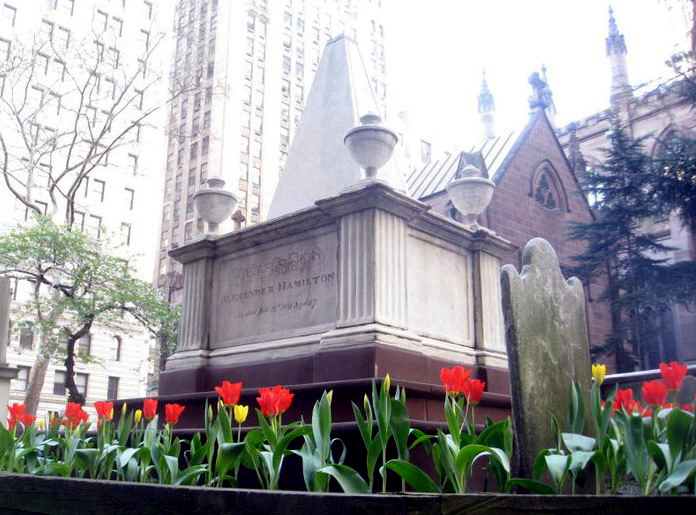
Arguably the most famous burial site in New York City (along with General Ulysses S. Grant and his wife in the upper east side) belongs to Founding Father Alexander Hamilton and his dear wife, Eliza (or Betsy) Schuyler Hamilton, daughter of Maj. Gen. Philip Schuyler. For decades, the monument was not particularly well kept and dreary in appearance, even after circa 2010. However, the popularity of the musical “Hamilton” inspired Trinity Church and partnering organizations to have the Greek Revival-style monument cleaned and repaired to restore it to its glory. Remarkably, Eliza lived to ninety-seven years old, dying in 1854 after attending the dedication of the Washington Memorial, the only person left alive who had known George Washington.
The monument is a reminder that Hamilton was more than a colonel and aide to General Washington in the American Revolution. He went on to serve Washington as a major general in the Quasi-War with France, 1798-1799. Alexander and Eliza, along with their children, were members of Trinity Church. The emcee for the large funeral that included members of the Society of the Cincinnati was Gouverneur Morris. Sadly, the remains of their son, Philip Schuyler Hamilton, killed in a duel at the mere age of nineteen, are officially unknown. In spite of claims they are at the Hamilton monument, the Trinity Church website says his gravesite is actually unknown.

Major General Horatio Gates
Say what you will about Gen. Horatio Gates, but the thorn in the side of General Washington who badgered Congress numerous times and who threatened the leadership of Washington was a significant general for his leadership, especially in the Saratoga campaign. Curiously, he was buried in an unmarked grave at Trinity Church and no one seems to know why such a famous figure—although infamous for the Conway Cabal and his defeat at the Battle of Camden—was not marked. Gates died at his Rose Hill home in Manhattan in 1806. He is recognized for being buried somewhere in the Trinity Churchyard thanks to being included in the 1957 marker placed by the Society of the Cincinnati in the State of New York.
Major General William Alexander, aka Lord Stirling
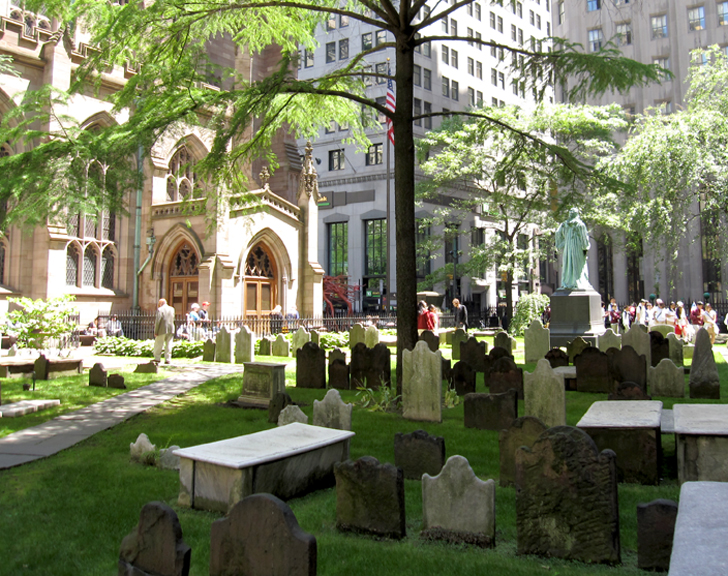
William Alexander, who, like Hamilton, was of Scottish descent, styled himself as Lord Stirling, necessitating General Washington to address him as “My Dear Lord” in letters. Whatever his claims to Scottish aristocracy, he and his parents were certainly wealthy, as the Stirling family owned a huge townhouse in lower Manhattan that likely burned during the great fire in New York in 1776. They also owned a large, country estate in the Morristown region of New Jersey. Lord Stirling distinguished himself in many battles for his leadership and bravery, most importantly the Battle of Long Island in August 1776. A heavy drinker, Stirling died in January 1783, likely of liver failure. Surprisingly, while buried in the Stirling family vault at Trinity Church only 100 feet from the Hamilton monument, few are aware he is there, tucked next to the far side of the church in a tight location. Thanks to the efforts of this author, his plot is marked with US flags.
Hercules Mulligan
Also buried at Trinity Church and also of Scottish descent was a tailor turned spy, Hercules Mulligan. He once rented a room at nearby Kings College to a young student named Alexander Hamilton. Prior to the Revolution he was a member of the New York Sons of Liberty. His tailor shop attracted the business of British officers, who would mention military updates or otherwise gossip. He would note the most important information on paper and have it hand delivered by his Black servant, Cato, who was his courier. Mulligan largely operated as a solitary agent or spy separate from the Culper Ring. Sadly, there is little evidence of his work as a spy and lot is left to speculation or the imagination.

Captain Nathan Hale – MIA
Another patriot spy buried in New York City is Capt. Nathan Hale, though the whereabouts of his grave is largely mysterious. Often thought of as only a spy, Hale actually had served as a captain in the elite Continental Army unit, Knowlton’s Rangers, named for its commander, Lt. Col. Thomas Knowlton. Both Hale and Knowlton were from eastern Connecticut. Hale was captured as an untrained spy posing as a school teacher looking for work when he met Robert Rogers, Loyalist Ranger, at a bar in Long Island, who had him arrested. Hale was likely buried near where he was hanged as a spy. While the Yale Club on Vanderbilt Place has an exterior plaque from the New York Daughters of the American Revolution stating he was buried in the building’s midst, he was actually buried in the Murray Hill section in eastern mid-town Manhattan near Third Avenue and 66th Street.
Captain Silas Talbot
No list would be complete without a naval officer. Silas Talbot is the most famous naval officer buried in Manhattan. He was appointed a captain in the Continental Navy in 1779 and was later captured by the British. In 1792 he was elected as a Congressman to help represent New York, serving from 1793 to 1794. He then returned to Navy service as a captain in the newly-formed federal US Navy, one of six officers to be commissioned as captain. He died in Greenwich Village at sixty-two in the summer of 1813 and is buried with so many other patriots at Trinity Church.
Major General Alexander McDougall – MIA
Unfortunately, Gen. Alexander McDougall suffers like scores of other early Presbyterians in Greenwich Village, Manhattan in that their gravesites were, for some terrible reason, built over by development some time in the latter 1800s. How a church cemetery was not preserved is likely an issue of cruel land value increase in the eyes of developers. All that is known is that the cemetery was located at the First Presbyterian Church at 5th Avenue and 12th Street. Though not a well-known general, McDougall was an early leader of the New York Sons of Liberty. He spent almost all of his wartime service within New York State. He was an original member of the Society of the Cincinnati. He is better known for his non-military leadership, including as a member of Continental Congress in 1781 and as a member of the New York State Senate from 1783 to 1786. He was the first president of the Bank of New York. Sadly, he died in 1786.
Major General Richard Montgomery
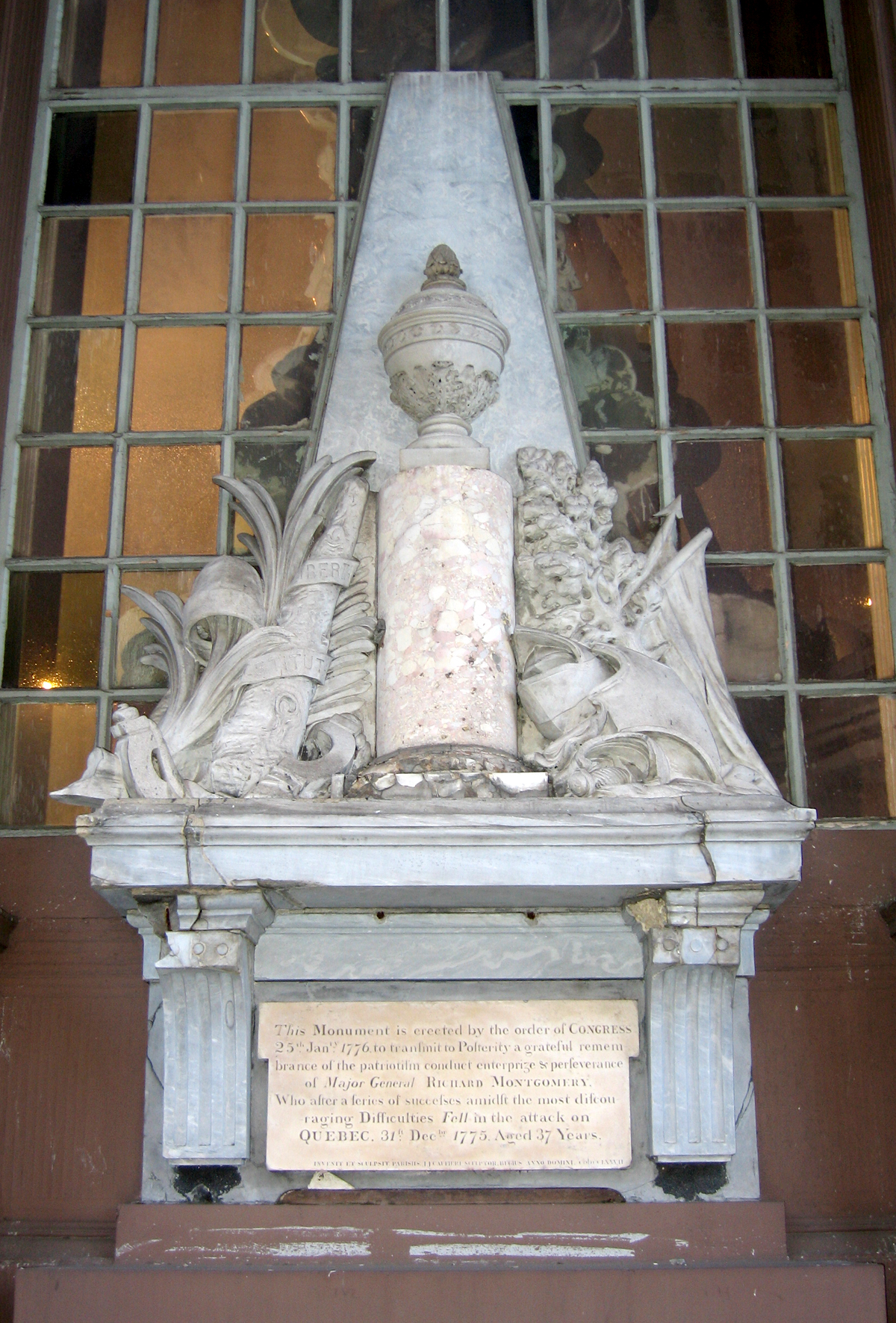
McDougall was one of the first generals to die following the war, but Richard Montgomery was the first general to die during the war, cut down by musket fire while attacking the Crown Forces at Quebec on the wintry New Year’s Eve night of 1775. He was only thirty-seven, leaving behind his widow, Janet Livingston, for another fifty-three years! Montgomery was a well-regarded general who was temporarily buried in Quebec City. In January 1776, Congress approved the creation of a monument in memory of Montgomery. However, as is often the case with Congress, things took time, and the monument was not installed at St. Paul’s Chapel until 1787. Curiously, the fancy, beautifully-carved monument by Jean-Jacques Caffieri is equally impressive both inside and outside from busy Broadway Avenue. As if the delay in building the monument was not enough, Montgomery’s remains were not moved until 1818, floated down the Hudson River on July 4, arriving in New York City on July 8 to a huge crowd of 5,000 people.


Recent Articles
Ten Patriot Gravesites of New York City
American Whig Ideology and Canadian Participation in the American Revolution
James Selkirk’s Revolutionary War
Recent Comments
"American Whig Ideology and..."
One correction to the line "Both regiments were deployed to the Northern...
"The Loyalist Declaration of..."
Did Nicholas Wallingsford sign the Declaration of Dependence? I am a descendant....
"The Blue Hills Beacons"
The beacon at Mt. Bethel was located at the Old Mt. Bethel...