


Introduction
The actions of the cavalry at the Battle of Cowpens on January 17, 1781 have been particularly difficult to understand. Previous researchers have struggled to explain the actions of the cavalry under Lt. Col. William Washington while accounting for his seeming to be in multiple places on the battlefield at different times.[1]
During research for his historical novel, Nor the Battle to the Strong, Charles F. Price and this author attempted to find documentation of what tactics Lt. Col. Washington and the Continental Cavalry may have used in the South in 1781.[2] There simply was no contemporary American cavalry manual. Our conclusion was that the only way to understand Washington’s tactics was to plainly describe what he did. Further research showed that accurate descriptions of William Washington’s tactics during the major 1781 battles of Cowpens, Guilford Courthouse, Hobkirk’s Hill, and Eutaw Springs reveal a striking similarity to tactics described as state of the art for the Prussian cavalry of the preceding thirty years.
Given the lack of an American cavalry doctrine, the most obvious source for knowledge for American cavalry commanders would have been their European counterparts. While several military treatises were available, there is no clear documentation that American cavalry officers, and specifically William Washington, had direct access to these sources. Many European officers did serve with the American cavalry, bringing and disseminating their knowledge of cavalry tactics to American officers. In particular, the practice and success of the Prussian cavalry loomed large in the European experience.[3]
Regarding the action of cavalry in the line of battle, Frederick the Great wrote:

When the enemy cavalry has been driven beyond the next defile, then the proper course of action for cavalry is two-fold: a portion must be detached to keep the enemy cavalry from returning to the battlefield while the rest proceeds to attack the enemy infantry in the rear in order to cut off its retreat. It is also very good if you can fall upon the enemy infantry in the flank and in the second line, but in this case an officer must be sent to apprise our own infantry so that they do not fire upon the enemy while the cavalry attack is in progress. Otherwise our cavalry will easily be thrown into confusion . . . I remind you only that the attack on the flanks of both enemy lines is the surest and shortest, because then the lines fall by heaps like a house of cards.[4]
Frederick the Great regarded intuition on the battlefield, or coup d’oeil, as encompassing the knowledge of terrain and enemy dispositions to make the best use of a situation. “All movements of cavalry are swift. It can decide the fate of a battle in one instant. It must be used only at the right time,” he wrote.[5] Maurice de Saxe stated, “The important thing is to see the opportunity and to know how to use it.”[6]
Frederick may just as well have been describing the American cavalry at the Battle of Cowpens. Once a crucial element of timing is understood, examining the primary sources with an eye toward accepted eighteenth century European cavalry tactics reveals a perfectly timed charge followed by the best-case scenario: a cavalry force not only in the rear of the enemy but effectively placed to roll up the enemy line. In this light, the actions of the American cavalry at Cowpens were surprisingly straightforward.
John Eager Howard Sets the Stage
A complete description of the battle is beyond the scope of this article.[7] The initial reconnoiter by Sgt. Lawrence Everheart, the encounter between Washington and British Lt. Col. Banastre Tarleton, and the cavalry pursuit that preceded the main action are relatively straightforward and not subject to the same confusion that plagues the actual battle. Crucial to an understanding of the American cavalry charges is the timing of Washington’s first charge on the troop of the 17th Regiment of Light Dragoons on the American left, in relation to John Eager Howard’s infantry charge on the American right. Most scholarship on the battle places the clash between the American cavalry and the 17th Light Dragoons as a separate engagement, fully completed, before Howard’s celebrated “retreat” and charge.[8] Standard accounts state that Washington charged the 17th, reformed, and returned to his place as a reserve in the American rear. Tarleton himself indicates the timing in that way; his description of the charge of the 17th Light Dragoons and Washington’s repulse of them occurs in his narrative as a distinct event, chronologically before the British gains on the American right.[9]

Many first-hand accounts suggest that both events occurred at the same time. As will be seen, this is borne out by the words of John Eager Howard in two separate letters. The first is dated 1804, and directed to John Marshall who was writing his Life of Washington;[10] the second is dated 1822 and is thought to have been directed to author William Johnson in response to his work on Nathanael Greene.[11] In his own description of the battle, Howard clearly states that his charge on the American right was not accompanied by a charge by Washington.[12] It has been suggested that Howard was either mistaken in his memory of events or that he did not remember correctly at all.[13] This assessment is incorrect when Washington’s actions are examined in a straight, fluid manner, bearing in mind the goals of an eighteenth-century cavalry commander and how he would have reacted to the opportunity presented to him.
There is surprisingly little help from British sources in understanding the timing of Tarleton’s orders. As noted before, Tarleton himself separates out Howard’s and Washington’s actions in his narrative.[14] Admittedly, it cannot be easily discerned from his own narrative if the order for the 17th Light Dragoons to charge the American left was a separate event from the order for the 71st Highlanders and British Legion cavalry to charge the American right. Tarleton’s narrative style suggests that this might be so. One cannot, unfortunately, read into his description any sense of timing. Roderick McKenzie, present at the battle, only describes the charge by the British Legion dragoons on the American right; he does not mention the 17th Light Dragoons’ charge on the American left, and so is not helpful with timing. He does state that Tarleton’s “fourth error was, ordering Captain Ogilvie, with a troop, consisting of no more than forty men, to charge, before an impression was made on the continentals, and before Washington’s cavalry had been engaged.”[15] Does this suggest, at the time of the Ogilvie order, that the 17th Light Dragoons had not yet “engaged” Washington, or even that Washington’s cavalry was supposed to have been engaged before Ogilvie attacked? It may.
Phase One: Howard retreats toward Washington
All sources agree that Howard’s retreat was made toward the position originally occupied by William Washington and the American cavalry. Gen. Daniel Morgan instructed Howard to retreat to Washington’s position, and Howard wrote, “I had a full view of him as we retreated.”[16] According to Howard, it was during this movement, and not before, that the 17th Light Dragoons rounded the American left flank in pursuit of the militia: “About the time of our retreat, a large body of British Cavalry passed round my left flank (as Howard commanded the whole third line) and pursued the flying militia to their horses. Washington observing this, charged them.”[17] Howard also noted, “At the time our line was retreating the Cavalry of the enemy on their right passed round our left flank in pursuit of the flying militia who were retreating to their horses where they were overtaken . . . with their horses and the dragoons were hacking at them.”[18] This description of timing by Howard places the attempts by Tarleton to outflank the American left and right at the same time, suggesting that Tarleton was attempting a double envelopment of the American line. Howard’s description contradicts modern assessments of the timing of the 17th Light Dragoon charge. There are other accounts by participants which place the charges as occurring simultaneously. Militia private Robert Long stated,
At that time Tarleton brought 200 or 300 cavalry round in the rear of our left wing of militia. Col. Washington charged them with his cavalry; at the same time our infantry charged the British with the bayonet, and took their field pieces, while those on the right and left surrendered or retreated.[19]

Phase Two: Washington carries out his orders
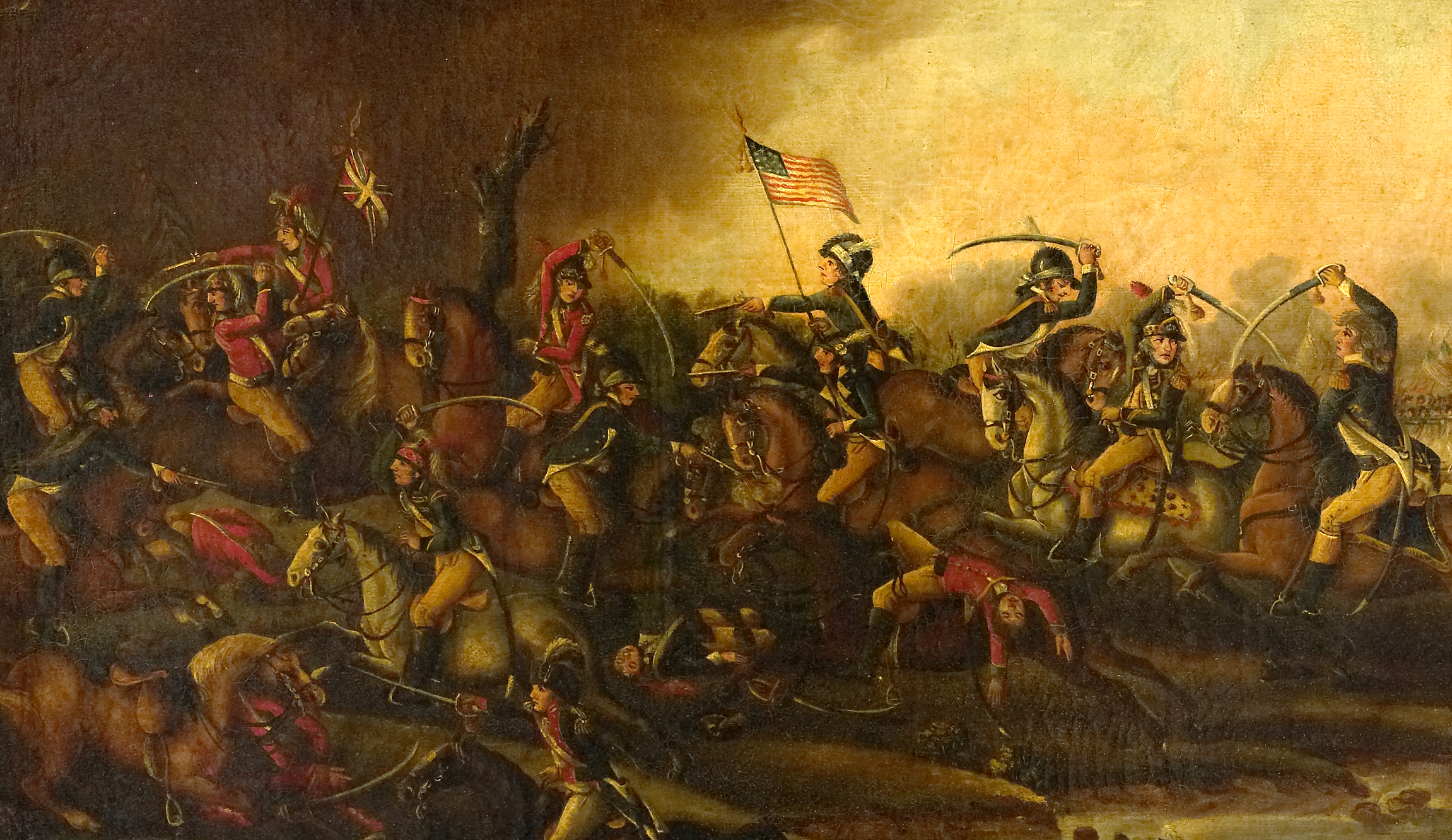
Even as Howard began to retreat with the American line, William Washington had not yet responded to the British main advance. Morgan’s own response to the British gains on the American right did not involve Washington charging the British left.[20] Acting on his own, Washington perceived the greater immediate threat to be the passing of the American left by the 17th Light Dragoons. A far greater threat than the attack on the American militia would have been the presence of an enemy cavalry force on the flank of the American line or, worse yet, in the American rear. Washington hit the 17th Light Dragoons’ right as the militia reached their horses. The British had become scattered, and Washington’s charge was “sudden and violent” lasting only a few minutes.[21] Howard was clear in placing Washington’s response to the threat on the American left at the same time as the threat on the American right:
As well as I can recollect this charge was made at the same moment that I charged the infantry, for as soon as we got among the enemy and were making prisoners I observed the enemy’s cavalry retreating the way they had advanced, by our left flank and he followed them some distance – you will observe by this statement that Washington’s charge had no connexion with mine as his movement was to the rear in a quite different direction.[22]
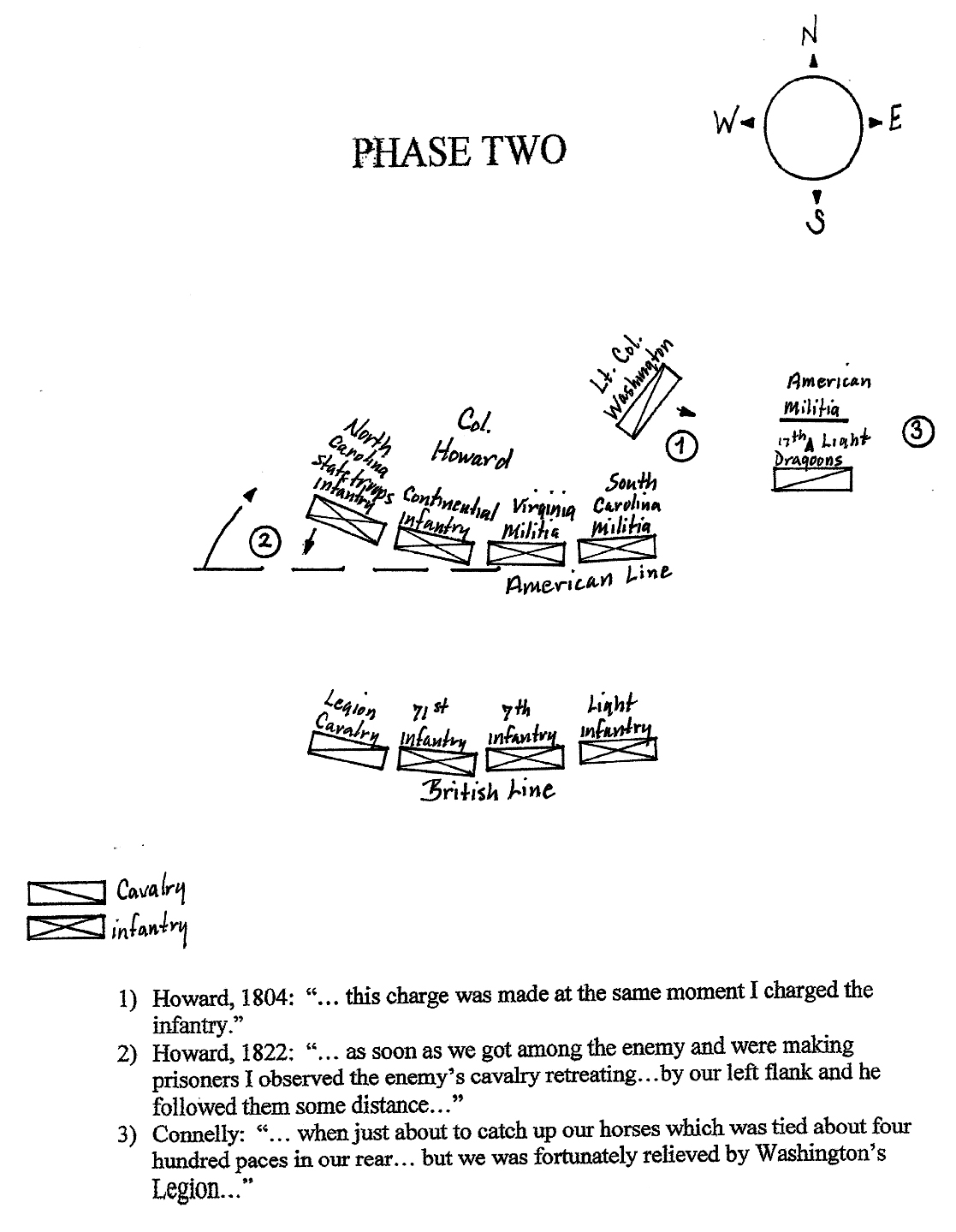 He stated again later: “Washington observing this made a charge upon them and drove them from the ground and pursued them round our left flank . . . This was at the Time we were advancing upon the enemy.”[23] Both American flanks were at risk of being turned at the same time and Howard’s charge in response to the right threat and Washington’s charge in response to the left threat occurred simultaneously.
Phase Three: Washington charges the broken British right flank
Once Washington repulsed the 17th Light Dragoons, he pursued them beyond the American left flank. He then found himself in an ideal position—in the British rear. In addition, Howard’s charge on the American right left the British in a confused, staggering state:
As the enemy repassed our left flank they received a severe fire from the company on the left. This was at the time we were advancing on the enemy—When Washington passed our flank he discovered the broken enemy endeavoring to form and he called on our infantry on the left to support him. The infantry of the enemy were taken.[24]
 James Simons, who participated in the battle as a cornet under Washington, wrote “your third charge was made on the right wing of their Army, composed of their Legionary Infantry, intermixed with the Battalion of the Brave 71st . . . And who, under the operation of a universal panic, (having been successfully charge on the left of their Army by our friend Col Howard) instantly surrendered.”[25]
Militia captain Henry Connelly is often quoted at this point of the battle, mostly in support of an American cavalry charge on the American right. Connelly stated that he was on the right flank, and then described “Washington’s Legion” as assisting his unit.[26] Connelly’s statements of being on the right flank only places him in the militia line.[27] Connelly said,
the company which belonged to this applicant was placed under a Col. Howard on the extreme right flank of the division and this applicant commanded a company in the action our company when just about to catch up our horses which was tied about four hundred paces in the rear of the line of Battle fell upon us with great fury but we was fortunately relieved by Washington’s legion.[28]
Connelly was not describing a charge by Washington on the American right. He was describing the first charge by Washington against the 17th Light Dragoons in the American left rear.
Additionally, the uncited quote attributed to Washington, “They are coming on like a mob, give them a fire and I will charge them”[29] is usually placed in sequence after Washington “returns” to the American rear and in support of Howard’s infantry charge.[30] However, it must be remembered that Howard commanded the whole American line, right and left, and by his own statement, Washington called on the infantry of Howard’s left to support him.
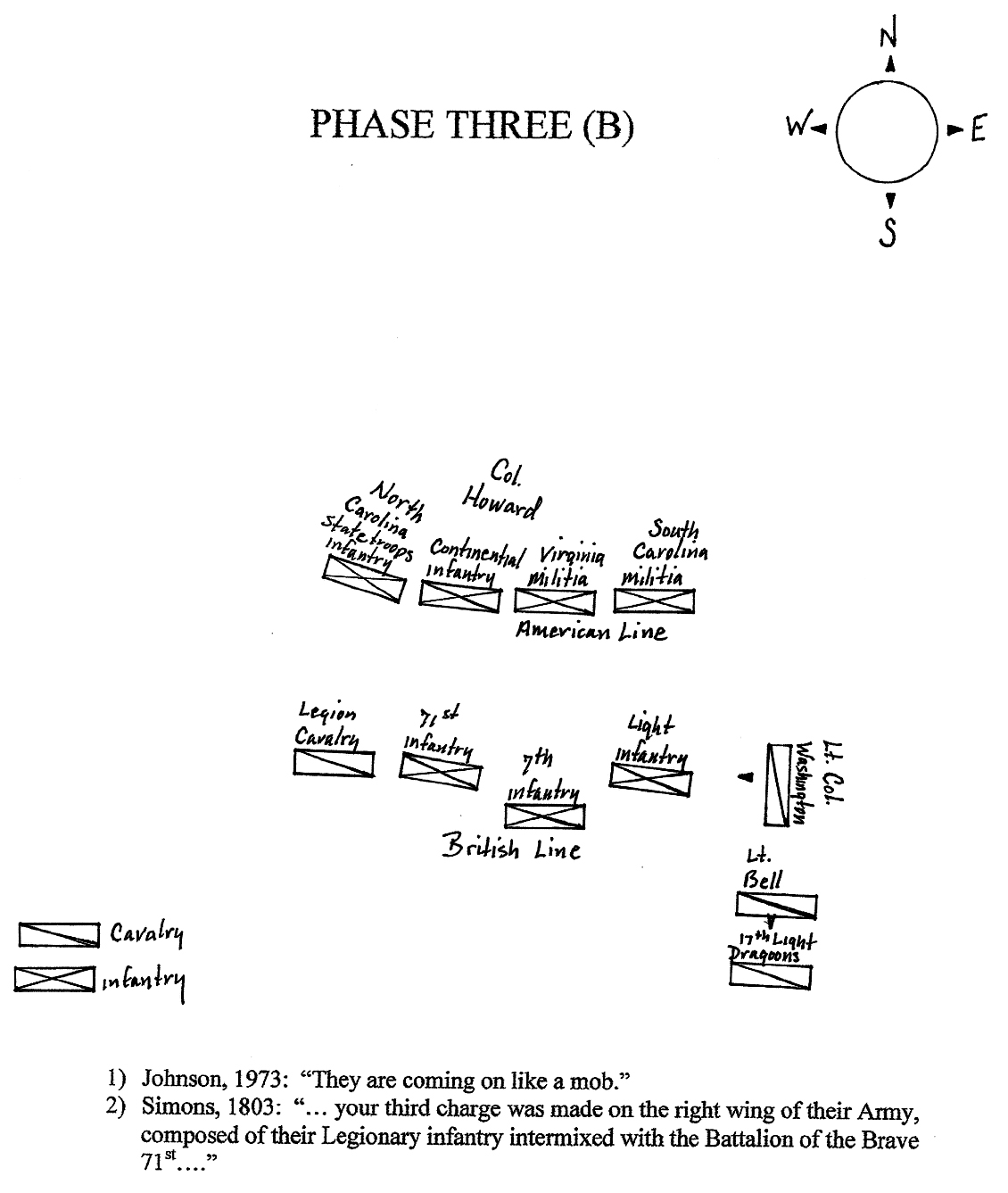 The Washington quote is often shortened from historian William Johnson’s narrative of the battle.[31] The corresponding text reads:
Morgan also under the impression that the movement was made under the order of Howard, rode along the rear of the line, reminding the officers to halt and face as soon as they reached their ground. But just at that crises they were accosted by another officer, and their attention was drawn to some facts which produced an immediate change of measures. This officer was a messenger from Colonel Washington, who having been carried in pursuing the enemy’s cavalry some distance in advance of the American line, found the right flank of the enemy wholly exposed to him, and had a fair view of the confusion existing in their ranks. ‘They are coming on like a mob, give them a fire and I will charge them,’ was the message delivered, and the messenger gallopped back to join his command.[32]
The House of Cards
The following sequence of American cavalry action at the Battle of Cowpens is proposed. The American main line and the British line faced each other without intermingling after the retreat of the American militia to the rear. Tarleton ordered the 17th Light Dragoons to turn the American left flank while the 71st Foot and the British Legion Cavalry turned the American right flank. Howard’s right began the retreat while the 17th Light Dragoons were passing his left. The American militia had not fully formed in the American rear, and the 17th Light Dragoons hit them. Washington perceived this and acted to counter the threat to the American rear. This decision was made after Howard began to rally on Washington’s position in the rear. Washington decisively hit the 17th Light Dragoons, driving them back beyond the American left and into the British rear. The American right main line charged and drove back the British left, including the British Legion Dragoons. Washington found himself square on facing the exposed British right flank. Lt. Henry Bell set off in pursuit of the 17th Light Dragoons to keep them from returning to the fight. The reeling British units, now mixing together, began to fall back. Noting this confusion, Washington sent a messenger to the American left main line to fire on the British as a prelude to his charge on the flank. Washington’s charge rolled up the British right flank, encountering Legion Infantry, Light Infantry, and the 7th Regiment of Foot. The encounter between the American cavalry and the British 71st Regiment of Foot and Legion cavalry occurred in the British rear, as Washington rolled up the line, hitting those repulsed and fleeing from Howard’s charge. The British line collapsed like Frederick the Great’s house of cards.
Notes on Washington’s Force
The exact way that Washington organized his force on a tactical level may never be understood. By the end of the eighteenth century, cavalry organization fell into two categories, administrative and tactical. [33] During 1781, troop structure may have been kept but how this played out between large battles is not clear. Based on common European eighteenth-century tactics, the detachment commanded by Washington probably acted more as a “squadron,” usually consisting of two troops. Washington’s force consisted of approximately seventy-two troopers.[34] Commanding these men were Washington himself, Maj. Richard Call, Capt. William Barrett, Lt. Henry Bell, and Cornet James Simons.[35] With the exception of one captain, this matches the return of numbers present on January 5, 1781. The number of troopers present was not much greater than that prescribed for one troop and closely reflects the number of present fit for duty troopers on January 5.[36] There is no evidence for any other Continental cavalry officers at the Battle of Cowpens. Exactly how the state and militia dragoons operated and organized is open to speculation. Uniting them under their own command as a separate squadron, likely under James McCall, would have made the most operational sense.
Much has been made of Washington’s order not to use firearms. While this usually is pointed out as reflective of Washington’s personality and preference, the use of only sabers during a charge was common, accepted practice by eighteenth-century cavalry. Rather than this indicating that Washington was not especially bold, it serves to reinforce that Washington had been influenced by established European practice.
Conclusion
Existing sources for the Battle of Cowpens provide confusing information regarding cavalry action. The late stages of the battle were confusing. The intermixing of British units only adds to the confusion of the sources. However, most of the participants’ statements, when taken in the proper context, support a classic cavalry action executed by William Washington on the British right flank and in the British rear. A complicated explanation of Washington’s movements is not necessary when the sources are viewed through the lens of eighteenth-century cavalry practice.
Confusing aspects remain. One is a statement by Thomas Young: “I recollect well that the cavalry was twice, during the action, between our army and the enemy.”[37] This could suggest that the cavalry was in front of the American main line covering the retreat of the American militia. Another are two statements from William Gordon in his history that seem to contradict each other; either could be pulled out and used to support a position. “Col. Ogilve, with his troop of forty men, had been ordered to charge the right flank of the Americans, and was engaged in cutting down the militia; but being exposed to heavy fire, and charged at the same time by Washington’s dragoons, was forced to retreat in confusion.”[38] This author believes that Gordon is confusing Ogilvie’s charge on the American right with Nettles’ charge on the American left. “Lieut. Col. Howard seized the favorable opportunity, rallied the continentals, and charged with fixed bayonets, nearly at the same moment when Washington made his successful attack.”[39] While the first quote has been used to support a cavalry charge by Washington from the American rear on the American right, this author believes that the second quote supports the above statements regarding the timing of Howard and Washington’s charges. It is the author’s conclusion that Gordon’s first statement confuses the actions of the British Legion Dragoons and the 17th Light Dragoons. This has only served to compound the difficulty of understanding the cavalry at Cowpens.
Washington’s coup d’oeil, and his understanding of established European cavalry doctrine, was demonstrated in the American victory at Cowpens and would be instrumental in future American success in the southern theater.
Acknowledgements
The author would like to thank Dr. Jim Piecuch and the late Charles B. Baxley for encouragement and editorial support, and Shane Ciminel for his hard work in creating maps to accompany this article.
[1] See: Lawrence Babits, Devil of a Whipping (Chapel Hill: University of North Carolina Press, 1998) and Daniel Murphy, “The Cavalry at Cowpens: Thinking Inside the Box,” Southern Campaigns of the American Revolution, 3, No. 2 (February 2006), 23-27; John Eager Howard to unknown recipient (possibly William Johnson), c. 1822, courtesy of Samuel K. Fore; Edwin C. Bearss, The Battle of Cowpens (Johnson City, TN: Overmountain Press, 1996); John Moncure, The Cowpens Staff Ride and Battlefield Tour (Fort Leavenworth, KS, US Army Command and General Staff College, 1996).
[2] Charles F. Price, Nor the Battle to the Strong: A Novel of the American Revolution in the South (Savannah, GA: Frederic Beil, 2008).
[3] Lee F. McGee, “Foundations of Revolutionary Mounted Troops: European Cavalry Doctrine in the Eighteenth Century,” The Cavalry and Armor Journal, No. 16, 5-11; Lee F. McGee, “European Influences on Continental Cavalry,” in Jim Piecuch, Ed, Cavalry of the American Revolution (Yardley, PA: Westholme Publishing, 2012).
[4] Jay Luvaas (trans.), Frederick the Great on the Art of War (New York: De Capo Press, 1999), 153-154.
[5] Ibid., 149.
[6] TR Phillips, Roots of Strategy (Mechanicsburg, PA: Stackpole Books, 1985), 296.
[7] See Babits, A Devil of a Whipping, for an overview of the battle.
[8] See, for example, Babits, A Devil of a Whipping, 97-98, Murphy, “The Cavalry at Cowpens.”
[9] Banastre Tarleton, A History of the Campaigns of 1780 and 1781 (North Stratford, NH: Ayer Company Publishers, 1999), 216.
[10] John Eager Howard to John Marshal, 1804 (Maryland Historical Society, Bayard Collection), courtesy of Lawrence Babits; and John Marshall, The Life of George Washington (Philadelphia: CP Waye, 1805).
[11] Howard to unknown, 1822; William Johnson, Sketches of the Life and Correspondence of Nathanael Greene (New York: De Capo Press, 1873).
[12] Howard to Marshall, 1804; Howard to unknown, 1822.
[13] Babits, A Devil of a Whipping, 126 and Murphy, “The Cavalry at Cowpens,” 25.
[14] Tarleton, A History of the Campaigns, 2016.
[15] Roderick MacKenzie, Strictures on Lt. Colonel Tarleton’s History (London: R Jameson, 1787), 109.
[16] Howard to unknown, 1822.
[17] Howard to Marshall, 1804.
[18] Howard to unknown, 1822.
[19] Statement of Robert Long in John H. Logan, A History of the Upper Country of South Carolina (Greenville, SC, 1980), 6; see also Babits, A Devil of a Whipping, 98, and Murphy, “The Cavalry at Cowpens,” 24. The detachment of the British 17th Light Dragoons probably consisted of no more than fifty troopers.
[20] Long, in Logan, A History of the Upper Country of South Carolina, 6.
[21] Regarding Washington’s role as the reserve, it is unlikely that Washington, with his corps serving as the reserve, would have formed a “reserve” for himself with this first charge. Washington did form a reserve at Rantowles Bridge on March 26, 1780. Baylor Hill, A Gentleman of Fortune: The Diary of Baylor Hill, First Continental Dragoons, 1777-1781 (Fort Lauderdale, FL: The Saddlebag Press, John T. Hayes, ed., 2002), 50. However, in that situation Washington commanded the whole force, an entirely different role than the one he filled at Cowpens. In addition, an action by a cavalry reserve in the eighteenth-century warfare had the potential to decide a battle. A cavalry reserve would have been expected to remain intact (Dr. Christpher Duffy, personal correspondence with the author, July 22, 2007), Howard to Marshall, 1804, and Howard to unknown, 1822.
[22] Howard to Marshall, 1804.
[23] Howard to unknown, 1822.
[24] Ibid.
[25] James Simons to William Washington, 1803 (National Archives), courtesy of Lawrence Babits.
[26] Henry Connelly, W8188, Federal Pension Application (National Archives) www.revwarapps.org. See for example Murphy, “The Cavalry at Cowpens,” 24-25 and Patrick O’Kelley, Nothing but Blood and Slaughter: The Revolutionary War in the Carolinas, Vol. 3 (Blue House Tavern Press, 2005), 45.
[27] Babits, A Devil of a Whipping, 76.
[28] Connelly, W8188.
[29] Johnson, Sketches, 381.
[30] Babits, A Devil of a Whipping, 127, Murphy, “The Cavalry at Cowpens,” 25 and O’Kelley, Nothing but Blood and Slaughter, 45.
[31] Babits, A Devil of a Whipping, 127, Murphy “The Cavalry at Cowpens,” 25 and O’Kelley, Nothing but Blood and Slaughter, 45.
[32] Johnson, Sketches, 281.
[33] Christopher Duffy, The Army of Maria Theresa: The Armed Forces of Imperial Austria, 1740-1780 (New York: Hippocrene Books, 1977), 91 and The Army of Frederick the Great (Chicago: Emperor’s Press, 1996), 163.
[34] James Martin pension, S9392, www.revwarapps.org.
[35] Edward Giles, A list of the commissioned officers in the action of the 17th January, 1781, www.fold3.com, US Continental Congress- Papers; Letters from General Nathanael Greene, 1:547.
[36] Frederick Steuben Papers, NYHS microfilm, Return to the 3rd Regiment of Light Dragoons, January 5, 1781.
[37] Thomas Young, “Memoir of Major Thomas Young,” Orion, 3, 1843.
[38] William Gordon, The History of the Rise, Progress and Establishment of the Independence of the United States of America (Freeport, NY: Books for Libraries Press, 1969), 34.
[39] Gordon, The History of the Rise, Progress and Establishment, 35.

One thought on “Coup D’oeil: William Washington at the Battle of Cowpens”
It is my understanding that it was The Old Waggoner that positioned Washington on the Army’s left rear, for the purpose of screening the retreating militia that Morgan directed to retreat around the Army’s left flank. Considering Morgan’s tactical genius, he may have been hoping the sight of the militia retreating pell-mell would entice a British Pursuit that could be dealt a reverse. It seems that Daniel Morgan had a more far-sighted version of the Coup D’Oeil! It was widely reported that Morgan spent the eve before the battle discussing and encouraging all his troops, moving from camp-fire to campfire far into the hours of the morning. It’s more than plausible that he discussed, in great detail, Washington’s role in the coming fight. In the event, the militia circled all the way around the rear of Eager’s line to emerge on the Right Flank and taking the charging British infantry in the flank. While much in battle is left to chance, there is too much careful positioning, and then an all night inclusive serial discussion of what everybody’s role would be in the coming fight to believe it was all chance! Without Washington’s charge, the militia would not have been able to scamper around the rear to emerge unexpectedly on the British Left Flank.