


As the Revolutionary War began, the fledgling Continental and state governments were faced the huge burden of holding and provisioning thousands of captured enemy soldiers and insurgent Loyalists. In 1776, prisons were improvised across the states—with the infamous Simsbury Mine in Connecticut as the most notable example.[1] By the end of the year, a chain of prisons existed along the Appalachian Piedmont from Virginia to New York.
Detaining local criminals, even violent ones with Loyalist leanings, nonetheless remained primarily a local responsibility. In war-torn localities such as those stretching around British-occupied New York City, armed resistance to the Revolution intermingled with violent crime; large numbers of dangerous criminals soon overwhelmed the small county prisons of farm counties.[2] A narrative about the Monmouth County Gaol (in Freehold, New Jersey) and the climactic jailbreak of February 1781 provides a case study.
The Monmouth County Gaol, 1776-1780
The Monmouth County Gaol was in the basement of the Monmouth County Courthouse in Freehold. While no surviving document describes it in detail, it can be gleaned from a smattering of documents that the prison consisted of few rough rooms that were never expected to house dozens of dangerous prisoners at the same time.
In November 1776, roughly 200 Loyalist insurgents were taken by troops and militia led Colonels David Forman and Charles Read.[3] The insurgents were never confined in the county. They were marched to the jail in Philadelphia—and then further west to Lancaster, Pennsylvania and on to Frederick, Maryland.

In early 1777, the Monmouth County Gaol swelled with prisoners brought in by Col. Francis Gurney’s regiment of Pennsylvanians (sent into the county crush a simmering Loyalist insurrection).[4] The county gaol was not up to the task. William Perrine was one of the Loyalists who escaped at that time. After the war, he wrote:
He was applied to by agents of Congress to sign a paper called the Association, and on refusal of the same was deemed an enemy to my country and committed to close confinement, from thence I found means to break prison & escape to the British Army and left my house and family to the mercy of my enemies.[5]
In March, several Monmouth County leaders petitioned the New Jersey legislature about the insecurity of their jail:
The gaol of said County has been frequently broken out, and prisoners rescued; and praying that their Magistrates may be empowered, in extra-ordinary cases, to send disaffected persons out of the County to be confined.[6]

The petitioners apparently received permission to move prisoners outside the county. In April, dangerous prisoners Jesse Woodward and Richard Robins and a few other Loyalist insurrectionists were sent off and jailed in distant Sussex County.[7]
In the spring, the militia re-organized and began serving at Freehold as prison guards. Josiah Dey wrote of this service that he:
was a considerable time stationed at Monmouth Court House to guard the prisoners confined in jail and prevent their being liberated by the enemy, and served as one of the guards to remove the prisoners thereupon to the jail in Burlington County.[8]
Another militiaman, John G. Holmes, wrote that his company was “stationed at Monmouth to guard the prisoners then in jail, as the jail was not thought sufficiently strong.”[9]
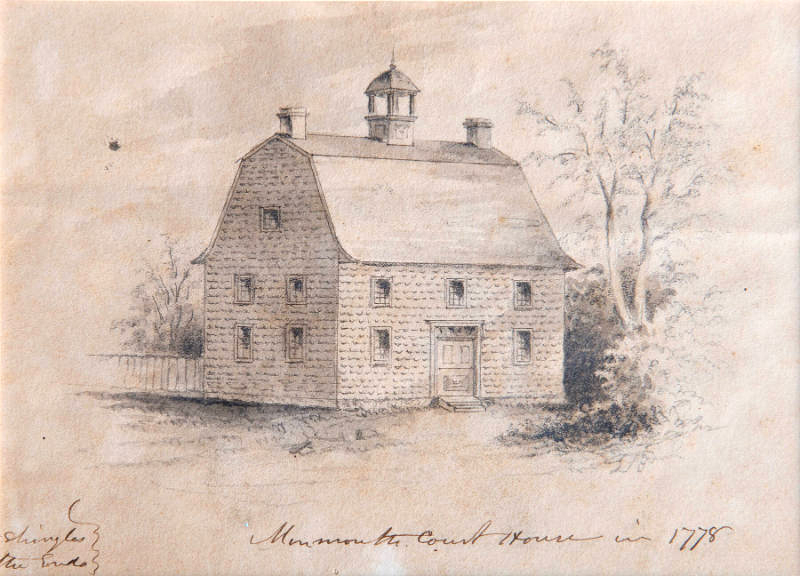
In January and May 1778, Monmouth County’s gaol swelled with dozens of prisoners in anticipation of Courts of Oyer and Terminer, special courts convened to adjudicate severe and war-related crimes. At the 2nd Court of Oyer and Terminer, which carried into June 1778, twelve men were sentenced to death (some were then quickly pardoned by Governor William Livingston). On June 22, Baptist Minister Abel Morgan ministered to the condemned men. He wrote: “At the request of some prisoners, I preached to 8 under sentence of death. A moving sight.”[10]
Executions did not come quickly. The British Army was marching across New Jersey and encamped in Allentown on June 25, heading toward Freehold. That same day, Sheriff Nicholas Van Brunt took the condemned men to Morristown. But another felon housed in the jail, Chrineyonce Van Mater, remained in jail. He was freed by the British on June 27. The Pennsylvania Gazette reported:
The court sentenced him to pay a fine of £300 and to suffer six months imprisonment. We hear that the enemy in their late passage through that country released Van Mater; who, after having piloted them through his neighborhood, went off with them to New York.[11]
Mistreatment of prisoners in the county jail began after the British Army burned a dozen homes near Freehold immediately before the Battle of Monmouth on June 28, 1778. This gratuitous act no doubt stoked local resentments.[12] At least two prisoners died in the county jail afterward. Joseph Williams wrote that his brother Obadiah “was taken prisoner & confined in the dungeon in Freehold gaol, until he was emaciated & soon after died.”[13] James Pew, a Loyalist boatman, was captured while visiting family. Pew was murdered by the prison sentry, James Tilley, who shot him in his prison cell.[14]
In late 1779, increased Loyalist partisan activity led to increased captures and detentions. In October, Sheriff Van Brunt again transported prisoners out of the county, this time to Burlington. Meanwhile, conditions in the Monmouth County Gaol worsened. In March 1780 the jailkeeper, William Lawrence, complained about Maj. Henry Lee, who had “taken charge of and maintained a number of different prisoners confined for different crimes and misdemeanors.”[15] This surge of prisoners led Kenneth Anderson, the county clerk, to write to the governor about “several prisoners, committed for sundry most atrocious robberies perpetrated in this county.” Anderson was “apprehensive that the prisoners may effect an escape.”[16]
In August 1780, a Loyalist raiding party penetrated inland as far as Colts Neck, just five miles from Freehold. Chief Justice David Brearley, worried about an attack on the county jail, writing, “there is a design to rescue them [Loyalist prisoners] by a party from the Pines.”[17] This, again, prompted prisoners to be moved out of the county. In September, a “List of Prisoners of War in Monmouth Gaol to be Sent to Philadelphia” was compiled; it included six British sailors, five British soldiers, and five local Loyalists.[18]
The Prison Break of February 1781
In late 1780, David Rhea, the county quartermaster agent, wrote that a food shortage at the county jail was causing unrest, “as there are a number of prisoners, very impudent, in the gaol now.”[19] Days later Col. David Forman foiled a near-escape:
We now have some atrocious villains in gaol & they would have made their escape had I not providentially discovered them and had them secured in irons—no guard having been kept at the court house since the elections.[20]
While Forman may have stopped this attempted prison break, he did not stop the next one. On February 6, 1781, the New Jersey Gazette reported:
On the night of the 4th instant, the prisoners in the gaol of the County of Monmouth made their escape by sawing off their irons and some of the window grates; it is thought that the sentry was remiss in his duty. Among those who escaped were Humphrey Wade and Joel Parker, both under sentence of death for horse stealing. There were several others who were charged with capital offenses; one of whom, of the name DeNight (together with a Negro man) was retaken.[21]
The Monmouth County prisoners may have been inspired by five Monmouth County prisoners who escaped from Philadelphia three weeks earlier, on January 10. The Loyalist New York Gazette reported:
The following persons arrived in this city, they have been made prisoners by the Rebels and confined in Philadelphia gaol, from whence they fortunately escaped on the 10th inst., a reward of $2000 was published for apprehending them.
The five Philadelphia escapees included Chrineyonce Van Mater, who had been freed from jail in Freehold in June 1778 only to be retaken in the summer of 1780.[22]
The prisoners who escaped the Monmouth County jail on February 4 likely committed a robbery in Upper Freehold the day after their escape. The New Jersey Gazette reported, “at eleven o’clock in the forenoon, a certain Samuel Read of Philadelphia, being on his way to Freehold in Monmouth County, was robbed by three villains, disguised in frocks and trousers, of sixty guineas, twenty half Joes and nine hundred Continental dollars.”[23]
Chief Justice Brearley wrote Governor Livingston about the escaped convicts on February 6:
The following persons were capitally convicted and sentenced to be hanged on Friday next, Robert James for High Treason . . . Humphrey Wade and John Parker for Horse Stealing, their cases are very clear—they were in the company of stolen horses, and taken together at a place called Squankum in Shrewsbury. They acknowledged that they stole the horses out of the pasture of John Coward of Upper Freehold. Wade is an elderly man, Parker is a youth about seventeen.[24]
James would be pardoned by Livingston on March 20. Three Loyalist robbers apparently were quickly retaken and immediately hanged. On February 8, the Royal Gazette reported: “On Thursday last, three Loyalists were put to death, on a gibbet in Monmouth County, New Jersey, their crime being an attachment to the old Constitution.”[25]
Problems at the Monmouth County Gaol Continue, 1782
In April 1782, Richard Lippincott, a captain in the para-military Associated Loyalists (who would soon be scandalized for the extra-legal hanging of Captain Joshua Huddy), proposed a raid against Freehold to free Clayton Tilton, an Associated Loyalist jailed there. Samuel Blowers of the Board of Associated Loyalists summarized the plan:
Captain Lippincott then proposed to make an expedition against the Jerseys with a view to force the gaol in Monmouth County, with a party of about thirty Loyalists, and to rescue Clayton Tilton.[26]
If a party of thirty might travel twenty miles inland and open the county jail, it could not have been very heavily guarded. While Lippincott never made it to Freehold, Tilton did escape. He wrote after the war:
He had the great misfortune of being made a prisoner by the rebels, who tried him by their own laws for High Treason against the State & condemned him to be hanged for his loyalty, but he had the good fortune to be rescued, and got safe again to British lines in New York.[27]
Clayton Tilton’s brother Ezekiel was jailed in Freehold just three months later. Elizabeth Tilton, Ezekiel’s wife, appealed to British leadership to intervene with a prisoner exchange:
He is carried to Monmouth Gaol and confined, and it is reported as a State prisoner—So much oppressed with close and heavy irons that his flesh is in a state of mortification, in which apartment [cell] one of his neighbors [James Pew] has been shot & murdered without provocation, and others led to the gallows for their loyalty.[28]
Another Loyalist taken that summer, Peter Stout, claimed that he was extorted into forfeiting his claim to the family estate while confined in the county jail. He wrote:
He was about the month of August 1782 taken prisoner by the Americans & confined in Freehold gaol for near four months, after which he was exchanged upon giving bond & security in £1000 that he would not leave the county, but should return to gaol when called for.
When Stout sought to return to New York, he ran into problems with Sheriff John Burrowes. The sheriff, “absolutely refused suffering the deponent to come within British lines and discharging his security bonds” and jailed Stout again. Stout continued:
Upon which the deponent’s mother conveyed her right to the deponent’s confiscated estate unto Mr. John Burrowes, the purchaser thereof, upon which being done, the deponent was retrieved from irons, and discharged from the dungeon. [29]
Historian David Fowler noted that John Bacon, the Loyalist partisan leader, was captured in 1782. David Forman, now a judge, secured a writ to put him in irons at a secret location rather than the county jail. The writ authorized Forman to “safely keep him close, confined in irons to answer charges of High Treason, murder and horse stealing.” Despite the exceptional confinement, Bacon escaped.[30]
Meanwhile, other dangerous prisoners continued to be sent out of the county and then returned for trial. In November 1782, Sheriff Burrowes paid Capt. John Walton for “bringing Edward Price, Peter Patton, Joseph Sheldon, John Okerson, Ezekiel Tilton, William Horner, Fuller Horner & others from Burlington to Monmouth gaol.”[31] The security of the Monmouth County Goal never really improved, but the threats to it diminished as the war ended.
Problems at Other New Jersey County Jails
Other counties also experienced difficulties at their county jails. The Burlington County jail, for example, had a number of problems during the Revolutionary War. David Fowler notes that in April 1780 Governor Livingston admonished the Burlington County sheriff for allowing three men to escape. The jailkeeper may have been complicit. In June 1781, the Burlington County sheriff requested funds to strengthen the jail “to prevent the escape of prisoners” and called for “a proper guard” for the insecure jail. No matter, a year later, William Giberson, a Loyalist partisan, escaped the jail by exchanging clothes and places with his sister and walking out.
Fowler documents problems at other county jails. The Sussex County jail, for example, had a number of prison breaks, prompting Justice John Cleve Symmes to write that prisoners “escape almost when they please.” October 1780, eight Loyalists escaped from the Cumberland County jail. Inland jails holding prisoners of war had their own problems—including overcrowding, shortages of provisions, and escapes. Throughout the war, a trickle of escaped prisoners of war seeking transport to British-held New York came into Monmouth County. Here they no doubt intermingled with some of the same Loyalist robbers discussed above.[32]
The difficulties at the Monmouth County jail were likely more acute than in most other places. But the vulnerability and mishaps at the Monmouth County Goal were not unique.
[1] Harry Schenawolf, “Simsbury Mine – American Revolution’s First National Prison,” Revolutionary War Journal, revolutionarywarjournal.com/simsbury-mine-american-revolutions-first-national-prison-a-dark-dismal-cavern-of-slippery-stinking-filth/.
[2] A good overview of increased local violence during the Revolutionary War is Harry M. Ward, Between the Lines: Banditti of the American Revolution (Westport, CT: Praeger, 2002).
[3] Michael Adelberg, “David Forman’s Campaign Against William Taylor’s Loyalists,” 250 for the 250th, Monmouth County Historical Association, 2025, www.monmouthhistory.org/250/formans-campaign-against-taylors-loyalists.
[4] Michael Adelberg, “Lt. Colonel Gurney’s Campaign Against Monmouth Loyalists,” 250 for the 250th, Monmouth County Historical Association, 2025, www.monmouthhistory.org/250/lt-col-gurneys-campaign-against-monmouth-loyalists.
[5] Loyalist compensation application of William Perrine is on microfilm at Rutgers University Special Collections, Great Britain Public Record Office, Loyalist Compensation Claims, D96, AO 13/19, reel 6 and AO 13/111, reel 10.
[6] The March 1777 petition is in New Jersey Votes of the Assembly, March 3, 1777, p. 90, Library Company, Philadelphia, PA.
[7] See David J. Fowler’s Egregious Villains, Wood Randers, and London Traders The Pine Robber Phenomenon in New Jersey During the Revolutionary War, PhD Dissertation, Rutgers University, 1987.
[8] Josiah Dey’s Revolutionary War pension application, National Archives and Records Administration, Washington, DC (NARA).
[9] John G. Holmes’s Revolutionary War pension application, NARA.
[10] Michael Adelberg, “Second Monmouth County Court of Oyer and Terminer,” 250 for the 250th, Monmouth County Historical Association, 2025, www.monmouthhistory.org/250/second-monmouth-county-court-of-oyer-and-terminer.
[11] Van Mater’s release is printed in Pennsylvania Gazette, July 14, 1778.
[12] Michael Adelberg, “British Plundering and Arson at Freehold, June 27-28, 1778,” 250 for the 250th, Monmouth County Historical Association, 2025, www.monmouthhistory.org/250/british-plundering-and-arson-at-freehold.
[13] Loyalist compensation application of Joseph Williams, Rutgers University, Special Collections, Loyalist Compensation Applications, Coll. D96, PRO AO 10/20, reel 7
[14] Michael Adelberg, “The Disaffection of Rhoda Pew and Murder of James Pew,” 250 for the 250th, Monmouth County Historical Association, 2025, www.monmouthhistory.org/250/the-disaffection-of-rhoda-pew-and-murder-of-james-pew.
[15] William Lawrence’s petition is in New Jersey Votes of the Assembly, March 1, 1780, p. 132, Library Company, Philadelphia, PA.
[16] Kenneth Anderson to William Livingston in New Jersey State Archives, William Livingston Papers, reel 11, April 27, 1780.
[17] Brearley’s letter is excerpted in Fowler’s Egregious Villains, p. 242.
[18] See “A List of the Prisoners of War in Monmouth Gaol to be Sent to Philadelphia by order of the Governor and Council of the State of New Jersey,” American Philosophical Society, Prisoners of War collection, item #66.
[19] David Rhea to Moore Furman, New Jersey State Archives, Dept. of Defense, Revolutionary War, Numbered Manuscripts, #5591-5592.
[20] David Forman’s letter is in David Forman to William Livingston, New York Public Library, William Livingston Papers, vol. 3, pp. 55-58.
[21] New Jersey Gazette, February 6, 1781, microfilm, Library of Congress.
[22] New York Royal Gazette, Library of Congress, Rivington’s New York Gazette, reel 2906, January 20, 1781.
[23] The robbery of Samuel Read was printed in the New Jersey Gazette, re-printed in William Horner, This Old Monmouth of Ours (Freehold: Moreau Brothers, 1932), 162.
[24] David Brearly to William Livingston, in Carl Prince, ed., Papers of William Livingston (New Brunswick: Rutgers University Press, 1987), 4:139-40.
[25] Royal Gazette, February 8, 1781.
[26] Samuel Blowers’s statement is in the transcript of the Court Martial of Richard Lippincott, printed in Howard Peckham, Sources of American Independence: Selected Manuscripts from the Collections of the William L. Clements Library (Chicago: University of Chicago Press, 1978), 562.
[27] Clayton Tilton’s Loyalist compensation application, Rutgers University, Special Collections, Loyalist Compensation Applications, Coll. D96, PRO AO 10/20, reel 7 and AO 13/112, reel 10.
[28] Elizabeth Tilton to Gen. Guy Carleton, Elizabeth Tilton to Guy Carleton, Great Britain National Archives, British Headquarters Papers, #5097.
[29] Peter Stout, Affidavit, Great Britain National Archives, British Headquarters Papers, #9154, 9177.
[30] Fowler, Egregious Villains, 252.
[31] The list of prisoners is in, New Jersey State Archives, Dept. of Defense, Revolutionary War, Numbered Manuscripts, #4100.
[32] The discussion of prison difficulties in other New Jersey Counties is in David J. Fowler, The State of New Jersey versus Joseph Mulliner, 1781 (unpublished manuscript).


One thought on “The Monmouth County Gaol and the Jailbreak of February 1781”
Insurrectionist is defined as a person who participates in an armed uprising, rebellion, or violent resistance against an established government or authority. So were the Loyalists insurrectionists or were the Patriots?