



John L. Linn, born March 21, 1738, was most likely the son of John and Elizabeth Linn of Philadelphia and was baptized on April 3 of the same year.[1] He was apparently one of the early graduates of the Philadelphia College of Medicine where he earned his medical degree.[2] Linn is not listed as a graduate of a college in the Publications of the Colonial Society of Massachusetts which listed Boston physicians from 1760-1798, perhaps because he did not remain in Massachusetts. He was denoted as part of the Whig party. No religion was listed, which may align with some sources that said he was most likely a Presbyterian; no Presbyterians are listed in the Massachusetts listing of religions. Linn is listed as having military experience.[3]
That military experience began when joined the 18th (Royal Irish) Regiment of Foot as its surgeon’s mate in the summer of 1774 while the majority of the regiment were stationed in Philadelphia. Linn replaced Edward Hand who was promoted to ensign and would later serve as a general in the Continental army. Linn appears in the return for the general’s company on February 8, 1775 at New York City, but since that return covered the period beginning in June 1774, he almost certainly joined the regiment in Philadelphia. The returns completed in July 1774 show Hand as the Mate, although absent for the period through June 24.[4]
The 18th Foot’s officer corps was fractious while Linn served with the regiment. In New York City, he appears to have been aligned with Lt. Alexander Fowler and Ens. Nicholas Trist, which would have been enough to cause him discomfort with the other officers of the regiment, as both were apparently sympathetic to the Continental cause.[5] When Capt. Benjamin Charnock Payne was tried by a general court martial in Boston later in 1775 on an assortment of charges brought by other officers of the regiment, Linn testified via an affidavit that during the winter of 1774-1775 in New York City, Payne had offered him one hundred pounds to poison the regiment’s Maj. Isaac Hamilton while he was under Linn’s care. Ensign Trist testified
that Mr. Lynne late Surgeon’s Mate to the 18th Regt. told him that Capt. Payne had desired him whilst Major Hamilton was under a Salivation to put him out of the way as he was grown childish, and a disgrace to the Regiment; & if he could comply with his request, he would himself give him an hundred pounds, and was certain that he would receive other rewards from the Officers[6]
It does not appear that the court found his testimony credible, as Payne was not found guilty of the charge of having “wickedly, impulsively, and of Malice aforethought, conceived and promoted a black and unnatural design against the life of his superior officer.” There were no repercussions for Linn, for he had already chosen another path.
When the five companies of the 18th Foot in New York prepared to leave for Boston, Linn told Major Hamilton he was not going with them. He stayed in New York and resigned his warrant as the surgeon’s mate effective on June 24, 1775. Though not arrested, he was later referred to as a rebel and a deserter by British officers.[7]
Lynn did side with the rebels. He was commissioned as surgeon of the 1st New York Regiment on June 30, 1775. The 1st New York was organized in and around New York City in the late spring of that year. The regiment was involved in the invasion of Canada including the failed attempt to take Quebec City on December 31, 1775, under Brig. Gen. Richard Montgomery. He served in this capacity until the regiment was reorganized on April 15, 1776.[8]
At that time, Linn transitioned to the Continental Hospital for the District of Quebec. He was the director of that hospital from September 1776 through January 1777. By March 28, 1777, Linn was listed as “senior surgeon of the General Hospital, Fort George,” near Lake George, New York.[9]
For reasons no longer extant, Linn traded his commission in the Continental Army for a place in the Continental Navy. He is listed as the Continental Ship Boston’s surgeon on July 16, 1777.[10] On October 9, Capt. Hector McNeill of the Boston wrote a letter of introduction to John Adams on Linn’s behalf as Linn was on his way to testify to Congress about the medical needs of the fledgling navy. In this letter, McNeill endorsed Dr. Linn’s petition to the Continental Congress advocating for better pay and conditions for naval medical officers. McNeill’s letter began:
This will be handed you by Doctor John L Linn, the Surgeon of our Ship, he goes to Congress with design to represent the hardships himself and others in that capacity suffer at present from the inadequate appointments of Surgeons on board the Navy.
The rest of the letter suggested that frigates should each be provided a surgeon in place of the captain of marines, who McNeill felt were “of no Service in life on board a Ship.”[11]
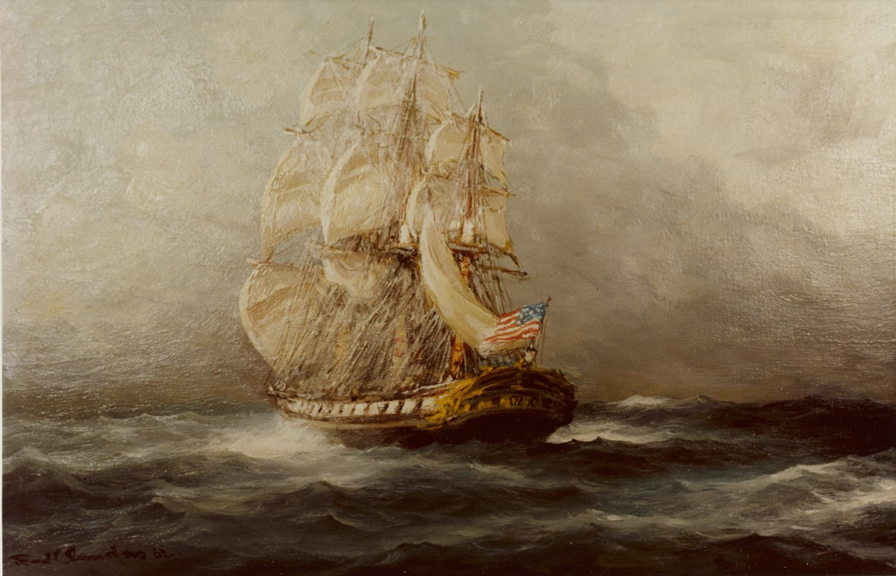
The Boston was a twenty-four-gun frigate launched on June 3, 1776, and considered by contemporaries well built.[12] She carried John Adams to France in early 1778 and then remained in the North Atlantic before being sent to defend Charlestown, South Carolina in early 1780. He likely remained as the surgeon of the Boston until she was captured by the British during the Siege of Charlestown on May 12, 1780. Linn then appears to have moved to Boston where he was listed by the town assessors as living in Ward 10.[13] At some point Linn married a woman named Jennet; two letters between them from 1779 survive.[14]
Linn returned to the sea when he served as the surgeon on board the thirty-six gun frigate Alliance, a “continental Vessel of War” from about November 1781 and remained with her until July 1782.[15] During that time the Alliance carried the Marquis de Lafayette home to France from Boston, landing at L’Orient, France on January 17, 1782. After disembarking Lafayette, the frigate sailed European waters looking to capture British vessels in order to force the exchange of American seamen held by the British. The voyage was unsuccessful, and the Alliance put in at L’Orient again on February 26. The ship remained in port until March 15 when they carried Benjamin Franklin’s diplomatic observations home from France. The Alliance was chased by a British man of war off the Delaware on May 10, and finally arrived at New London, Connecticut on May 15. Severe weather and poor winds contributed to the death of eight sailors.[16]
Capt. John Barry, who commanded Alliance, wrote to Robert Morris on August 2 that he received a letter from Linn on July 22 asking to be given leave to attend private business. Barry wrote,
I can assure you his private business was not the Inducement which actuated me to give him leave. He is naturally of a Weak Constitution, add to that he was Very disagreeable to the Officers in the Ward Room, and as my desire is, to Keep a Quiet Ship, I thought it best on the whole to get Clear of him[17]
His voyage on the Alliance appears to have been John Linn’s final military service. He continued to practice medicine in Boston and was one of the fourteen founding members of the Massachusetts Medical Society when it was formed on November 1, 1781.[18]
In September 1787, Lynn was present in Philadelphia where he was listed as a “doctor of physic” according to his affidavit at that time on behalf of the Trist family.[19] Lynn was listed as living at 70 East Water Street in the 1790 census, with a free white male under sixteen and four free white females also living in his dwelling. He is listed as “Doctor John Linn” but no profession was listed on the census record. There were three vacant lots on one side of his home and a blacksmith shop on the other.[20]
Linn died at during the Great Yellow Fever Epidemic of 1793 in Philadelphia while tending to the sick and dying. The epidemic appears to have begun at the Delaware River wharf in August. Linn was one of 5,000 people who died between August 1 and November 9. At the time, Philadelphia had a total population of only fifty thousand. Nearly one in ten residents died of yellow fever during those months of late 1793 making it one of the most severe epidemics in American history.[21]
A John Linn, possibly a son, was listed in the 1800 federal census for the east section of the Northern Liberties of Philadelphia. That household included two other free white men, one under ten and the other between sixteen and twenty-five years of age. Two of the four free white women were over forty-five; one may have been Linn’s widow, Jennet.[22]
Dr. John L. Linn’s life illustrates the mobility and dedication of Revolutionary-era physicians. He served on battlefields and aboard warships, then on the home front combating disease. Though not as famous as contemporaries such as Dr. Benjamin Rush or Dr. John Warren, Linn’s multi-faceted career as an Army surgeon and hospital director, a Navy surgeon, and a respected practitioner makes him a figure of considerable interest in early American medical history. His story is part of the broader narrative of how medically trained patriots were vital to both the war effort and the advancement of medical practice in the young United States. Linn’s varied career shows that he was most likely a competent, if not skilled, surgeon. He appears to have been esteemed by his peers as he was one of the founding fellows of the Massachusetts Medical Society and was sent by the Navy to advocate before the Continental Congress. But his ability to work well with others appears to have shifted depending upon the situation. He is one of only a few who served in the British Army, the Continental Army and the Continental Navy during the American Revolution.
[1] Baptismal and Burial Records, Christ Church, Philadelphia. Lynn is listed in other sources as being born in 1740 in New York.
[2] The college was also known as the College of Philadelphia medical school.
[3] Colonial Society of Massachusetts. Medicine in Colonial Massachusetts, 1620-1820: A Conference held 25 & 26 May 1778 (University Press of Virginia, 1980), 57, 96. This text lists his birth year as 1750. Only graduates of Harvard appear to be listed as college prepared physicians in the text.
[4] UK National Archives, War Office Series (WO), WO 12/3501, Returns of the 18th (Royal Irish) Regiment of Foot.
[5] Both other officers resigned shortly after the Revolution started. Fowler would eventually return to Pittsburgh and serve the Continental Congress and Trist moved to Louisiana where he died before the end of the war. Trist’s wife, Elizabeth House Trist would later live at Jefferson’s Monticello.
[6] WO 71/81, Court martial of Capt. Benjamin Charnock Payne, 94-95.
[7] Ibid.
[8] Roster of Officers of the 1st New York, April 15, 1776, Papers of the Provincial Congress.
[9] Frank A. Gardner, Military and naval history of Salem in the French and Indian Wars and the American Revolution, 1700-1782 (Essex Institute, 1935), 5:470.
[10] Alphabetical list of Officers and Men of the Frigate Boston (1777), continentalnavy.com/archives/2010/alphabetical-list-of-officers-and-men-of-the-frigate-boston-1777/.
[11] John Adams, Papers of John Adams, Massachusetts Historical Society (Digital Edition, 2025), 5:303-304.
[12] K. Jack Bauer & Stephen S. Roberts, Register of Ships of the U.S. Navy, 1775-1990: Major Combatants (Greenwood Press, 1991), 6.
[13] Assessors’ “Taking Books” of the Town of Boston 1780, 1780.
[14] Draper Manuscript Collection, 9VV: Daniel Stinson Papers, v. 9.
[15] Bauer & Roberts, Register of Ships, 7. The Alliance was originally named the Hancock but was renamed prior to being launched on April 28, 1778.
[16] Robert Morris to Thomas Russel, April 8, 1783, in The Papers of Robert Morris, 1781-1784, E. Jame Ferguson, ed. (University of Pittsburgh Press, 1973), 7:681. According to the US Navy, the USS Alliance was a 900-ton frigate mounting twenty-eight 12-pound and eight 9-pound guns. www.usni.org/magazines/naval-history-magazine/2008/august/alliance-last-continental-navy-frigate.
[17] John Barry to Morris, August 2, 1782, The Papers of Robert Morris, 6:132-133.
[18] Henry R. Veits, A Brief History of Medicine in Massachusetts (Houghton Mifflin, 1930), 106.
[19] Affidavit of John Lynn, September 15, 1787, Trist Papers, University of Virgina Archives.
[20] US Federal Census 1790, M637_9, Image 0347.
[21] Matthew Carey, A short account of the malignant fever, lately prevalent in Philadelphia: with a statement of the proceedings that took place on the subject in different parts of the United States (Printed by the author, 1793), 101; The editor of the Robert Morris Papers lists Linn’s death as 1793, as well. Morris The Papers of Robert Morris, 5:308
[22] US Federal Census, 1800, Census Place: Northern Liberties (East), Philadelphia, Pennsylvania; Roll 42; p. 330.


Recent Articles
The New Dominion: The Land Lotteries
The Home Front: Revolutionary Households, Military Occupation, and the Making of American Independence
A Strategist in Waiting: Nathanael Greene at the Catawba River, February 1, 1781
Recent Comments
"A Strategist in Waiting:..."
Lots of general information well presented, The map used in this article...
"Ebenezer Smith Platt: An..."
Sadly, no
"Comte d’Estaing’s Georgia Land..."
The locations of the d'Estaing lands are shown in Daniel N. Crumpton's...