




BOOK REVIEW: The Home Front: Revolutionary Households, Military Occupation, and the Making of American Independence by Lauren Duval (Charlotte: University of North Carolina Press) $45.00 hardcover
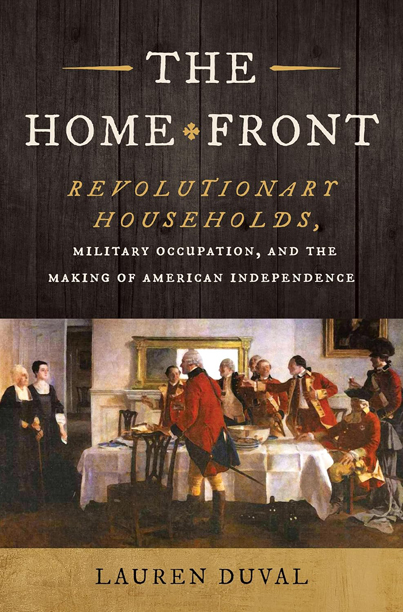
The Home Front by Lauren Duval, published by the Omohundro Institute of Early American History and Culture in conjunction with the University of North Carolina Press, offers a comprehensive and multifaceted examination of American colonial life under British occupation. Focusing primarily on urban life in New York, Philadelphia, Boston, and Charleston, Duval’s core arguments in The Home Front present the colonial American home as a microcosm of the social workings of the thirteen colonies—and the Revolution, in relation to the existing disparities and social structures of gender, race, class, and socioeconomic status. The war and occupations of the largest cities of the American colonies essentially meant a threat to the established social order where white landowning and/or wealthy men sat comfortably at the top. Not accustomed to being challenged or questioned, Duval contends that disempowerment within their own domains meant a threat to the patriarchal household. Furthermore, in “British common law, the household was a legal construction that embodied the relations of power that structured colonial society, where authority was vested in the male head of household who functioned as the legal, social, and political representative for his assorted dependents, including his family, servants, and enslaved people . . . [this law] upheld the hierarchies of race, gender, status, wealth, freedom and political power” (page 13). If colonial patriarchal authority equated households to “little monarchies” and plantations to “little kingdoms,” the British military invasion and occupation was a direct attack upon white, masculine authority in the colonies in that “property was an integral pillar of support [in bolstering] white men’s racial and gendered authority and serv[ing] as a means for its display” (p. 126).
 Despite the British threat to colonial homes, not all white men allied to the Continental cause had violent interactions with British soldiers and officers. On the contrary, men of similar social status and wealth could more easily put their political differences aside. Duval provides primary source examples of these social interactions, one regarding Col. Banastre Tarleton, explaining that some men’s “elite status could facilitate negotiation and resolution of civilian-military disputes over domestic spaces through mutual engagement in a transatlantic culture of genteel honor. . . . Anger could be begrudgingly tolerated from social equals and resolved through mutual adherence to the customs of honor” (p. 139). The primary source accounts illustrate these genteel dynamics in stark contrast to the interactions between officers and those of lower classes, as well as those of differing genders and races.
The Home Front does not demonize one side or the other but rather offers a balanced and detailed look at the sins and graces of both Continental and British soldiers and officers. Two interesting, if little known, examples Duval offers regarding British officers’ behavior is that they actually paid rent while quartering in an already-occupied home and that no British officer was ever tried for rape during the war (which does not mean it did not happen.) British officers quartering in homes in occupied cities, while perceived as a threat by many residents, in reality could offer valuable protection and security in homes where women and children were bereft of their traditional patriarch protector. Those with British or German officers quartering in their homes were able to lodge complaints to a billet office. Men still in their homes, as well as those receiving letters from home detailing occupation and quartering, no doubt found “these circumstances particularly galling for free white people of the upper ranks, exposing the precariousness of the bodily autonomy, privileges, and security of property to which their rank and their race had previously entitled them and subjecting them to levels of scrutiny and violence reminiscent of those that they themselves imposed on the people they employed and enslaved” (p. 41).

Duval offers multiple examples of Quaker Elizabeth Drinker’s experiences during the British occupation of Philadelphia. With her husband imprisoned for his neutrality (due to their religion), she continually putt off requests for quartering officers in her home. She eventually agreed to billet an officer of a Highland regiment, and in time their interactions turned to cordial friendship. Still, not every instance of quartering proved harmonious. Duval details very human and relatable episodes entailing people of opposing views sharing spaces resulting in residents stamping forcefully through the hallway and on the stairs above an officer’s rooms, an officer leading his horses through the house rather than taking them around the house to the barn, a woman raising her fist in an officer’s face and “insult[ing] him with very bad language” (p. 148). Yet women of certain social status and wealth who were left at home, with the luxury of denying officers’ rental income, hoped domestic seclusion would keep them safe. This level of seclusion was a privilege as they could send out lower-class servants or enslaved people to gather their supplies from the dangerous surroundings. Duval takes care to explain how women of all races, statuses, and political affiliations were susceptible to violence and sexual assault, explaining how “politics offered little in the way of protection, but being labeled as an enemy made women more vulnerable to assault” (p. 60). There are accounts of rapes and sexual assault (perpetrated by both sides) of servants and enslaved women. Despite these disturbing occurrences, prosecutions “permitted British officers to exhibit paternalistic masculinity and martial honor by obtaining justice for vulnerable [white] women . . . [there was a] performative nature [to] these hearings” in that all court-martialed defendants were either enlisted men or loyalists. Duval argues that by “contrasting the actions of British troops with the supposed virtues of their Continental counterparts, revolutionaries alleged that British officers were seducing young women away from their proper roles, duties, and obligations—to the peril of the women themselves, their households, and, possibly, the entire revolutionary cause” (p. 211). Most important to note, however, is the implication that British soldiers and officers consorting with American women was perceived as a direct threat to the property of Continental-allied men.
Owing to the dangers, free Black and enslaved women, as well as white women of lower socioeconomic status, did what they could to survive in taking on labor or sex work in camps or occupied zones. Behind British Lines, enslaved people fleeing plantations or wealthy homes could find paid work and rations. What’s more, children born to enslaved women behind the lines were considered free under British law. While free and self-liberated Black refugees sought to improve their situations, “officers and their families rarely shielded Black refugees out of pure compassion; most did so because they stood to benefit from their labor” (p. 251). Duval cites an example of an enslaved child being taken from her biological family to evacuate to Canada with a loyalist family, describing her as being viewed as “less as a maidservant and more as a transportable form of capital” (p. 246). The Home Front details experiences of free and enslaved Black women in occupied cities such as a supposed role-reversal type party hosted by enslaved women for British officers in Charleston. Philadelphia’s infamous Meschianza ball is also discussed; the farewell to the British army lasted eighteen hours and was described by Elizabeth Drinker as “insensible [to have] while our land is so greatly desolated, and death and sore destruction has overtaken and impends over so many” (p. 217).
The Home Front correctly portrays the varying shades of gray in the Revolution and urban occupations, with the war being fought not just on the field of battle but in homes, camps, and public government buildings. Duval aptly summarizes her thesis in that by “reframing the messy, chaotic home fronts of the war years, early national portrayals of occupation frequently [depict] household instability as emerging from British tyranny, rather than acknowledging how occupation had exposed preexisting fissures endemic to the household itself” (p. 300). In a post-war, post-occupation world, white men were able to re-establish the private home as a national symbol of “masculine authority and the sacrifices of war.” While the personal battles fought on the home front may have widened the existing disparities in colonial society, the disenfranchised no doubt felt a shift in social structure. Lucy Knox wrote to her husband, Gen. Henry Knox, asking that after the war, she hoped he would “not consider [him]self as commander in chief of our house. There is such a thing as equal command.” History tells us such equality among genders, races, and social ranks would not come until centuries later, if at all in totality for some. Duval paints a vivid and accurate picture of war and occupation experienced on the home front, of those left behind and of those willing to do anything and everything to save their families and themselves from violence and certain death. Such themes are universal and eerily apply to many of the sociopolitical events of today’s world.
PLEASE CONSIDER PURCHASING THIS BOOK FROM AMAZON IN HARDCOVER OR KINDLE.
(As an Amazon Associate, JAR earns from qualifying purchases. This helps toward providing our content free of charge.)


Recent Articles
The New Dominion: Virginia’s Land in The Northwest
Lineage: Genealogy and the Power of Connection in Early America
Coup D’oeil: William Washington at the Battle of Cowpens
Recent Comments
"Coup D’oeil: William Washington..."
Great article. I am reminded of a point only incidentally mentioned, the...
"Thomas and Peter Costner..."
Thanks for your wonderful article. As we study the Revolutionary War, we...
"The Revolutionary War Letter..."
Superb storytelling!