

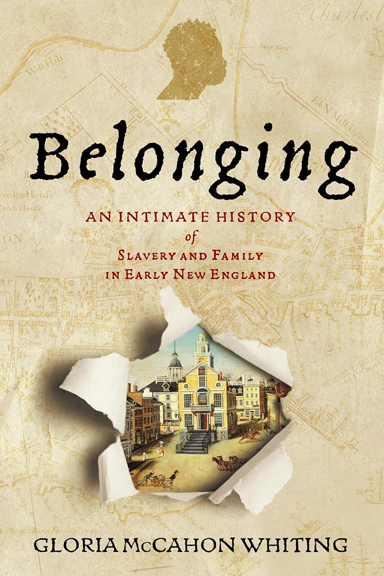
BOOK REVIEW: Belonging: An Intimate History of Slavery and Family in Early New England by Gloria McCahon Whiting. (Philadelphia, PA: University of Pennsylvania Press, 2025) $39.95 hardcover.
Massachusetts had no large plantations due to its harsh winters and rocky soil, and without the ability for cash crops to be grown successfully, the demand for enslaved labor was not as much as in other colonies. But slavery was still widespread in the colony. People owned enslaved persons to toil on small farms or work as domestics. Gloria McCahon Whiting’s book, Belonging: An Intimate History of Slavery and Family in Early New England, examines the slave world of the Boston area and emphasizes the intimate lives of those who were enslaved. It explores how people of African descent created family and kinship during 150 years of history, from the settlement of Massachusetts to the American Revolution.
 Each chapter, arranged chronologically, focuses on individuals whose situations represent an aspect of life that enslaved people had to either endure or navigate. The first chapter, “Dorcas and Her Kin: Slavery, Family, and the Law in the Seventeenth Century,” is about the life of Dorcas, the first person of African descent to be accepted as full member of the First Church of Dorchester. Her story includes a description of the law known as the “Body of Liberties,” which sanctioned slavery of both Africans and Pequots in Massachusetts. Dorcas’s situation was unusual, for being accepted into a puritan church community was a rigorous process. Her standing as a full-fledged member in good standing makes her distinctive.
Chapters two and three each take on the intimate aspects of life for bonded people. In “Sebastian, Jane Lake, and Their Children,” a young African couple tries to figure out a way to be married when the woman’s owner refuses to support the marriage. The famous judge Samuel Sewall (one of the Salem witch judges and the author of the anti-slavery tract The Selling of Joseph) is integral to the story. The third chapter, “Sue Black and Her Sons: Childbirth, Child-Rearing, and Childhood in Bondage,” presents a largely unknown picture of enslaved children in Massachusetts. Whereas in many southern colonies the children of enslaved people were seen as a future investment, in Massachusetts the children of enslaved couples were often offered for free to any takers. Raising a slave child, along with other children, could be very expensive, and many enslavers advertised in newspapers that they had children available to be taken. This situation truly set New England apart from the rest of the British Atlantic World.
Chapter four, “The Bedunahs: Sex and Family Across the Color Line,” tackles interracial marriage. Thomas Bedunah, of African descent, sought the help of Samuel Sewall to marry Lydia Crafts, a white woman. This was done before the passage of a law in 1703 prohibiting racial intermarriage. Thomas Bedunah, over the course of his life, became a valuable member of society, achieving the status of “whiteness.” Their son Joseph, whose left more of a historical imprint, used his status as a Black person to be relieved of militia duty during King George’s War in 1747.
A story of sexual exploitation and murder is the topic of chapter six, “Mark, Phyllis, and Phoebe: Community, Kin, and Other Intimacies.” The final chapter, “The Vassalls: Black Families and the End of Slavery in Revolutionary Massachusetts,” starts with a tale of a young Black boy who simply walked away from slavery after asking Gen. George Washington for wages. Black people chose on their own to take advantage of the political upheaval in Massachusetts to just walk away from bondage. They did not wait for any laws to be passed stating that they were free. It was a “bottom-up” revolution.
Gloria McCahon Whiting concludes her fascinating study by stating that the search for family and kin went far in helping to end slavery in Massachusetts. What happened in Massachusetts would soon affect the rest of the nation: “In early New England, as in so many other times and places, the enslaved were the first, the fiercest, and the most effective advocates of their own emancipation. Fighting through the generations to embed themselves in community, time and again they etched their humanity – and slavery’s devastation – in bold relief. Eventually, belonging to one another would help the enslaved to convince those who shared their world that they ought not to belong to enslavers” (p. 237). Belonging: An Intimate History of Slavery and Family in Early New England was certainly a challenge for Whiting, who had to rely on sometimes scant historical sources. Many enslaved people did not keep records, but Whiting found her stories through thorough research and finding names that continued to appear in the records. Her efforts were well-rewarded with an amazing book.
PLEASE CONSIDER PURCHASING THIS BOOK FROM AMAZON IN KINDLE.
(As an Amazon Associate, JAR earns from qualifying purchases. This helps toward providing our content free of charge.)


Recent Articles
Belonging: An Intimate History of Slavery and Family in Early New England
The Monmouth County Gaol and the Jailbreak of February 1781
The New Dominion: The Land Lotteries
Recent Comments
"The 100 Best American..."
I would suggest you put two books on this list 1. Killing...
"Dr. James Craik and..."
Eugene Ginchereau MD. FACP asked for hard evidence that James Craik attended...
"The Monmouth County Gaol..."
Insurrectionist is defined as a person who participates in an armed uprising,...