


Since 2014, the Journal of the American Revolution has recognized the new adult nonfiction volume that best mirrors the mission of the journal with its national Book-of-the-Year Award. This year the editors are pleased to announce a winner and two runners-up. All three books are outstanding contributions to the history of the Revolutionary and Founding Eras.
Award Winner
The American Revolution and the Fate of the World by Richard Bell (Riverhead Books)
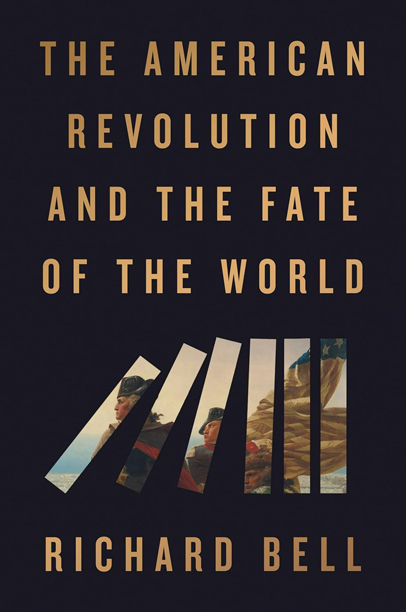 The American Revolution undoubtedly changed world history. Many nations seeking their own independence tried to emulate the ideals of the Declaration of Independence, a document whose words still influence national and world events. What many people do not realize was that, at the time, the Revolution directly affected places all over the world. It was truly a global happening, reaching not only Europe, but also Latin America, India, China, and even Australia. Each place was touched in some way by the American Revolution.
The 2025 Journal of the American Revolution Annual Book Award deservedly goes to Richard Bell’s excellent work, The American Revolution and the Fate of the World. Bell uses the stories of events, individuals and groups to demonstrate how far-reaching the American Revolution actually was. Each chapter is its own story of a setting and how the Revolution either caused problems or created favorable conditions. The Boston Tea Party was connected to China’s tea trade. Irish soldiers sought the same independence for Ireland. Australia became a depository for prisoners who were in Britain’s overcrowded jails. The coast of Africa was the scene of an attempted home for free Blacks. France’s loans led to bankruptcy and revolution. India was invaded and became part of the British Empire. And the people of Great Britain were deeply affected. The selected individuals profiled in the book included Molly Brant, King Louis XVI, Harry Washington, Baron von Steuben, and Benedict Arnold’s infamous wife, Peggy Shippen.
Each chapter is brief, concise, and very informative, so much so that each one could be a separate book subject. Bell’s writing style is a simple and direct narrative. The Revolution was painted on a wide, global canvas, and Bell captured this painting perfectly. In his conclusion Bell includes an appropriate observation by John Adams: “’A compleat History of the American War … is nearly the History of Mankind’” (page 345).
Read our review of The American Revolution and the Fate of the World.
Runners-Up
Enemies to Their Country: The Marblehead Addressers and Consensus in the American Revolution by Nicholas W. Gentile (University of Massachusetts Press)
 Enemies to Their Country: The Marblehead Addressers and Consensus in the American Revolution is a fascinating microhistory that illuminates an obscure incident in the coastal town of Marblehead, Massachusetts. Author Nicholas Gentile demonstrates how, even before a single shot was fired, the Revolution lived in the minds of this town’s residents as they harshly reacted to thirty-three signers of a letter of support to the departing governor Thomas Hutchinson. What follows is an interesting look at dynamics in this town—heavily influenced by Puritan theology—and the ways in which residents exerted social pressure to essentially coerce the signers back to the Patriot cause, placing ultimate importance on maintaining unity. Signers (“Addressers,” as they were called) ended up recanting through written and published statements, showcasing the growing importance of print culture during this period and the role that it played in creating a uniform identity going into the conflict. Gentile traces the fate of each of the thirty-three as they recanted and either rejoined the Patriot cause or, in the case of several, led lives in exile. Readers will come away with a fresh perspective on the Revolution’s origins and learn about an incident about which even ardent students of the period may know little.
Read our review of Enemies to Their Country.
The Course of Human Events by Steven Sarson (University of Virginia Press)
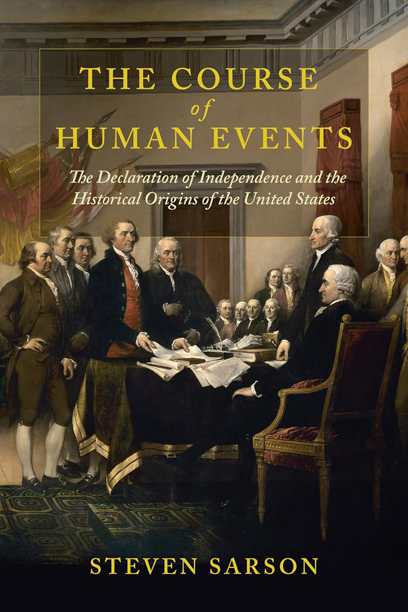 Steven Sarson seeks to reorient our understanding of the Declaration of Independence away from modern readings and back to the Founders’ own intentions. Although the document justified separation from Britain, Sarson explains that the Continental Congress sought to do so on the basis of well-established principles in British law and political philosophy. He outlines those ideas in a serious but readable fashion.
Sarson also encourages readers to look closely at the lengthy list of grievances that comprise most of the Declaration’s text. To us, they seem vague and lacking in substance, he says, only because its original audience required no examples or explanations. Each complaint had been thoroughly examined in the press of the day. Modern readers will need some studying to understand them, but it is strange, Sarson argues, “that few historians have taken the Declaration of Independence seriously as an account of the causes of the American Revolution.” The process of its adoption ensured that the Declaration reflected the consensus of the colonies. That makes it worth close study, and Sarson’s book is a helpful guide.
Read our review of The Course of Human Events.

Recent Articles
Surprise Attack at Great Savannah
The New Dominion: Virginia’s Land in The Northwest
Lineage: Genealogy and the Power of Connection in Early America
Recent Comments
"Coup D’oeil: William Washington..."
Great article. I am reminded of a point only incidentally mentioned, the...
"Thomas and Peter Costner..."
Thanks for your wonderful article. As we study the Revolutionary War, we...
"The Revolutionary War Letter..."
Superb storytelling!