

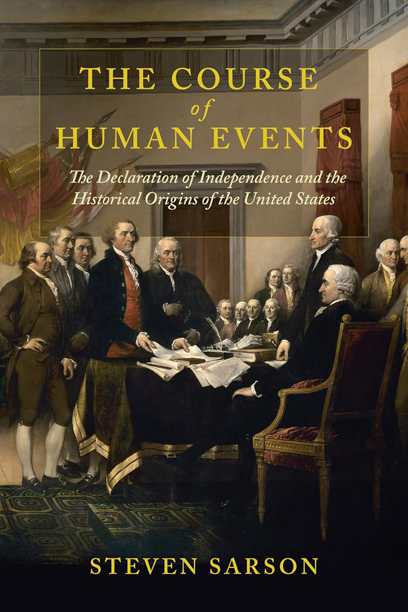
BOOK REVIEW: The Course of Human Events: The Declaration of Independence and the Historical Origins of the United States by Steven Sarson. (Charlottesville, VA: University Press of Virginia) $35.00 paperback
Modern interpretation of the Declaration of Independence is distressingly polarized. To some, it was the contrivance of hypocrites engaged in a war to perpetuate slavery.[1] To others, its promises are a creed, or a “promissory note” that the nation is striving to make good on.[2] Author Steven Sarson, an Englishman living in France, argues that both interpretations are wrong. He says that the Declaration’s authors (he consistently refers to them in the plural) had no intention of producing new claims about human nature, human rights, or the nature of politics. Rather, they sincerely sought to justify independence using ideas that were already widely accepted. To its 1776 audience, and to us if we are willing, the Declaration is and was a history lesson and a reassertion of well-established Lockean ideas of natural rights and natural law.
 Sarson is a professor at Jean Moulin University in Lyon, France. He has written three previous books: The Tobacco Plantation South in the Early American Atlantic World; British America, 1500-1800: Creating Colonies, Imagining an Empire; and Barack Obama, American Historian. The new book is quite good, but it concludes with an unfortunate handful of ill-considered claims.
Except in that last chapter, Sarson laudably seeks to peel away the layers of cultural varnish that have accumulated on the Declaration’s words and understand the document as its authors and their audience understood it. He walks his readers through a century of earlier writing to explain why Thomas Jefferson and his co-authors viewed the world as they did. He then looks at Jefferson’s draft, the committee’s submitted draft, and the final work approved by Congress to identify the points of sensitivity, gravity, and controversy that prompted tweaks, revisions, and deletions.
English political philosopher John Locke looms large over the entire work, and Sarson presents his ideas without academic cynicism. “Locke viewed the laws of nature and God not as abstract concepts but as actual laws,” he writes, “it was the same with the state of nature and the social contract, which he regarded as real phenomena and not just theoretical or heuristic devices.” He quotes jurist Edward Coke’s assertion that “the law of nature is immutable,” that it came “before any judicial or municipal law in the world,” and was “part of the laws of England.” Sarson presents James Otis’s argument that “Every British subject born on the Continent of America, or in any other British dominions, is by the law of God, and nature, by the common law, and by act of Parliament … entitled to all the natural, essential, inherent, and inseparable rights of our fellow subjects in Great-Britain.” Jefferson, too, Sarson says, “saw the laws of nature and God that he wrote into the Declaration of Independence as material phenomena to be drawn on for understanding the course of human events.”[3]
Sarson’s chapter titled “Our Emigration and Settlement Here” is perhaps the most interesting, exploring the principles Europeans believed justified the settlement of an already populated continent. Again, he helps his readers understand how elite colonists viewed it, which is valuable. He does not explain how common settlers understood their situation, which is a shame. It is here, too, that he begins to use terms like “settler colonialism” and other contentious jargon from postcolonial studies.
Despite the modern labels, Sarson’s narrative reveals how nuanced and sometimes varied the Founders’ views were. British courts had, before 1776, determined that “A Country, conquered by British Arms, becomes a Dominion of the King in Right of his Crown, and therefore, subject to the Legislature, the Parliament of Great Britain.” But the rebelling American colonies had not been conquered by British Arms. No British army ever set foot on North American soil before the French and Indian War.[4] Nor was the Crown’s money invested. Jefferson asserted, “Not a shilling was ever issued from the public treasures of his Majesty” for the colonies’ assistance before 1755.[5]
Some Americans believed that colonial charters established Britain’s ultimate authority. Others thought the first colonists had founded new states that were and always had been independent. Colonists had argued for self-rule as early as the 1670s. Jeremiah Dummer of Massachusetts argued in 1721 that “while ‘Queen Elisabeth gave out the first patent to Sir Walter Rawleigh in 1584,’ she had no ‘Right of Inheritance, because those Countries did not descend to her from her Ancestors,’ or of ‘Conquest, because she neither conquer’d, nor attempted to conquer’ the Indigenous people, and nor was there any ‘preceding Injury or Provocation’ that might have given a right of conquest.”[6]
The charters, meanwhile, could be read in multiple ways: they were issued by the Crown, not Parliament, and generally promised self-rule. The Navigation Acts (1651-1696) were admitted to have violated the promise, but that was viewed as further evidence of the since-deposed House of Stuart’s tendency toward tyranny. Richard Bland said Virginia’s lands “had a regular Government long before the first Act of Navigation, and were respected as a distinct State, independent, as to their internal Government, of the original Kingdom, but united with her as their external Polity, in the closest and most intimate LEAGUE AND AMITY, under the same Allegiance, and enjoying the Benefits of a reciprocal Intercourse.” John Dickinson of Pennsylvania’s Lower Counties (Delaware) disagreed on the details, but also insisted, “The colonies have no other head than the king of England.”[7]
The Navigation Acts broadly limited the colonies to producing labor-intensive raw materials and barred them from diversifying their economies. Sarson could have, but did not, explain how these laws increased and perpetuated economic dependence on slavery, especially where staple crops were grown.
Colonists and Britons alike looked very far back to find the origins of their liberties. In their memory, there was an ancient pre-feudal Saxon Constitution that featured property rights, a legislature, and a constrained monarchy. Like the early American colonists, the Saxons had found a “barbarous” land and civilized it, thereby earning ownership. This idyllic past, which Bland said was “founded on Principles of the most perfect Liberty,” was interrupted by the Norman Conquest in 1066 and not restored until the Glorious Revolution and the ouster of the Stuarts in 1688 and 1689.[8]
But colonists and Britons differed on what ensued. In Great Britain, Parliament was now splendidly preeminent, terminating the Divine Right of Kings and ensuring that government and law reflected the will of the freeholders. For Americans, a weakened monarchy had nearly opposite implications because they were unrepresented in Westminster. Relinquishment of the monarch’s ancient power to veto legislation left the colonies with no defense whatsoever in London. This dynamic was also examined in 2014 by Eric Nelson in The Royalist Revolution.[9]
Sarson traces the growing tension back to the 1670s through many essays and colonial petitions, the Stamp Act Congress, the First Continental Congress’s Declaration of Rights and Grievances and Petition to the King, the Second Congress’s Declaration on the Causes of Taking Up Arms and Olive Branch Petition, to the Declaration itself.
Having painted that picture, he says it is strange “that few historians have taken the Declaration of Independence seriously as an account of the causes of the American Revolution.” He sees two reasons for this. First is the “disparity between the Declaration’s supposed ideals and the social realities of the time,” which leads many to dismiss it as hypocrisy or a mere “augury of the future.” Second is that the grievances that make up the bulk of the Declaration’s text seem so vague to modern readers as to be nearly devoid of meaning.
Sarson attacks the “vagueness” complaint by arguing that many of his peers have not done the work needed to understand the text. He then goes through each grievance, briefly explaining its history. The “vague” language was partly modeled on the style of the indictments of James II in the English Bill of Rights and was partly shorthand made possible by the extended discussion of each issue in the press of the day. At the time, everyone knew what the grievances meant, and no explanation or examples were needed. Considering them differently than is often done, he counts them as eighteen in number, with the thirteenth having nine clauses or “subgrievances.”[10] This attention to the grievances is welcome and well-timed for comparison with Matthew Spalding’s just-released The Making of the American Mind.
Most of the grievances are explained in a paragraph or two. The final one gets an entire chapter and the bulk of a short postscript, and does warrant close attention. Modern Americans have many questions about its meaning. It asserts the Crown “has excited domestic insurrections amongst us, and has endeavoured to bring on the inhabitants of our frontiers, the merciless Indian Savages, whose known rule of warfare, is an undistinguished destruction of all ages, sexes and conditions.”
“Domestic insurrection” is widely understood to refer to slave uprisings, and the description of Native warfare reads today like racist stereotyping. On slavery, Sarson is fair to the Founders insofar as he argues their views, even here, were mostly consistent with their own professed beliefs. He gives Jefferson and the committee appropriate credit for proposing a condemnation of slavery in their draft. Racism is part of the explanation for Americans’ acceptance of slavery, but it was not foundational. He returns to Locke’s state of nature and the social contract and sees that the Founders wanted a government based on Natural Law, not Natural Rights. “Created equal” referred in the Declaration to humanity’s condition in the pre-social state of nature. Moreover, “all men” referred to everyone collectively and was not intended to mean that, in a society, all people retained all their natural rights or that they would retain them in equal measure. Actual differences required society to discriminate as was deemed necessary. “All sacrificed something in the sense that individual self-sovereignty was absorbed into the collective sovereignty of the people, and all submitted themselves to the rule of a legislative and the civil laws it produced.”[11]
One could choose, of course, to reject the social contract, in which case one becomes an outlaw. Loyalists, for example, were regarded as having done this. Most Indians, too, lived in a “state of nature” outside of society. Slavery, justified for centuries as a feature of war, was perpetuated according to society’s duty to defend itself. However unjust, “slavery was still war, and as long as enslaved people collectively represented a threat of violence, then the first law of nature, self-preservation, rationalized the enslavement of one people by another.”[12] Sarson astutely notes that “domestic insurrections” probably described not only slave revolts, but also the creation of Loyalist regiments.
Though he quotes Locke to show that the Founders’ views were deeply rooted, Sarson does not let them off the hook. He calls them out for racism, noting especially that Jefferson warned “race mixing” would degrade the white race, but produced mixed-race children himself.[13] Sarson deserves credit for broadening the usual reading of “domestic insurrections” and for explaining the Founders’ views in terms they would recognize. His generalized assessments about enslaved Americans ring true because the defining circumstance of their condition robbed them of the agency required for complex consideration.
That was not true of Native Americans. They varied widely in the military, political, diplomatic, and even religious choices they made. Unfortunately, Sarson treats them as a single group, which is unfair to them and undermines the value of his analysis. This might have been understandable had he limited himself to political theory and the ideas in the Declaration. Instead, he makes several claims about “erasing” native voices and America-born whites “appropriating” the title “native.” He characterizes the Great Seal of the United States as an imperialist symbol, in which the eagle’s grasped arrows represent conquest. The seal, he asserts, betrays an American national identity based “not on new-fangled ideas but on old-fashioned blood and treasure.” The olive branch in the eagle’s other talon goes unmentioned.[14]
Sarson has studied Locke and the writings of coastal elites in depth. His research would have benefited from an equally close examination of Western perspectives. This would have enabled him to consider what life was actually like where Natives and European settlers rubbed elbows. Most actual settlers never read John Locke or the Declaration. They, or their parents, came from a continent where all useful land was farmed and developed, but was unobtainable for people like themselves. Moreover, in Joseph Warren’s words, Great Britain had “persecuted, scourged and exiled our fugitive parents from their native shores.”[15] They were called “crackers,” “riff-raff,” and “little more than white Indians.” John Buchanan once quoted Rev. Charles Woodmason, calling them “ignorant, mean, worthless, beggarly Irish Presbyterians, the Scum of the Earth, and Refuse of Mankind.”[16] Only in the American West could “crackers” find what was denied them in the Old World, the one thing that had the power to improve their lives dramatically: land.
In the memories of at least some Founders, fair acquisition had always been the policy. Warren wrote of Massachusetts’ first settlers: “When they came to this new world, which they fairly purchased of the Indian natives, the only rightful proprietors, they cultivated the then barren soil by their incessant labor, and defended their dear bought possessions with the fortitude of the Christian, and the bravery of the hero.”[17]
There is plenty to criticize in the history of white dealings with America’s Native communities, but it was never legal to settle on Indian land not acquired by purchase or treaty. Private purchases were banned in 1763. The British Crown, the colonies, and Congress all viewed squatting on Indian land as wrong and provocative. It was a felony in colonial Virginia and punishable by “death without the benefit of clergy” in Pennsylvania.[18] The first regiment of troops raised by the postwar Congress was tasked with removing trespassers from Indian land.[19] They did their job, burning cabins for many miles along the Ohio River.[20] A string of postwar Indian treaties included provisions declaring that anyone squatting on Indian land “shall forfeit the protection of the United States, and the Indians may punish him as they please.”[21] But the impulse to move west into undeveloped territory (what they called “waste” land) was impossible to get out of the minds of poor folks. To the untutored, what Sarson calls “settler imperialism” was the simple logic of “If you’re not going to use it, then I will.” The land was, of course, being used, but not in the European fashion. However much they schemed, wealthy land investors generally followed the letter of the law.
Elsewhere in the book, Sarson allows the Founders to speak for themselves, explaining their thinking in eighteenth-century terms before occasionally contrasting it with a modern perspective. Here, he preemptively labels the Indian warfare passage in the Declaration “brutally racist.” “Savages” is an ugly label, but it was used at the time to describe Irishmen and Highland Scots as well as Native American combatants.[22] Many tribes waged war as British proxies, and the record does show that mercy for noncombatants was rarely a feature of Indian warfare. Sarson might also have pointed out that the Declaration’s strong words did not prevent Congress from allying with the Oneida, Tuscarora, Stockbridge, Catawba, and Delaware tribes. He could also have related instances when white settlers were themselves mercilessly savage, such as at Yellow Creek in 1774 and Gnadenhutten in 1782, and compared political leaders’ reactions.
To the extent that the final chapter reveals Sarson’s ideological views, he deserves credit for holding them mostly in check elsewhere. The book is of great value and should be read by anyone seeking to understand the Declaration in depth. “The novelty of the Declaration,” Sarson argues, “lay in its explication of ancient principles, rather than in their invention or unprecedented application.” To illustrate, he explains that the motto “Novus ordo seclorum,” taken from the Roman poet Virgil, describes a rebirth rather than a new creation.[23]
PLEASE CONSIDER PURCHASING THIS BOOK FROM AMAZON IN PAPERBACK OR KINDLE.
(As an Amazon Associate, JAR earns from qualifying purchases. This helps toward providing our content free of charge.)
[1] Nikole Hannah-Jones, “Our Democracy’s Founding Ideals Were False When They Were Written,” The New York Times Magazine, August 18, 2019, and revised March 11, 2020.
[2] Martin Luther King, Jr., “I Have a Dream,” August 28, 1963, npr.org/2010/01/18/122701268/i-have-a-dream-speech-in-its-entirety.
[3] Steven Sarson, The Course of Human Events: The Declaration of Independence and the Historical Origins of the United States (University of Virginia Press, 2025), 20, 23, 31, 33.
[4] Sarson, Course of Human Events, 46.
[5] Sarson, Course of Human Events, 48.
[6] Sarson, Course of Human Events, 54.
[7] Sarson, Course of Human Events, 58-59.
[8] Sarson, Course of Human Events, 48-52, 56.
[9] Eric Nelson, The Royalist Revolution: Monarchy and the American Founding (Belknap Press, 2014), 29-65.
[10] Sarson, Course of Human Events, 110-112.
[11] Sarson, Course of Human Events, 207.
[12] Sarson, Course of Human Events, 185.
[13] Sarson, Course of Human Events, 186-187.
[14] Sarson, Course of Human Events, 194-206.
[15] Sarson, Course of Human Events, 65.
[16] John Buchanan, “Charleston to King’s Mountain: The Southern Partisan Campaign,” in Edward G. Lengel, ed., The 10 Key Campaigns of the American Revolution (Regnery, 2020), 155-175; John Buchanan, The Battle of Musgrove’s Mill, 1780 (Westholme, 2022), 4, 11, 18, 28, 41.
[17] Sarson, Course of Human Events, 64-65.
[18] William Waller Hening, ed., The Statutes At Large: Being a Collection of All the Laws of Virginia, 13 vols. (various publishers, 1821-1823), 1:324; James T. Mitchell and Henry Flanders, eds., The Statutes at Large of Pennsylvania from 1682 to 1801, 18 vols. (Harrisburg: Clarence M. Busch, 1896-1915), 7:153.
[19] “Colonel Harmar to the President of Congress,” May 1, 1785, in William Henry Smith, The St. Clair Papers: The Life and Public Services of Arthur St. Clair, 2 vols. (Robert Clark & Co., 1882), 2:3.
[20] Consul Willshire Butterfield, ed., Journal of Capt. Jonathan Heart … To Which is Added the Dickinson-Harmar Correspondence of 1784-1785, (Joel Munsell’s Sons, 1885), 64, 93-94.
[21] Charles Joseph Kappler, ed., Indian Treaties, 1778-1883 (New York: Interland Publishing,1972), 5-6, 14-18.
[22] Nicola Martin, “Inculcating Loyalty in the Highlands and Beyond, c.1745–1784,” Atlantic Studies, 21:2 (2023), 265-286, 266, 277; Geoffrey Plank, Rebellion and Savagery: The Jacobite Rising of 1745 and the British Empire (University of Pennsylvania Press, 2006), 8, 22, 53-76; David Hayton, “From Barbarian to Burlesque: English Images of the Irish c. 1660-1750,” Irish Economic and Social History, 15 (1988), 5-31; Jeop Leerssen, Mere Irish & Fíor-Ghael: Studies in the Idea of Irish Nationality, its Development and Literary Expression prior to the Nineteenth Century (University of Notre Dame Press, 1997), 32, 37, 68, 72, 83, 335, 340.
[23] Sarson, Course of Human Events, 145, 147.


Recent Articles
The Monmouth County Gaol and the Jailbreak of February 1781
The New Dominion: The Land Lotteries
The Home Front: Revolutionary Households, Military Occupation, and the Making of American Independence
Recent Comments
"Hero to Zero? Remembering..."
I did come across this record, it adds a little bit: He...
"Hero to Zero? Remembering..."
How did Gates's son Robert die? I have not been able to...
"A Strategist in Waiting:..."
Lots of general information well presented, The map used in this article...