


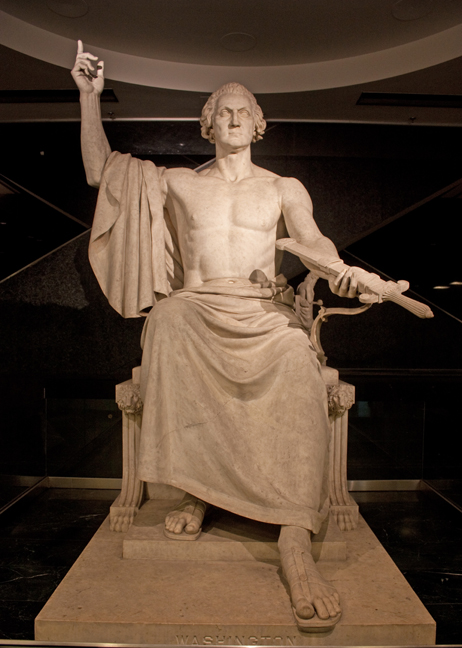
For all the flaws of the framers, Americans can still look to the founding era for wisdom and guidance. That deeply learned collection of statesmen, whatever its shortcomings, committed itself to advancing the public good and securing the long-term survival of the nascent nation.[1] And when the first members of congress, justices of the bench and, of course, first commander in chief breathed life into and gave form to the new Constitution, those federal officials set about establishing protocols, behavioral decorum, and ethical standards worthy of the new Rome.[2] Many of these officials believed the untested government needed to act with dignity and competence if it were to endure in a cutthroat world dominated by paranoid princes, petty tyrants, and ruthless autocrats. Critically, George Washington, the first president of the new constitutional order, also recognized the delicate balance he needed to strike. If he grew too familiar with the public, the presidency would lose its veneer of dignity. And if he acted too aloof, he would suffer accusations of monarchism.[3] Either scenario would hamper his ability to govern and test the public’s trust in the new political architecture; finding a middle ground kept Washington up at night during this moment of federal conception. “The eyes of Argus are upon me,” he noted, “and no slip will pass unnoticed.”[4] The new president agonized over the scrutiny his new public role brought upon him, but dedicated himself to meeting the moment.
“Many things which appear of little importance in themselves . . . at the beginning,” a concerned Washington warned, “may have great and durable consequences from their having been established at the commencement of a new general Government.” He predicted that “It will be much easier to commence the administration upon a well-adjusted system built on tenable grounds, than to correct errors or alter inconveniences after they shall have been confirmed by habit.” Even at this nebulous moment, Washington grasped that his personal behavior, for better or worse, was going to shape the office of the presidency. “The President in all matters of business and etiquette” has little choice but to act “in his public character, in such a manner as to maintain the dignity of Office,” Washington wrote.[5] Notably, one small window into Washington’s political anxiety is memorialized in a discourse he began with Vice President John Adams less than two weeks after the first presidential inauguration.[6] Unlike Congress or the courts, the president is both an institution and an individual, which caused Washington to wrestle with fusing the appropriate combination of public and private elements into his singular role. To help him navigate spaces where he felt the private and public dimensions of the presidency intersected, he solicited Adams’s advice.
Should the president, Washington asked the second magistrate, avoid the pomp and pageantry of a court as well as the Spartan seclusion of a recluse? And if a social middle ground could be struck, he asked, “how is it to be done?”[7] In other words, how might the president best reflect republican virtue and values in company while refraining from broadcasting as either monarchical or hermetical? Adams agreed that Washington should avoid both extremes and further assured him that “the System of the President” will gradually develop itself through practice and without formal communication with Congress.[8]
Might the president, Washington next queried, hold public levees (formal receptions) each week to mix with the citizenry, thus making the president (both the institution and the individual) available in ways in which monarchs were not?[9] Most Americans, of course, had never experienced the gravity of a royal procession or felt the competitive pulse of a choreographed court.[10] Could Washington, with the advice and consent of his closest political confidants, establish a republican precedent that catered to the dignity of his office without demeaning it? John Adams reasoned that since so many people, Americans and curious foreigners alike, were sure to seek out the president’s company, holding public levees offered the most convenient way to satisfy this form of traffic. In fact, Adams suggested not one, but two weekly levees to meet public demand.[11]
Along a similar line, Washington, always consumed with public perception, inquired as to whether or not the president might meet personally with those who had specific business with his office.[12] Here the Virginian revealed his grasp on how some might confuse actual political transactions with subtle political corruption. He hoped to avoid any accusations of exchanging sinecures for favors in order to keep the presidency’s reputation unassailable. Adams responded, questioning why the chief magistrate of the realm would even consider consuming his time with such interviews. He felt the president ought to have an intermediary of sorts, a minister of affairs (a modern chief of staff) to handle these. Only in rare instances, Adams advised, should the president personally attend to these formalities.[13]
Washington also thought about national celebrations, festive functions that, at this early moment, served as public expressions of political union and harmony.[14] Recognizing the importance of national fellowship, the president asked if it were appropriate for him to personally host four “great entertainments in a year” in recognition of the Declaration of Independence, Franco-American Alliance, 1783 Treaty of Paris, and establishment of the new constitutional order. He feared some might accuse him of neglecting his work as president to organize and host these celebratory events.[15] John Adams cautioned, “in no Case whatever, can I conceive it proper for the President to make any formal public Entertainment.” A minister or perhaps even the vice president, Adams suggested, should plan such events and “the President in his private Character might honour [the occasion] with his Presence.”[16]
Washington also asked if it would be improper from him to make informal visits to his friends or other civil servants “in his private character,” without the public confusing such calls as being attended by the institution of the presidency.[17] Adams explained that the president could socialize with whom he pleased, as the executive’s private life “should be at his own discretion, and the World Should respectfully acquiesce.” But, Adams lectured, as president, Washington “should have no intercourse with society.” Adams closed by reminding Washington that his careful consideration in distinguishing between the president’s private character and public role “ought to govern [your] whole Conduct.”[18]
Finally, Washington expressed his sincere concern that holding levees and other state functions and celebrations “will eventually cause additional expenses.” He wondered whether or not it would be proper for Congress to make an indefinite fund available for the executive. Ultimately, was it the public’s responsibility to subsidize the executive’s official lifestyle?[19] John Adams offered his most profound response to this touchy subject. The federal treasury ought to support the president’s household, Adams argued, since any executive’s public dwelling requires numerous chamberlains, aides-de-camp, secretaries, masters of ceremonies, and other assorted personnel. Adams then claimed the office of the presidency, as created by the Constitution, “has no equal in the World.” Even most royal authorities offered but “a mere shadow” of actual power, Adams argued, compared to presidential authority. And people respect authority based partly on its proportionate “Splendor and Majisty,” he continued. Furthermore, since sending and receiving ambassadors remained one of the most important presidential prerogatives, Adams reasoned, state-funded pomp and pageantry were vital to developing foreign respect for the young United States. Adams rationalized his thoughts as the product of “my long residence abroad” and cautioned that his views may be “incompatible with the present Temper or Feelings of our Fellow Citizens.”[20]
President Washington apparently sent out similar questionnaires to James Madison, Alexander Hamilton, John Jay, and Robert Livingston, but the responses, if they were ever written, do not survive. It may be that Washington received answers from the aforementioned statesmen through informal conversation while New York was the nation’s capital and these men mixed together regularly. Still, Washington’s desire to probe some of the most serious minds forged by the revolutionary crisis for advice on public performance reflects the earnestness with which he considered his role and its future. After all, displays of republican virtue were publicly measurable acts; industriousness, frugality, courage, moderation, honesty, justice, and disinterestedness are each qualities that find expression in the proverbial town square. And so, too, did their equal and opposite qualities.[21] Washington hoped to establish a protocol for the presidency that would embody the republican simplicity so desperately sought by the founding generation. His behavior as president reveals his efforts to establish presidential precedent and protocol based on disinterestedness and inflexible justice to the dignify of the office.
Washington settled on holding one weekly levee to mix with the public, held on Tuesdays. His practice was to remove any chairs and stand at the front of the room, available but distant, his attempt at a republican middle ground.[22] He decided against accepting invitations to dinner, as he did not think it appropriate for the chief executive to be summoned (he also likely remained sensitive to surprise menu items given his dental challenges), but frequently hosted guests at his mansion (he remained comfortable summoning others). As president, he held formal dinners on Thursdays while still enjoying a vibrant social life in his private character, attending to tea parties as well as theater productions.[23] He also graced Martha Washington’s Friday levees, but, as noted by historian Rufus Griswold, “appeared as a private gentleman with neither hat nor sword.”[24] And when it came to considering applicants for coveted federal positions, a letter from the vice president expresses the importance Washington placed on guarding public esteem for both the presidency as an institution and his personal honor from charges of corruption. In a response to one office seeker, Adams explained, “I caution you … against having any dependence on my influence, or that of any other person.” No one, Adams warned, held any sway over the president and he “judges more independently than any other man.” He closed by noting, “It is of so much importance to the public that he should preserve this superiority” and only logic and evidence hold any influence over him.[25] The president, always fiercely independent, catered only to the public good without any private considerations.
George Washington received a constitutional education of the first order when he presided over the Constitutional Convention as president in 1787. There he learned firsthand what the architects both feared and desired in terms of personal qualities for the president.[26] And through The Federalist Papers, Washington read how the framers had designed the presidency exclusively for honest men who radiated civic virtue and commanded public esteem.[27] Critically, those papers assured, the geographic nature of the union protected the republic from designing creatures with “Talents for low intrigue” and “the little arts of popularity.” Washington entered that office embodying much of the virtue the framers sought while educated on the contours and limits of the presidency’s authority as envisioned by the framers. Yet for all his experience, he came to the presidency a reluctant participant in national affairs. Shortly before leaving Mount Vernon to travel to his inauguration, he confided in Henry Knox his anxieties:
that my movements to the chair of Government will be accompanied with feelings not unlike those of a culprit who is going to the place of his execution: so unwilling am I, in the evening of a life nearly consumed in public cares, to quit a peaceful abode for an Ocean of difficulties, without that competency of political skill—abilities and inclination which is necessary to manage the helm.
He closed by noting “Integrity and firmness is all that I can promise.”[28] These are not the projections of an arrogant man, but the confessions of an honest one, comfortable in political retirement but respectful of the public’s desire for him to return to national life.
Shortly after Washington delivered his first inaugural speech, he wrote a letter to Virginia congressman James Madison revealing the president’s appreciation of the moment. “As the first of everything, in our situation [we] will serve to establish a Precedent, it is devoutly wished on my part, that these precedents may be fixed on true principles.”[29] Washington determined to establish the presidency, as far as he could, on republican principles. Regarding the man, Washington’s behavior reflected a statesman jealously attentive to his reputation for public spirit, justice, and rigid honesty. Regarding the institution of the presidency, Washington established transparency, dignity, and disinterestedness as primordial qualities for that office. The overlap is clear; Washington molded the presidency as much as the presidency molded him. The first president certainly expected the civic spirit and integrity that he fused into the office to inspire his successors. And Washington further anticipated his mold to transform subsequent occupants of that office into, as Caesar Augustus so long ago remarked, the American Princeps Civitatis: first among American citizens.
[1] Some outstanding literature on this theme includes James Roger Sharp, The Politics of the Early Republic: A New Nation in Crisis (New Haven, CT: Yale University Press, 1993); Drew McCoy, The Elusive Republic: Political Economy in Jeffersonian America (New York, NY: W. W. Norton and Company, 1980); For Washington’s efforts, see John Ferling, The Ascent of George Washington: The Hidden Political Genius of an American Icon (New York, NY: Bloomsbury Press, 2009) 270, 283.
[2] See, for example, David Waldstreicher, In the Midst of Perpetual Fetes: The Making of American Nationalism, 1776-1820 (Chapel Hill, NC: University of North Carolina Press, 1997); Stanley Elkins and Eric McKitrick, The Age of Federalism: The Early American Republic, 1788-1800 (New York, NY: Oxford University Press, 1993), 46-50.
[3]Marshal Smelser, “The Federalist Period as an Age of Passion,” American Quarterly 10, no. 4 (1958): 391-419.
[4] George Washington to Bushrod Washington, July 27, 1789, in Dorothy Twohig, et. al., eds., The Papers of George Washington: Presidential Series, 21 vols. (Charlottesville, VA: University Press of Virginia, 1992-), 3:334.
[5] Ibid.
[6] George Washington to John Adams, May 10, 1789, in Twohig, et al., eds., The Papers of George Washington: Presidential Series, 21 vols. (Charlottesville, VA: University Press of Virginia, 1992- ), 2:245-50.
[7] Ibid.
[8] Adams to Washington, May 17, 1789 in Robert J. Taylor, et al., eds., The Papers of John Adams, 21 vols. (Cambridge, MA: Harvard University Press, 1977-), 19:459-60.
[9] Washington to Adams, May 10, 1789, in Twohig, et al, Papers of Washington: Presidential Series, 2:245-50.
[10] Gordon S. Wood, The Radicalism of the American Revolution (New York, NY: Alfred A. Knopf, 1991).
[11] Adams to Washington, May 17, 1789, in Taylor, et al., Papers of Adams, 19:459-60.
[12] Washington to Adams, May 10, 1789, in Twohig, et al., Papers of Washington: Presidential Series, 2:245-50.
[13] Adams to Washington, May 17, 1789, in Taylor, et al., Papers of Adams, 19:459-60.
[14] Some of the best work on this is still Waldstreicher, In the Midst of Perpetual Fetes; Jay Estes, The Jay Treaty Debate: Public Opinion, and the Evolution of Early American Political Culture (Amherst, MA: University of Massachusetts Press, 2006); Simon Newman, Parades and Politics of the Street: Festive Culture in the Early American Republic (Philadelphia, PA: University of Pennsylvania Press, 1997).
[15] Washington to Adams, May 10, 1789, in Twohig, et al., Papers of Washington: Presidential Series, 2:245-50.
[16] Adams to Washington, May 17, 1789, in Taylor, et al., Papers of Adams, 19:459-60.
[17] Washington to Adams, May 10, 1789, in Twohig, et al., Papers of Washington: Presidential Series, 2:245-50.
[18] Adams to Washington, May 17, 1789, in Taylor, et al., Papers of Adams, 19:459-60.
[19] Washington to Adams, May 10, 1789, in Twohig, et al., Papers of Washington: Presidential Series, 2:245-50.
[20] Adams to Washington, May 17, 1789, in Taylor, et al., Papers of Adams, 19:459-60.
[21] For an exploration about the Revolutionary Age and public virtue, see Shawn David McGhee, No Longer Subjects of the British King: The Political Transformation of Royal Subjects to Republican Citizens, 1774-1776 (Yardley, PA: Westholme Publishing, 2024).
[22] Joanne B. Freeman, Affairs of Honor: National Politics in the New Republic (New Haven, CT: Yale University Press, 2001), 53, 55.
[23] Odai Johnson, “Jefferson and the Colonial American Stage,” Virginia Museum of History and Biography 108, no. 2 (2000): 139-54.
[24] Rufus Wilmot Griswold, The Republican Court or American Society in the Days of Washington (New York, NY: D. Appleton and Company, 1856), 270.
[25] John Adams to Sylvanus Bourne, August 30, 1789, in Taylor, et al., Papers of Adams, 20:143-44.
[26] See Elkins and McKitrick, Age of Federalism, 44-45; Max Ferrand, ed., The Records of the Federal Convention of 1787, 4 vols. (New haven, CT: 1937); Jonathan Elliot, ed., Debates in the Several State Conventions on the Adoption of the Federal Constitution, 5 vols. (Philadelphia, PA: J.B. Lippincott & Co.,1863), Thomas E. Cronin, “On the Origins and Invention of the Presidency,” Presidential Studies Quarterly 17, no. 2 (1987): 229-35; Arthur N. Holcombe, “The Role of Washington in the Framing of the Constitution,” Huntington Library Quarterly 19, vol. 4 (1956): 317-34.
[27] Federalist 64 (John Jay) and Federalist 68 (Alexander Hamilton) in Clinton Rossiter, ed., The Federalist Papers, (New York, NY: New American Library, 1961), 396, 414.
[28] Washington to Henry Knox, April 1, 1789, in Twohig, Papers of Washington: Presidential Series, 2:2-3.
[29] Washington to James Madison, May 5, 1789, in ibid., 2:232.


One thought on “The American Princeps Civitatis: Precedent and Protocol in the Washingtonian Republic”
I enjoyed this excellent article, thank you very much.