


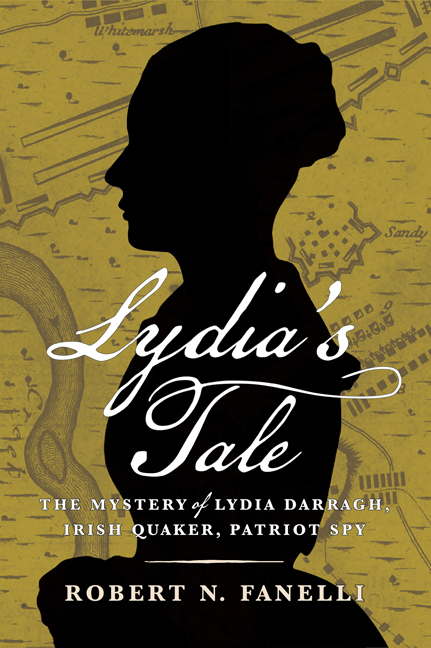
BOOK REVIEW: Lydia’s Tale: The Mystery of Lydia Darragh, Irish Quaker, Patriot Spy by Robert N. Fanelli (Yardley, PA: Westholme Publishing, 2025) $34.95 hardcover
Robert N. Fanelli’s Lydia’s Tale attempts to contextualize the life and legacy of the famed heroine spy Lydia Darragh. Fanelli is a contributor to the Journal of the American Revolution; his articles frequently cover Pennsylvania’s role in the revolutionary war. Therefore, it is of no surprise for his first book to cover a legendary figure of the state. Darragh supposedly overheard plans of a surprise attack on Washington’s forces in Whitemarsh. She crossed American lines and indirectly warned Washington. American forces were fully prepared against the British.
 Fanelli takes portions of diary entries from acquaintances Sarah Logan Fisher and Elizabeth Drinker to reconstruct Lydia’s thoughts, feelings, and attitudes. He also extensively analyzes her background as a Quaker through the Society of Friends. These reconstructions help historians look at Lydia as a person rather than a mythical figure. This is one goal of the book; the other goal is to examine how this story transformed into American mythology.
Chapters two through four explain the genealogical background of the Darraghs and Barringtons (Lydia’s maiden name). All came from Ireland as Fanelli traces their roots and examines connections with local Quaker families upon their move to Philadelphia. The Darraghs used these connections to their advantage in building business. Lydia’s husband William had many occupations including stenography, selling tobacco and spirits. They were financially secure enough to rent homes and sell various goods. Lydia herself was a midwife, wet nurse, mortician, and hat maker. I found the sections on her duty as a midwife fascinating, as she seemed well known in her community and helped women from various social classes. Fanelli attempts to connect midwife “gossip” to Lydia overhearing soldiers, but again it is speculative on why, and if, an officer believed Lydia’s information on the surprise attack.
The Darraghs’ son Charles served with the 2nd Pennsylvania Regiment, and there may have been some conflict with Friends. References to the Quaker Marshall and Eddy families and the later “strife” between Quakers illustrates division that came with the American Revolution. Fanelli is able to capture this and the fear (of arson in particular) that existed within Philadelphia at this time.[1] Again, inferences must be made from family stories regarding Lydia’s allegiances. Fanelli uses two examples in chapter five to support the idea that the Darraghs were Patriots. One, they were connected to local Patriots, some of whom were Quakers. And there is a family story about Lydia’s initial defiance in using her home as a meeting place for British Gen. William Howe’s men. However, it could also be that Lydia was such a staunch Quaker, she opposed any war planning, no matter which side. According to Fanelli, Lydia’s motivation to warn Washington may also have stemmed from wanting to protect her son.
Lydia’s story first appeared in print in the 1827 American Quarterly Review article by Robert Walsh Jr. Fanelli includes this article and the original account from Hannah Marshall Haines, and compares them to later accounts by John Fanning Watson and Henry Darrach. In particular, he examines the differences about how Lydia obtained a pass, her possible excuse to get one, and what her exact route to the American lines may have been. The book also mentions that people published stories like Lydia’s during anniversaries of the American Revolution. Fanelli is aware that people told myths to bolster the American nationalistic spirit.
It was also interesting to read Fanelli’s take on an older report by the Office of Public Affairs which claims Lydia’s story is “colorful but uncorroborated.” Most of this report is reconstructed from statements by historian Henry Leffman. Fanelli does a superb job at tackling Leffman’s argument that it was impossible for a woman to travel alone behind enemy lines. Again diaries of Sarah Logan Fisher and Elizabeth Drinker discuss women obtaining passes for this exact reason. He also challenges the notion that flour was not an important commodity. Nevertheless, when and if Lydia actually went across lines to pass information along is not known. Again, Fanelli pulls information entirely from the accounts of Walsh, Haines, Watson, and Darrach, echoing statements from the Darragh family. Letters from Charles Craig indicate that he knew of the attack beforehand, but he does not mention how he came to know.[2]
Legends and myths do inform our history. Sometimes how people remember something is just as important as what really happened. And Lydia Darragh was indeed a real person, although her espionage activities may or may not be real. Maybe that should be the more important takeaway, rather than focusing on proving Lydia’s role as a spy. She assisted childbearing women and the sick within her community, was a devout Quaker, and enjoyed some financial independence, rare for women of that time. In that sense, Fanelli achieved his goal in looking at civilians behind the scenes (and legends) of war.
PLEASE CONSIDER PURCHASING THIS BOOK FROM AMAZON IN HARDCOVER OR KINDLE.
(As an Amazon Associate, JAR earns from qualifying purchases. This helps toward providing our content free of charge.)
[1] Robert N. Fanelli Lydia’s Tale: The Mystery of Lydia Darragh, Irish Quaker, Patriot Spy. Westholme Publishing, 2025, 100-107.
[2] “Intelligence in the War of Independence – Personalities,” CIA.gov. United States Office of Public Affairs, January 14, 2009. www.cia.gov/resources/csi/static/Intelligence-in-the-War-of-Independence-web.pdf.


Recent Articles
The Killing of Jane McCrea
The American Princeps Civitatis: Precedent and Protocol in the Washingtonian Republic
Thomas Nelson of Yorktown, Virginia
Recent Comments
"The American Princeps Civitatis:..."
I enjoyed this excellent article, thank you very much.
"Decoding Connecticut Militia 1739-1783"
Hi, I'm looking for discussion in the records for troop movement and...
"General Israel Putnam: Reputation..."
Gene, see John Bell’s exhaustive Analysis, “Who Said ‘Don’t Fire Till You...