




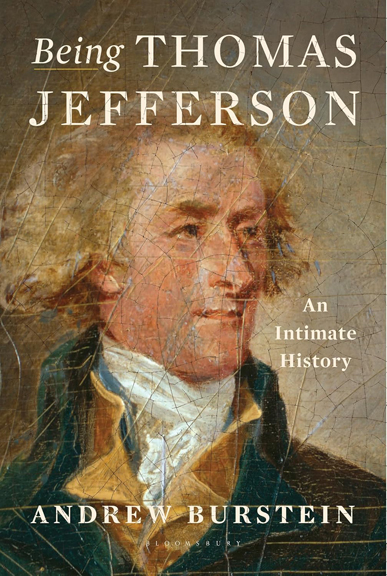
BOOK REVIEW: Being Thomas Jefferson: An Intimate History by Andrew Burstein (Bloomsbury Publishing, 2026)
In Being Thomas Jefferson: An Intimate History, Andrew Burstein tackles the inner life of Thomas Jefferson and seeks to provide a fuller picture of the man in both public and private. Although Jefferson spent much of his life in public service, his true desire for privacy and his introspective, bookish nature makes a study of his mind a worthy task, even if deducing the thoughts and motivations of a historical figure can be difficult at best. Luckily, Jefferson’s careful record keeping of his own life, his prolific writing, and his expansive library provide plenty of evidence to examine and to place in the context of his life and times. This allows Burstein to engage with Jefferson’s personal life in close detail for fresh insight and carefully considered speculation that illuminates Jefferson’s sometimes contradictory behavior, as well as offering a greater understanding of the impulses, desires, and ideals that motivated him.
 Burstein closely reads Jefferson’s own writings and considers what he read to form a more complete picture of his mind, pointing to a number of contexts and layers that illuminate why language and the written word is particularly important to understanding the inner Jefferson. Moreover, Burstein points to the influence that Jefferson’s reading and writing exerted in both his public and private lives. Jefferson depended heavily upon his full library and his correspondence in forming his ideals as well as using them for his mental well-being.
Despite Jefferson’s careful use of language and dutifully crafted letters and writings, there are some inconsistencies in the ways he applied scrutiny to sources. For example, Jefferson took personal attacks to heart, proving himself a far more reactive president than either George Washington or John Adams had been, yet he also blindly believed bad press about his enemies when it bolstered his own ideas and position.
Tackling the battle between the public and private person, Burstein examines the way in which Jefferson sought to carefully craft his own image – both among his contemporaries and for posterity. As Burstein emphasizes, Jefferson’s intimate life cannot be completely separated from his life as a public figure. The things that stirred his passions – positively and negatively – impacted the way he executed his public duties and the allegiances he formed. Throughout the chapters, patterns emerge in Jefferson’s behavior, particularly his need for control. Jefferson’s carefully and specifically planned home at Monticello evidences his desire for complete control over his environment, as does his periodic headache spells that often seemed to coincide with situations in which Jefferson could not exert his desired amount of control. Burstein suggests that this indicates a psychological component to the suffering, but also notes that it appears that Jefferson never had a willingness to apply the same level of scrutiny to himself as he did to others.
Jefferson’s relationships are threaded throughout the narrative, with Burstein deftly paralleling the events of Jefferson’s public and private lives. Some noteworthy hypocrisies arose throughout the course of his life, particularly when Jefferson was removed from his carefully crafted world at Monticello. A number of these hypocrisies centered around his relationships with women and his concepts of femininity. For example, although Jefferson embraced many parts of his experience in France, he balked at French sexuality. He did not, however, seem to similarly balk at the men of the planter class and their sexual access to enslaved women. He enjoyed the company of intelligent and learned women, but repeatedly demonstrated his belief – even among the beloved women in his own family – that the primary duty of a woman was as a wife and breeder of the next generation. Although Jefferson is usually painted as a staunch revolutionary based on his fervent political writings, any blurring of the lines between the sexes sent him into a panic (page 133). In a similar vein, Jefferson could not, despite his ideals, bring himself to completely embrace an anti-slavery movement, nor did he balk at taking land from Native Americans. As much as Jefferson was a revolutionary, he was also a man of his time, although this leaves modern readers grappling to understand Jefferson’s contradictory beliefs and impulses.
The subject of much controversy, Jefferson’s relationship with Sally Hemings is carefully dissected in this work. Once again emphasizing that Jefferson was a man of his time, Burstein examines Jefferson’s own words and works and uses the available evidence to draw conclusions about the relationship. Burstein admirably achieves a balance by recognizing the difficulties historians encounter when trying to determine a subject’s thoughts and feelings and the potential pitfalls and speculation that can result. While Burstein does make some claims that he recognizes as speculative, enough context and evidence is used to make his speculatory claims quite justifiable. In examining Jefferson’s motives for his relationship with Sally Hemings, Burstein recognizes that it cannot be entirely determined if the relationship was consensual. Although it would have been the norm for a man of his age in the planter class to remarry, Burstein suggests that perhaps he did not because of his profound grief and guilt upon his wife’s death. Although Jefferson never acknowledged the children that Sally Hemings bore him, the position of the Hemingses constituted a subordinate secondary family at Monticello (p. 206).
This volume is worthy of a place on the shelf of any Jefferson enthusiast. Although Jefferson has been alternately deified and vilified, Burstein’s analysis demonstrates that the truth is somewhere in the middle of these extremes. This close examination of his personal life makes the real Jefferson come to life in ways that make him relatable, complex, and at times frustrating. Perhaps most importantly, Burstein’s work gives readers a real sense of Jefferson’s humanity.
PLEASE CONSIDER PURCHASING THIS BOOK FROM AMAZON IN HARDCOVER OR KINDLE.
(As an Amazon Associate, JAR earns from qualifying purchases. This helps toward providing our content free of charge.)


Recent Articles
The Home Front: Revolutionary Households, Military Occupation, and the Making of American Independence
A Strategist in Waiting: Nathanael Greene at the Catawba River, February 1, 1781
This Week on Dispatches: Brady J. Crytzer on Pope Pius VI and the American Revolution
Recent Comments
"A Strategist in Waiting:..."
Lots of general information well presented, The map used in this article...
"Ebenezer Smith Platt: An..."
Sadly, no
"Comte d’Estaing’s Georgia Land..."
The locations of the d'Estaing lands are shown in Daniel N. Crumpton's...