




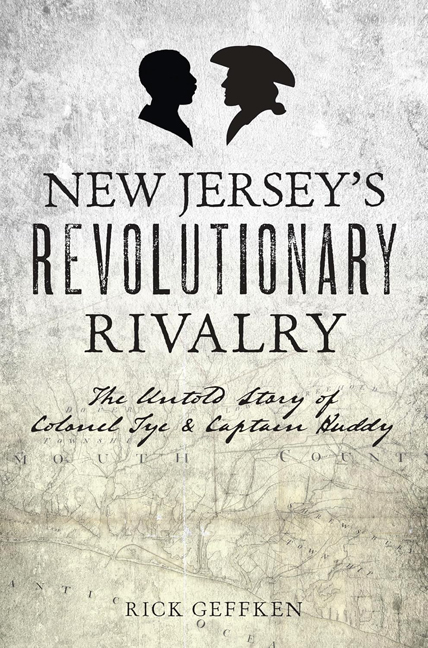
BOOK REVIEW: New Jersey’s Revolutionary Rivalry: The Untold Story of Colonel Tye & Captain Huddy by Rick Geffken (Charleston, SC: The History Press, 2025) $24.99 Paperback
Rick Geffken’s New Jersey’s Revolutionary Rivalry revolves around two antagonists. Titus was an enslaved man who escaped to British lines and, as the leader of a mixed group of Black and white Loyalists, earned the honorary title Colonel Tye. Josiah “Jack” Huddy was a Monmouth County militia officer whose execution while in British custody triggered an international crisis.
 We know more about Huddy than we do about Titus. Born to a Quaker family in 1735, Huddy grew up to be an incorrigible scoundrel with a penchant for exploiting vulnerable women. Geffken calls him “an opportunistic ne’er-do-well” (page 34). In one six-year period, he was sued a half dozen times for defaulting on loans, and then, in 1773, Huddy disappeared from his Salem hometown to avoid arrest, apparently on charges of fornication. He reappeared in 1777 as a Monmouth County militia officer in command of an artillery company protecting a powder magazine at Tinton Falls. Despite having shown no aptitude for responsible conduct in his private life, Huddy proved to be a highly competent commander. Of course, old ways die hard. In January 1778, he was fined for assault, and in March 1781, he was convicted of stealing a carriage belonging to a Continental Army private.
Titus was born about 1754 on the Monmouth County farm of John Corlies to an enslaved woman named Sarah. Geffken believes Corlies, or his oldest son, was Titus’s father. Titus ran away in 1775, and until 1779 we do not know for sure where he was. Geffen wisely dismisses a number of popular myths about him, including the legend that he had fled to Virginia. By 1779, and perhaps earlier, Colonel Tye was leading Loyalist raids against supporters of the American Revolution. In a civil war fought by irregular forces and semi-professional soldiers, both sides committed atrocities, with civilians as frequent targets.
Colonel Tye and Captain Huddy’s paths crossed in September 1780, when Tye guided a patrol to Huddy’s home in Colts Neck. After a sharp skirmish in which a blast from Huddy’s musket shattered Tye’s wrist, the rebel commander was taken prisoner. Fleeing by water, Tye’s party came under attack. Wounded by friendly fire, Huddy nevertheless escaped and made it to the shore. The already injured Tye apparently drowned. Put in command of a blockhouse near Toms River, Huddy’s luck ran out in March 1782 when the British seized the small fort.
After a brief imprisonment in New York City, Huddy was placed in the custody of a British captain, Richard Lippincott, who had written orders to exchange Huddy for a Loyalist prisoner of war. Instead, Lippincott, who had reason to believe Huddy had lynched at least one Loyalist, took him to Gravelly Point, and, on April 12, 1782, hanged him. Huddy’s murder provoked outrage on the American side, and a British court martial made matters worse by acquitting Lippincott on the grounds that he thought he was obeying orders from a semi-official group known as the Associated Loyalists.
George Washington responded to the uproar by ordering a British prisoner of similar rank to be chosen by lot for execution. The lot fell on the very young British captain Charles Asgill. As the story is often told, a tearful letter from his mother, Lady Asgill, led Washington to spare the young soldier. In reality, while Lady Asgill did her part, diplomatic considerations proved decisive. Benjamin Franklin, a member of the American delegation then negotiating with the British to end to the war, feared executing Asgill would disrupt the peace talks, a concern shared by the French, America’s most valuable ally. After the Continental Congress voted to spare Asgill as a courtesy to Louis XVI, Washington ordered the young officer to be freed.
Geffken’s treatment of the Asgill affair may be the most useful part of New Jersey’s Revolutionary Rivalry, and Giffken, an award-winning local historian, sensibly debunks a number of legends about Huddy and Tye that sprang up over the course of the nineteenth century. Nevertheless, his new book is not altogether satisfying. Despite its subtitle, the lives of Huddy and Tye are not really “an untold story.” New Jersey’s Revolutionary Rivalry contains a helpful glossary of its principal characters, ample illustrations, an impressive bibliography, and a serviceable index, but no footnotes or endnotes, and Geffken frequently inserts quotations without indicating a source, and in some cases without even identifying the speaker. Those omissions make it difficult to verify Geffken’s assertions, an especially relevant concern in light of a dispiriting disclaimer on the copyright page: “The information in this book is true and complete to the best of our knowledge. It is offered without guarantee on the part of the author or The History Press. The author and The History Press disclaim all liability in connection with the use of this book.”
More irritating is Geffken’s affection for his protagonists. “I hope,” he writes, “readers will come away with admiration for both of these men” (p. 15). He ends on a similar note: “As the grateful heirs to the people whose sacrifices bestowed so much, we manifestly espouse their ideals” (p. 179). Really? The ideals Huddy and Tye shared seem to have been a propensity for violence and a disregrard for the rules of war. As a former slave, Tye is the more sympathetic figure, but as for Huddy, if the British had not hanged him, somebody else probably should have.
PLEASE CONSIDER PURCHASING THIS BOOK FROM AMAZON IN PAPERBACK.
(As an Amazon Associate, JAR earns from qualifying purchases. This helps toward providing our content free of charge.)


Recent Articles
The New Dominion: The Land Lotteries
The Home Front: Revolutionary Households, Military Occupation, and the Making of American Independence
A Strategist in Waiting: Nathanael Greene at the Catawba River, February 1, 1781
Recent Comments
"A Strategist in Waiting:..."
Lots of general information well presented, The map used in this article...
"Ebenezer Smith Platt: An..."
Sadly, no
"Comte d’Estaing’s Georgia Land..."
The locations of the d'Estaing lands are shown in Daniel N. Crumpton's...