

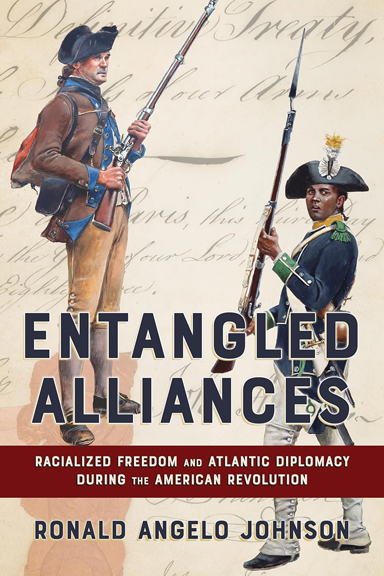
BOOK REVIEW: Entangled Alliances: Racialized Freedom and Atlantic Diplomacy During the American Revolution by Ronald Angelo Johnson (Ithica, NY: Cornell University Press, 2025)
The years between the two well-known peace treaties that ended conflicts in North America were a time of significant social upheaval. Two places in particular, the thirteen British colonies and the Caribbean French colony of Saint-Dominque (present-day Haiti) wrestled with issues regarding independence and liberty. Ronald Angelo Johnson’s new book Entangled Alliances: Racialized Freedom and Atlantic Diplomacy During the American Revolution examines the shared destinies of the British colonies and the Caribbean slave colony, along with the feats of international diplomacy surrounding the Treaties of Paris of 1763 and 1783.
 The first part of the book, “In the Shadow of the Treaty of Paris 1763-1775,” Johnson describes how the first Treaty of Paris, which ended the French and Indian War, influenced events on Saint-Dominque, a highly stratified hierarchical slave society. Although France lost a great deal of territory in North America to the British, it was able to keep its lucrative sugar island. The concepts of individual freedom were not new to the island’s slaves in 1763. They had been pursuing it long before. Such ideas of liberty were new to the British colonies on the Atlantic seaboard. The Stamp Act and Townshend Acts were in conflict with how colonists understood British liberty. Some colonists, such as John Adams, Benjamin Franklin, and Phyllis Wheately were using their talents to fight unfair tax policies. Johnson offers a rare outline of the life of Crispus Attucks, a runaway slave who was the first to die in the Boston Massacre, and then shows how that story was used by John Adams during his defense of the Boston Massacre soldiers. The life of the Dominguan slave Paul Carenan demonstrates the unpredictability of status in the French colonial world. Johnson returns to the troublesome colony of Massachusetts and gives credit to the achievements of the poet-activist Phyllis Wheately, a former slave whose work intrigued Gen. George Washington.
The Revolution itself is the setting for the book’s second part, “The Dawn of a New Treaty In Paris 1776-1783.” The proclamation of Virginia’s royal governor the Earl of Dunmore, which promised freedom to enslaved people who would fight for the British, put the fear of slave insurrection into all Southerners. Congress debated the prospect of arming slaves, as advocated by John Laurens. France was looked upon as a possible ally, and the Declaration of Independence was written with that in mind. John Adams and Benjamin Franklin became the diplomats who worked to get the French alliance. Adams came up with what became known as the “Model Treaty,” which became a blueprint for a possible treaty with France. In fact, Johnson gives Adams a great deal of credit for his diplomatic “brilliance.”
Once France did sign an alliance in 1778, Dominguan militias, which had been training since 1763, were used by French commanders in battles in the Southern states. These Afro-Caribbean troops fought with distinction, gaining valuable battlefield experience. Meanwhile, John Adams wrote the Massachusetts constitution, which made it possible to outlaw slavery in the state. Adams then contributed his efforts, along with Benjamin Franklin and John Jay, to the negotiations that led to the Treaty of Paris of 1783, ending the American Revolution. Still, the idea of liberty was elusive to many:
From the Stamp Act to Yorktown, Black people in North America, free and enslaved, considered the racialized meanings of Enlightenment ideals like freedom and liberty articulated in American assemblies and newspapers. Before and after the Treaty of Paris of 1763, Africans in diaspora fled plantations, wrote revolutionary poems, joined white American acts of insurrection, established new forms of Black Christian worship, submitted freedom petitions, and fought as minutemen and Continental Army soldiers, all in an appeal for freedom from white American patriots. Still, white Americans clung to slavery after independence. Before British General Cornwallis surrendered at Yorktown, Pennsylvania legislators passed the complicated Gradual Emancipation Act, which for years “freed no one.” (page 210)
The book’s Epilogue, “The School of Liberty,” put forth the terms of the Treaty of Paris of 1783 and looked at events beyond the Revolution. Some Dominguan veterans of the American Revolution eventually participated in “the Haitian revolutionary march toward freedom, equality, and independence” (p. 216). Toussaint Louverture, which gained his freedom in Saint-Domingue during the conflict, would become of the eighteenth century’s greatest revolutionary leaders. Once he became the general-in-chief of Saint-Domingue in 1790, President John Adams sent a childhood friend of Alexander Hamilton, Dr. Edward Steven, to be the US envoy to the Haitian government. Unfortunately, this relationship between the two republics would be abandoned by next several presidential administrations, all of whom were Southern slaveholders.
Entangled Alliances is an original look at how the Revolution affected the Caribbean world’s most profitable slave colony. The connections are not very well-known to many, or at least they have not been chronicled or recognized. The roles of some famous historical figures, such as Crispus Attucks, Phyllis Wheatley, and especially John Adams, make these connections more relatable to readers. Johnson’s book is an excellent examination of an unfamiliar subject.
PLEASE CONSIDER PURCHASING THIS BOOK FROM AMAZON IN PAPERBACK OR KINDLE.
(As an Amazon Associate, JAR earns from qualifying purchases. This helps toward providing our content free of charge.)

Recent Articles
A Strategist in Waiting: Nathanael Greene at the Catawba River, February 1, 1781
This Week on Dispatches: Brady J. Crytzer on Pope Pius VI and the American Revolution
Advertising a Revolution: An Original Invoice to “The Town of Boston to Green and Russell”
Recent Comments
"A Strategist in Waiting:..."
Lots of general information well presented, The map used in this article...
"Ebenezer Smith Platt: An..."
Sadly, no
"Comte d’Estaing’s Georgia Land..."
The locations of the d'Estaing lands are shown in Daniel N. Crumpton's...