



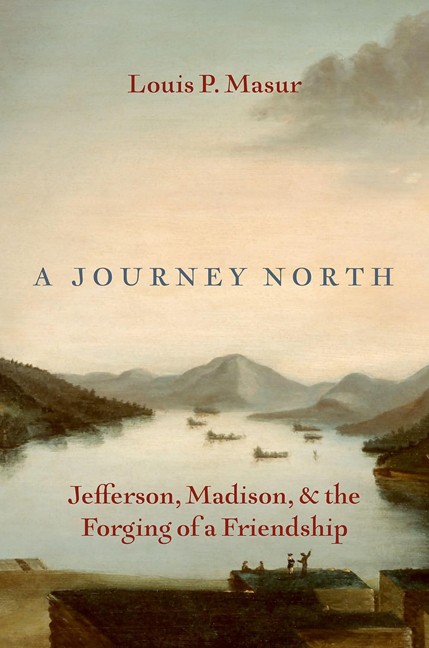
BOOK REVIEW: A Journey North: Jefferson, Madison, and the Forging of a Friendship by Louis P. Masur (New York, NY: Oxford University Press, 2025) $24.95 hardcover
Have you ever wanted to road trip through rural America with future presidents Thomas Jefferson or James Madison? Louis P. Masur’s A Journey North is probably as close to sharing that experience as possible. Focusing on a multi-week venture the two friends undertook in May and June 1791, Masur not only explores the trip itself, but its place in understanding the political tensions of the time, race relations, and the friendship of Jefferson and Madison.
 Masur constructs this narrative from the extensive letters the principal participants sent before, during, and after their adventure, as well as diaries and other contemporary materials. From there, Jefferson and Madison’s exploration of various topics, including the linguistics and vocabulary of the Unkechaug tribe of Long Island, the Hessian fly, maple trees and the sugar/syrup they produce, and more, were all seamlessly woven into the narrative. These presidents’ reputation as Renaissance men shines through this manuscript.
One of the most curious incidents Jefferson and Madison left clues about was their encounter with Prince Taylor, a freeman farmer from Fort George, New York. Madison’s attitude towards the free African American man is not particularly revealing of his broader attitudes of slavery or race relations: he did not use his name, but spoke highly of him, particularly his farm management skills. Taylor’s industriousness caught Madison’s attention, perhaps even his surprise: Taylor operated a farm of 250 acres and had six Caucasian farmhands.

Despite Madison witnessing Taylor’s capability (and, as Masur points out, his service to the Continental Army between 1779-1783), Madison’s view of slavery did not change because of his encounter with Taylor. It would be much later in Madison’s life that he would decide in favor of progressive manumission, though he never freed his own slaves. In this era, the 1780s and 1790s, Madison developed the notion of freeing American slaves and using them to (re)colonize a portion of western Africa (though Madison had little to do with it, this notion came to fruition with Liberia, and its capital city, Monrovia, named after James Monroe, the fifth president of the United States). Jefferson’s attitudes, while not identical, partially mirrored Madison’s, though he did not write specifically about Taylor.
Masur also does an admirable job of placing Jefferson and Madison’s journey in its appropriate political context. In 1791, the Constitution was only recently ratified, George Washington was ending his first term as president, and the tensions between Northern Federalists and Southern anti-federalism were only growing. Unsurprisingly, an excursion of the two most prominent Democratic-Republicans was seen as an incursion to many in the solidly Federalist north. At a time when the union between states was tenuous, a visit from the future writers of the Kentucky and Virginia Resolutions, precursors of nullification and succession, was not taken lightly. Masur masterly weaves the outlook on history into the budding friendship Jefferson and Madison continued to build and maintain for the next three decades.
A Journey North is a well written, entertaining, and informative read. At only 125 pages of text, Masur’s work is a great afternoon read. This is easily one of the high points of A Journey North. At the same time, it contributes to one of the weaker elements of Masur’s work: at times, it seems like A Journey North is not quite as focused as it should be. A full third of the book is spent setting up the titular venture north. While some of this is needed to place the book in its proper context, at times it seems a tad overwrought. Then again, if this is the extent of the book’s problems, it seems like a good read for the intellectually curious or student of great friendships.
In all, Louis P. Masur’s A Journey North: Jefferson, Madison, & the Forging of a Friendship is well worth the read. It offers a unique perspective on two of the era’s most intriguing figures, one of friendship first and politics or statesmanship on the backburner. The never-ending scholarship on presidents Jefferson and Madison gains an important secondary source with Masur’s work.

PLEASE CONSIDER PURCHASING THIS BOOK FROM AMAZON IN HARDCOVER OR KINDLE.
(As an Amazon Associate, JAR earns from qualifying purchases. This helps toward providing our content free of charge.)

Recent Articles
Surprise Attack at Great Savannah
The New Dominion: Virginia’s Land in The Northwest
Lineage: Genealogy and the Power of Connection in Early America
Recent Comments
"Coup D’oeil: William Washington..."
Great article. I am reminded of a point only incidentally mentioned, the...
"Thomas and Peter Costner..."
Thanks for your wonderful article. As we study the Revolutionary War, we...
"The Revolutionary War Letter..."
Superb storytelling!